

Quick answer
“Psychic traditions” is a modern English umbrella, not a single timeless practice. A Yoruba Ifá diviner, a Shang court divination record, a nineteenth-century Spiritualist séance and a present-day online reading belong to different languages, institutions and histories. Comparing them can be useful, but treating them as interchangeable erases the people who created and maintain them.
This guide uses a careful historical method: identify the community’s own name for a practice, separate objects and documents from interpretations, and distinguish a belief claim from evidence that outsiders can independently verify. It does not attempt to prove or disprove a community’s spiritual worldview.
How to compare traditions without flattening them
Words such as oracle, medium, diviner and shaman are not universal job titles. They come from particular histories or from later translations. “Shaman,” for example, should not be applied to every Indigenous healer, ritual specialist or knowledge keeper. Use it only when a community uses the term for itself or when a source explains why it is appropriate.
A responsible comparison asks four different questions:
- What survives? An object, inscription, oral corpus, photograph, newspaper report or living practice.
- Who explains it? A community practitioner, museum curator, archaeologist, translator, journalist or critic.
- What can the source establish? A date, material, documented use or recorded testimony.
- What remains uncertain? Private experience, supernatural causation, lost meanings or whether a reported prediction was accurate.
This framework leaves room for spiritual meaning while preventing a moving story from becoming a historical or medical claim.
Four cases with different kinds of evidence
Swipe horizontally if any columns are off-screen.
| Case | Source type | What it establishes | What it does not establish |
|---|---|---|---|
| Casita de Piedra stone cache, Panama | Archaeological context and material analysis | A cluster of unusual stones was deposited at a small rock shelter thousands of years ago | The owner’s identity, exact ritual or a supernatural result |
| Yoruba Ifá | Living heritage, trained practitioners, objects and a large oral/literary corpus | A specific knowledge system transmitted in Yoruba communities and the diaspora | A model for every African divination practice |
| Shang oracle bones, China | Inscribed animal bones and turtle shells | Royal divination questions and some of the earliest surviving Chinese writing | That an ancestor or deity caused an outcome |
| Modern Spiritualism | Newspapers, books, photographs, demonstrations and criticism | A large social and religious movement grew in the nineteenth century | That every séance claim was genuine |
An archaeological find is evidence of activity, not proof of powers
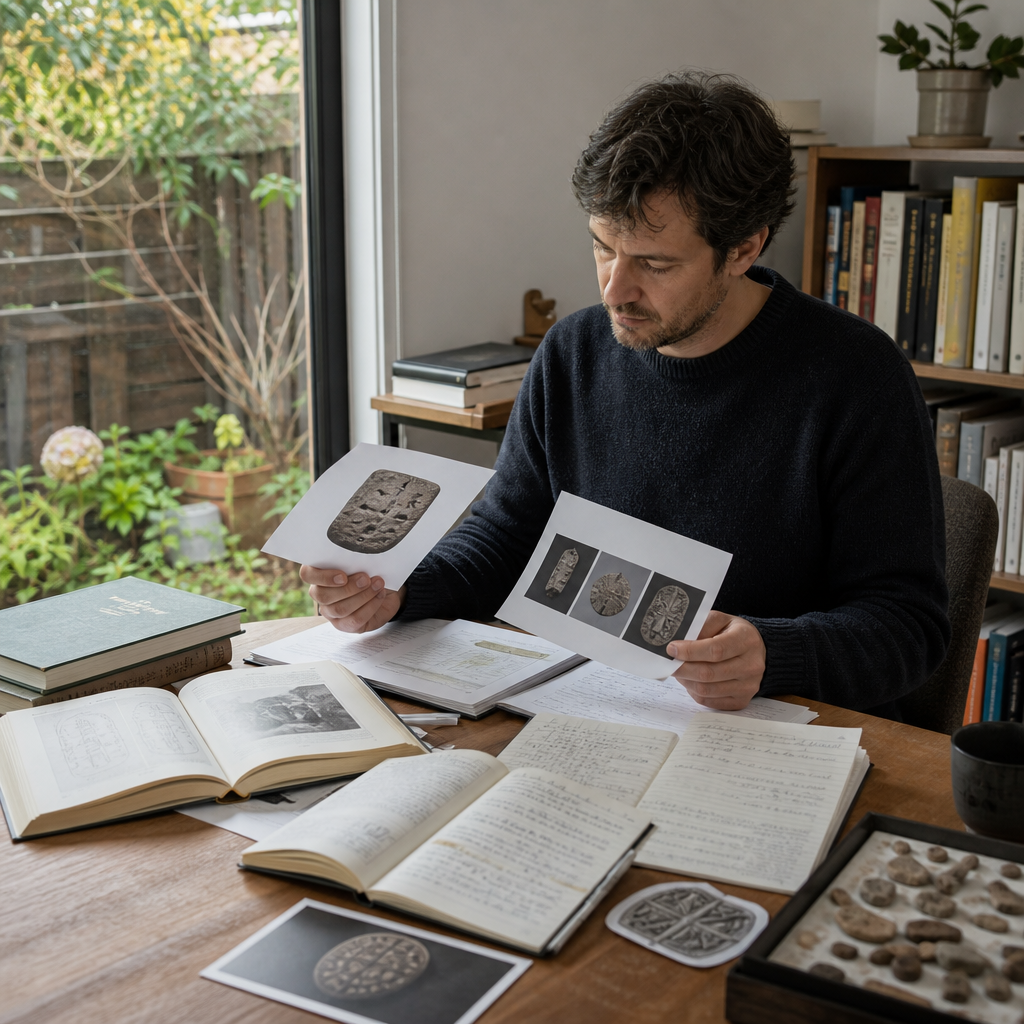
At the Casita de Piedra rock shelter near Boquete, Panama, archaeologists found a compact cache of twelve stones. Associated charcoal dated the context to roughly 4,800–4,000 years ago. Researchers proposed that the stones may have belonged to a ritual specialist because of their unusual materials and arrangement. The Smithsonian account of the discovery is careful about that interpretation.
The find shows why vocabulary matters. A news headline may say “shaman’s stones,” but the person’s name, role and language are unknown. The stones survive; the practitioner’s explanation does not. It is reasonable to discuss a scholarly interpretation and equally important to label its uncertainty.
Ifá is a living knowledge system, not shorthand for “African fortune telling”
Ifá is practiced among Yoruba communities in West Africa and across parts of the African diaspora. UNESCO describes an elaborate system of signs interpreted through a corpus of verses, with knowledge transmitted by trained practitioners. The UNESCO safeguarding project emphasizes training, language, history, philosophy and intergenerational transmission.
That specificity prevents two common errors. First, Africa is not one culture: Ifá should not be presented as a template for every African or diasporic tradition. Second, a brief internet reading does not confer the authority of community recognition, language knowledge or initiation. Public descriptions can explain a tradition’s history without exposing restricted material or imitating ceremony.
Oracle bones record royal divination in Shang China
Beginning around 1200 BCE, questions used in royal divination were scratched onto animal bones and turtle shells. These inscriptions are important evidence for Shang history and early Chinese writing. A Metropolitan Museum of Art collection record identifies them as records of royal divination ceremonies.
The bones can establish that questions were posed, cracks were interpreted and records were made. They cannot independently demonstrate that a supernatural being answered. This distinction respects both the artifact and the limits of historical evidence.
Modern Spiritualism developed in a documented media world
In the United States, the Fox sisters’ reported rappings in 1848 became a widely repeated origin story for modern Spiritualism. Séances, table-turning, spirit photography and public demonstrations later circulated through newspapers and lecture halls. The movement mattered socially and religiously, especially in a period marked by high mortality and war.
It also attracted investigators, skeptics and allegations of fraud. The Library of Congress uses period material about “psychic force” to teach source evaluation and notes the movement’s many supporters from the 1840s into the twentieth century. That Library of Congress source exercise is a useful reminder: a historical document proves that a claim was made and circulated, not automatically that the claim was true.
Grief can make a mediumship message feel deeply personal. Emotional meaning is real as an experience, but a specific detail does not by itself verify contact with someone who died. A responsible reader never tells a grieving person to stop professional care, isolate from family or keep paying until a message “comes through.”
What changed when readings moved online
Phone lines, livestreams, apps and generative systems changed access and presentation. They did not automatically inherit the cultural authority of older traditions, and speed is not the same as accuracy. An app can randomize cards, calculate a chart or retrieve text; it cannot prove spiritual contact, initiation or community standing.
Digital formats also create new risks: edited clips, cold-reading techniques, hidden research, repeated upsells and claims that an algorithm is spiritually authoritative. Treat a reading as reflection or entertainment unless a tradition’s practitioner and community describe it differently—and even then, keep health, legal, financial and safety decisions with qualified professionals.
A respectful checklist for readers and writers
- Name the specific community and practice. Avoid “African,” “Asian” or “Indigenous” as if each described one tradition.
- Prefer community-led and authoritative sources. Museums and archives help with objects; living communities are essential for present-day meaning.
- State whose interpretation you are repeating. Archaeologists, practitioners and colonial officials may describe the same material differently.
- Do not turn sacred clothing or ceremony into décor. Avoid invented composite imagery and do not copy restricted rites.
- Separate history from outcome claims. A documented practice is not proof that its predictions work.
- Set a high-stakes boundary. Spiritual reflection cannot diagnose illness, replace therapy, settle a lawsuit or guarantee money.
If you want a practical example of inclusive, evidence-aware spiritual activity, read the guide to community meditation and collective stress. For other reflective articles, browse the Psychic Help and Tips archive while applying the source checks above.
What these histories have—and do not have—in common
People in many times and places have used structured practices to address uncertainty, memory, authority, grief and decision-making. That broad observation can support comparison. It does not mean every practice has the same origin, method, theology or social role.
The most useful question is not “Which culture had psychics first?” It is “What did this practice mean in this community, according to which evidence?” That question makes the history more accurate and the encounter more respectful.
Frequently asked questions
1. Are all psychic traditions versions of the same practice?
No. Similar themes can appear across societies, but the names, training, objects, beliefs and institutions differ. Compare specific traditions without claiming a universal system.
2. Is “shaman” the correct term for every Indigenous healer or diviner?
No. Use the community’s own term whenever possible. “Shaman” should not be treated as a generic label for unrelated Indigenous roles.
3. Does archaeological evidence prove supernatural claims?
No. Archaeology can establish materials, dates, locations and plausible uses. It cannot independently verify a supernatural cause or the accuracy of a prediction.
4. How can I explore a tradition respectfully?
Use its specific name, consult community-led and authoritative sources, avoid imitating restricted practices, and never substitute spiritual claims for medical, legal, mental-health or financial advice.




As we contemplate the future of psychic traditions amidst technological advancements, will we witness a renaissance in how society perceives intuition and metaphysical guidance? This prospect deserves considerable contemplation moving forward.
The intersection of science and spirituality presents a compelling narrative regarding humanity’s quest for understanding beyond empirical evidence alone. Can this synthesis lead to a more holistic approach to consciousness? 🔍
It is intriguing how psychic practices have been preserved through centuries, often morphing to fit contemporary contexts. This raises pertinent questions about authenticity and the essence of such traditions in today’s world. 📜
‘Psychic work’ encapsulates more than mere fortune-telling; it serves as an essential aspect of emotional healing for many individuals today. The nuanced relationship between traditional beliefs and psychological well-being merits further exploration. 🌱
‘Mediumship has transcended its historical roots, adapting into an era defined by technology and immediacy. However, I ponder whether the core purpose—providing solace—remains unchanged through this evolution.
Indeed, while mediums might utilize modern platforms like TikTok or Instagram for outreach, are they able to maintain the spiritual depth that their predecessors held? This poses a vital question for future practitioners.
While it is easy to dismiss psychic phenomena as mere superstition, an analysis of their sociocultural significance unveils a deeper human yearning for connection with the unknown. How does this desire manifest in various cultures? 🌌
The exploration of psychic phenomena continues to provoke both intrigue and skepticism, thus one must wonder about the underlying psychological motivations. Can these traditions be interpreted as mere coping mechanisms for life’s uncertainties? 🤔
The historical continuum of psychic practices demonstrates a fascinating interplay between culture and spirituality. As societies evolve, one must consider how these ancient rituals adapt and survive amid modernity’s relentless pace. 🌍