

Quick answer
The “runes” of the Shadowhunters—angelic Marks drawn on skin in Cassandra Clare’s Mortal Instruments stories—are an invented magical symbol system created for fiction. They are not a historical runic alphabet. Tolkien’s Cirth, Skyrim scripts and Marvel’s Asgardian glyphs are also fictional systems, even when their angular appearance or origin stories borrow ideas associated with historical runes. This guide separates narrative devices from the inscriptions studied by historians and runologists.
Fictional runes versus historical runes
| Fictional systems | Historical runic alphabets | |
|---|---|---|
| Primary role | Serve a story: grant an ability, identify a group, unlock something or signal an imagined culture | Record language in names, memorials, ownership marks and other inscriptions; some finds also have debated amuletic or ritual contexts |
| How they work | Follow rules established by an author, game designer or screen production | Represent sounds and words; carving skill affects form and legibility, not proven supernatural power |
| Origin | Explained within a fictional universe—for example, as a gift from a supernatural being | The earliest known runic inscriptions date to roughly the first or second century CE; their development and connections to earlier alphabets remain subjects of scholarship |
| Inventory | Can expand whenever a story needs a new sign | Varies by time and region: Elder Futhark has 24 characters, Younger Futhark 16, and Anglo-Saxon futhorc expanded beyond those counts |
| Evidence | Books, production art, games and licensed reference materials | Surviving inscriptions, archaeological context, catalogues and comparative language study |
Where fiction borrows from history
- The name. Words related to “rune” carried senses such as secret, counsel or mystery in Germanic languages, making the term attractive to fantasy writers.
- An angular visual language. Many historical rune forms suit incision on hard materials, although carving practice was varied and the familiar “straight lines because of wood grain” explanation is too simple on its own. Fiction often exaggerates the geometry to make a script look old or forceful.
- Mythic discovery. The Hávamál tells of Odin gaining knowledge of runes after an ordeal. Modern stories frequently adapt the broader idea of special writing revealed through sacrifice, authority or another world.
- Literary rune magic. Medieval texts include episodes in which characters believe runes can heal, harm or protect. Those stories are cultural and literary evidence, not proof that inscriptions produced supernatural effects. Fantasy turns such episodes into consistent world-building rules.
Why the distinction matters
Popular culture can shape expectations before someone encounters an inscription or a modern rune set. Historical runes were writing systems, while their surviving contexts include ordinary communication, commemoration and some disputed or explicitly ritual uses. Modern reflective practice adds another layer, but it should not be confused with a franchise’s power system or treated as a reliable way to predict events.
If you want the historical starting point, compare the alphabets and evidence in our guide to rune stones and rune sets. For practical, clearly labeled contemporary activities—including fiction analysis—see ways of using runes.
A copyright-safe way to compare designs
Use official books or licensed reference material when identifying a franchise mark; do not rely on an unlabeled chart reposted online. For historical characters, record the alphabet, approximate date, find location and catalogue or museum source. Then compare functions rather than tracing or republishing protected artwork: does the sign spell a sound, identify a character, trigger a story effect or simply create atmosphere?
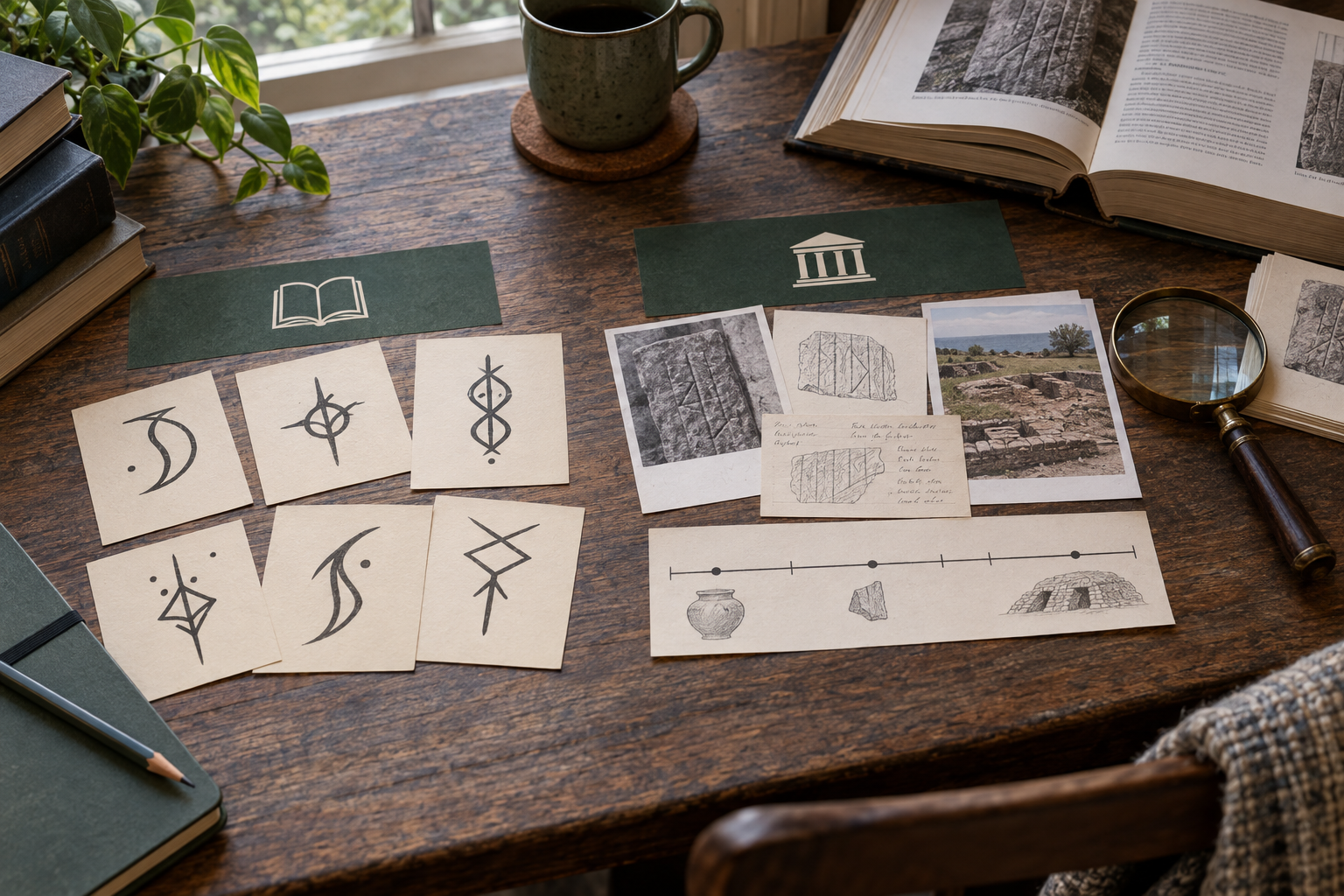
Image note: This page now uses an original study-table still life rather than reproducing a Shadowhunter Mark or another franchise design. The abstract sample cards are invented for the photograph and are not presented as historical inscriptions.
Frequently asked questions
Are Shadowhunter Marks historical runes?
No. They are fictional designs made for the Shadowhunter stories. Their name, angular style and supernatural role may echo popular ideas about runes, but they are not an attested historical alphabet.
Is Tolkien’s Cirth a real rune alphabet?
Cirth is a constructed writing system created by J. R. R. Tolkien for his fictional world. It draws visual inspiration from runic writing but has its own invented history and sound values.
Did historical runes grant powers?
Historical inscriptions include ordinary writing as well as examples interpreted as charms or ritual texts. Those finds show beliefs and practices; they do not establish that a carved character reliably caused healing, protection, fearlessness or another supernatural result.
Can I use fictional rune designs in a modern rune reading?
You can use an authorized fictional deck as a creative prompt if you clearly label it and follow its creator’s rules. Do not present the designs as historical evidence, and do not use any symbolic reading as a substitute for medical, legal, financial or safety decisions.


‘Steles made of adamas raise questions regarding what materials we consider holy or valuable—are they arbitrary?’
‘Marks are not just tools but also representations of beliefs.’ This statement provokes deeper exploration into why they are used in such ways.
‘The correlation between placement and effectiveness intrigues me; could this suggest that our choices shape our destinies?’
‘Symbols have power only if we ascribe them meaning,’ which connects to how individuals interpret their experiences with these marks.
The transformative nature of runes seems aligned with personal growth—could they symbolize phases we all undergo?
The mention of the Mark of Cain is quite thought provoking. It raises questions about punishment and protection within mythologies.
Relying on physical markings raises ethical questions regarding identity; how much do we allow symbols to define us?
‘Indeed, but perhaps there lies beauty in vulnerability; embracing our external manifestations can lead to greater self-discovery.’
‘As runes can be drawn partially, could one argue that beginnings are often incomplete yet hold potential for full realization?’
The complexity of the runes is quite intruiging, and I wonder how these were initially conceived by the Angel Raziel. Are they based on any pre-existing languages or symbols?
Symbols often carry deep meanings, and their usage across different cultures might suggest a universal archetype. Is this relevant in this case?
I think it would be prudent to consider the historical context of these symbols. Many cultures have similar motifs, do we really know their origins?
It is fascinating that a mark can hold such powers, however is there not a danger in relying too heavily on external sources for strength? What about inner fortitude?