

Quick answer
Runic writing is attested on early objects associated with Germanic languages and survived in some regions long after the Viking Age. Early dates depend on the find and its archaeological context; there is no securely known day or single place of invention. They were letters first; the idea that each rune was a pictogram of a “cosmological power” is a modern claim without support in the inscriptions. Our full account of the historical evidence and the limits of ancient-casting claims is here: Origins and ideas behind rune casting. This page gives an approximate timeline. Periods overlap, and the dates are not universal changeover points.
A timeline of runes
- Early centuries CE — early inscriptions. Short texts survive on portable objects and stones. The 2025 study of inscribed fragments from Hole, Norway, reports associated burial contexts dated to 50 BCE–275 CE; that range is not an exact carving date. The script’s alphabetic model and route of adoption remain debated. See the archaeological study for the dating limits.
- c. 200–700 — Elder Futhark period. Inscriptions on bracteates (gold pendants), stones and weapons across Scandinavia and the Continent. Some carry names, some the word alu, some apparent charms. The surviving texts vary in purpose, and some are difficult to interpret.
- c. 400–1000 — Anglo-Saxon futhorc. In England and Frisia the row grows to accommodate Old English sounds. Christian objects such as the Franks Casket and the Ruthwell Cross carry runic text; the Old English Rune Poem, known through a 1705 printed edition after the manuscript was lost, gives each rune a verse. Its composition date is uncertain.
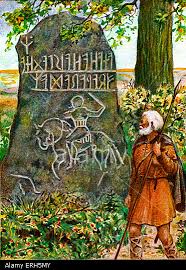
- c. 800–1100 — Younger Futhark and the Viking Age. The alphabet shrinks to 16 characters. Thousands of runestones are raised, mostly in Sweden, as memorials: A typical memorial records who commissioned the stone and whom it commemorates; individual inscriptions differ.
- c. 1100–1500 — medieval runes. Dotted variants match Latin letters; runes appear on church walls, wooden tallies and everyday messages, as at Bryggen in Bergen, where hundreds of runic sticks record trade, prayers and jokes.
- 16th–19th century — survival and scholarship. Runes linger in Dalarna, Sweden, into the 1800s. Antiquarian recording and interpretation also help shape later understandings of runes.
- 20th century — new occult systems. Modern esoteric authors create or reinterpret rune rows and practices. These should be studied as later systems, not treated as unchanged ancient alphabets or evidence of healing powers.
- 1980s onward — commercial oracle sets. Ralph Blum’s The Book of Runes becomes one influential modern commercial example, sold with 25 stones and a pouch. The publisher’s listing describes the package. That popularity does not establish that all current methods descend from it, or that a blank token is an ancient letter.
Two misconceptions to avoid
- “Each rune was an ideographic symbol of some cosmological principle.” Runes were phonetic letters. The rune poems attach a name and a verse to each, centuries after the script began, and those names (cattle, aurochs, thorn, hail) can aid learning; their imagery does not establish a single ancient cosmological system.
- “Writing with runes was a magical act.” Some inscriptions and sagas do refer to rune magic, and the sources are worth reading. Names, ownership statements, memorials and everyday messages also survive. A magical context does not demonstrate that the claimed effect occurred.
For the wider picture and the primary sources, the Swedish National Heritage Board’s Runor database lets you browse thousands of real inscriptions.
Follow the letters as well as the stories
Compare the historical families in our rune alphabet reference. Do not mix a 24-character Elder Futhark chart with a 16-character Viking-Age inscription and assume they represent the same system.
Frequently asked questions
How old are runes?
Early inscriptions survive from the first centuries CE. Dates depend on archaeological context and the object; a wide contextual date range is not the precise date when someone carved a letter.
Did Vikings use the 24-letter Elder Futhark?
The 16-character Younger Futhark is characteristic of Viking-Age Scandinavia. Elder Futhark belongs mainly to an earlier period, although transitions and regional forms complicate rigid date boundaries.
Were runes used only for magic?
No. Memorials, names, ownership and everyday messages survive alongside inscriptions interpreted as magical. The purpose of an individual inscription must be examined rather than assumed.
Does modern rune drawing reproduce one ancient method?
The surviving evidence does not establish one unchanged method behind every modern practice. Treat contemporary draws and blank tiles as declared modern choices, not historical facts or reliable forecasts.


The complexity of Runes and their meanings is quite fascinating. It seem that the origins are not as clear as one might hope.
The relationship between Runes and other alphabets raises some interesting questions about linguistic development. However, it is hard to know how much influence there was.
‘Tacitus’s observations remind us that ancient civilizations had complex ways of interpreting their surroundings, possibly more sophisticated than previously assumed.’
‘Secret’ or ‘mystery’ encapsulates the essence of Runes intriguingly. It’s noteworthy how language evolves to encompass such nuanced meanings.
This exploration into Runic alphabets sheds light on the interplay between culture, language, and belief systems through history.
Indeed! The ways these symbols were used reflect not just communication but also spiritual connections within those societies.
The use of ideographic symbols in the context of Runes suggest a depth of thought and cultural significance that warrants further investigation.