

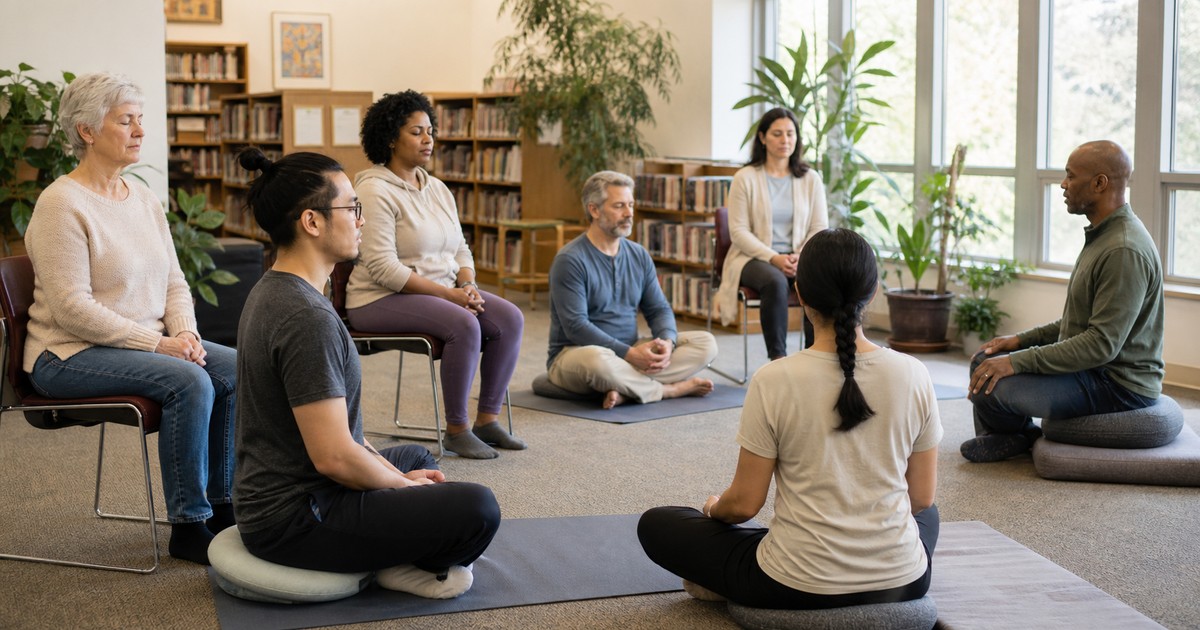
Meditating with other people can feel different from practicing alone. A regular time, a welcoming room, and the quiet presence of others may make it easier to show up. That experience is meaningful without claiming that a meditation circle remotely changes crime, conflict, weather, or a community’s invisible energy. Research supports a more modest conclusion: teacher-led group mindfulness programs can reduce psychological distress for some volunteer participants, while social and prosocial effects remain variable.
Quick Guide
What makes a group helpful
Groups provide time, place, and accountability. Participants may learn from an instructor, feel less alone in stress, and borrow practical ideas from peers. These ordinary social mechanisms are enough to explain why a session can feel supportive.
Calling that feeling “collective calm” is fine as poetic language. Presenting it as a measurable field that transforms nonparticipants is not supported by current evidence.
What research can and cannot say
A large individual-participant meta-analysis found that group-based, teacher-led mindfulness programs generally reduced psychological distress among community adults who volunteered. Effects varied, and the finding does not prove that every style works for every person.
Research on meditation and prosocial behavior also has limitations and possible bias. Claims about compassion, connectedness, or community change should therefore be cautious and specific.
Design a genuinely inclusive session
Offer chairs as well as floor seating, an eyes-open option, permission to move, and a clear statement that anyone may step out. Avoid touch unless explicit consent is given. Explain the practice in plain language without assuming one religion or worldview.
For trauma-sensitive facilitation, use invitations rather than commands. “If it feels comfortable, notice the breath” leaves more agency than “close your eyes and surrender.” Provide a quiet alternative for people who do not want inward focus.
A 25-minute community format
Begin with a two-minute welcome and boundaries. Continue with five minutes of orientation to sounds and contact points, ten minutes of breath or body awareness, five minutes of optional silent reflection, and three minutes for practical closing information.
Keep sharing voluntary and do not pressure people to disclose trauma. A meditation group is not automatically group therapy.
Evaluate without exaggerating
Use a short anonymous form: Did you feel welcome? Was the instruction clear? Did anything increase distress? Would you return? Track attendance and accessibility requests. These measures help improve the program without pretending to prove a change in the entire community.
If the group is connected to a school, workplace, or health service, protect privacy and make participation truly optional.
When meditation is not the right tool
Some people experience anxiety, intrusive thoughts, or worsening mood during meditation. A person in crisis may need direct support, safety planning, medical care, housing, legal help, or conflict intervention—not another breathing exercise.
Communities become safer through material resources and accountable action. Meditation can support people doing that work; it is not a substitute for it.
Continue Exploring
Frequently Asked Questions
1. Does group meditation work better than solo meditation?
Not necessarily. Groups may add instruction and accountability, while some people prefer private practice.
2. Can a meditation group lower community crime?
There is no strong basis for attributing community crime changes to a meditation circle alone.
3. Is collective energy scientifically measured?
Not in the spiritual sense used here. “Collective calm” is best treated as metaphor or shared experience.
4. Should everyone close their eyes?
No. Eyes-open practice can be safer or more comfortable for many people.
5. Is sharing after meditation required?
It should be optional. Participants do not owe the group personal disclosure.
6. Can meditation worsen anxiety?
Yes, some people report anxiety, intrusive thoughts, or other negative effects. They should stop or modify the practice and seek support if needed.
7. How long should a community session be?
Twenty to thirty minutes is approachable, but shorter sessions may be more accessible.
8. Is a community meditation group therapy?
No, unless it is explicitly delivered as therapy by qualified professionals within appropriate standards.
Sources and Method
This article distinguishes reflective or spiritual interpretation from established evidence and uses the following sources for factual health or research claims: