

Quick answer
An aura reading is a spiritual or symbolic service in which a reader assigns meaning to impressions, colors or images said to surround a person. There is no established scientific test showing that those colors form a measurable field that reveals health, personality, trauma or the future. A reading can be used as reflection or entertainment, but it should not diagnose a condition, replace care or pressure you into buying a cure.
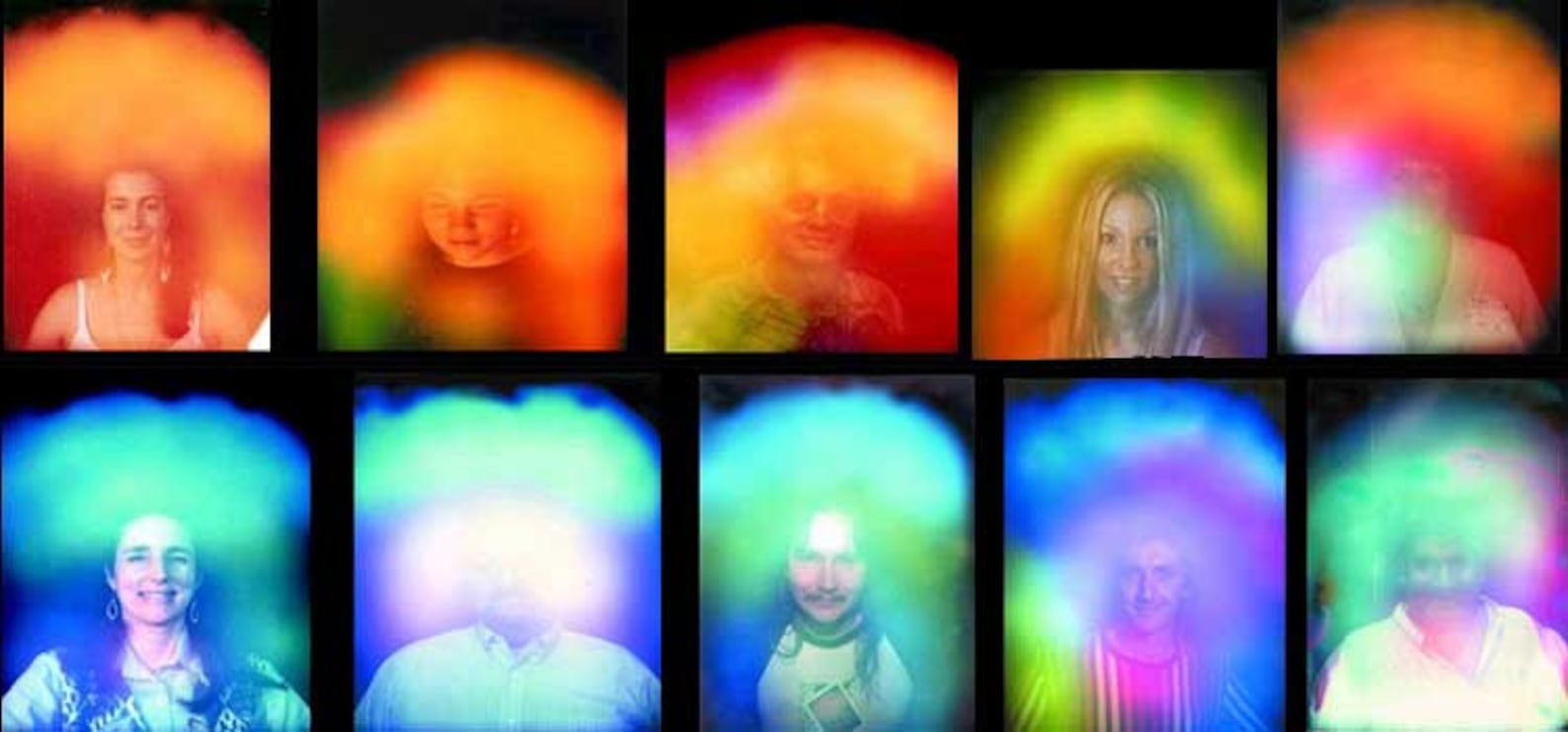
Before booking, decide what you are actually purchasing: a conversation, a photograph with a color overlay, a device-generated image, or a combined interpretation. Ask how the image or colors are produced, what the total price includes and whether you may decline topics or follow-up products.
What an aura reader may be describing
Different practitioners use “aura” for different ideas. One may report colors they say they see intuitively. Another may use hand sensors, photography software or a high-voltage corona-discharge process. A third may treat colors as metaphors chosen during a conversation. Those services are not interchangeable, and none should be presented as a medical scan.
Swipe horizontally if any columns are off-screen.
| Service format | What you receive | Important boundary |
|---|---|---|
| Verbal intuitive reading | A reader’s impressions and color symbolism | The impression is not an objective measurement of your body or mind |
| Portrait with color overlay | A photograph plus colors selected by software or a device | Ask how colors are generated; the image is not proof of a supernatural field |
| Corona-discharge or “Kirlian” image | A record produced around an object in a high-voltage setup | Physical discharge effects are not a validated health or personality diagnosis |
| Reflective color exercise | Prompts based on colors you notice or choose | Use the result as a metaphor, not as access to hidden facts |
Aura colors do not have one fixed dictionary
Color meanings vary by reader, school, culture, lighting, software and context. Red can be framed as energy, anger, courage or urgency; blue as calm, sadness, communication or distance. Black may be treated as protection by one reader and danger by another. These differences show why a color label should not be treated as a diagnosis or fact about someone’s character.
A useful reader will explain that their system is interpretive and invite you to reject what does not fit. They will not infer depression, addiction, pregnancy, illness, abuse, dishonesty, paranormal ability or financial fortune from a color. Clothing and décor colors are ordinary choices; they do not disclose another person’s health, consent, motives or spiritual status.
Photography and device claims
Some aura-photo services take a normal portrait and add colors using sensor input or software. Kirlian photography is different: it records a corona discharge created when an object is exposed to a high-voltage, high-frequency electrical field. Published reviews have found insufficient reliable evidence for treating aura-imaging methods as diagnostic alternatives. A vivid image can still be an interesting keepsake, but visual drama is not clinical validation.
Ask the operator to name the device, explain what it measures, disclose whether colors are added after capture and state what factors can change the output. Do not use a consumer aura photo to start or stop treatment, interpret laboratory results, evaluate pregnancy, identify a mental-health condition or decide that a symptom is caused by “blocked energy.”
Respect distinct spiritual and cultural traditions
Prana, qi, chakras, Jewish mystical traditions, Christian halos and modern aura photography developed in different communities and historical settings. Listing them as proof of one universal seven-layer system erases those differences. If a reader borrows a named practice, ask which source, lineage or community informs it and whether the description is historical, devotional or a modern adaptation.
Our third-eye meaning and safety guide uses the same distinction between metaphor, belief, anatomy and evidence. A respectful explanation can describe what a community believes without claiming that age or tradition proves a health effect.
Before the session: price, consent and privacy
- Price: get the total cost, duration, delivery format and refund terms in writing.
- Scope: ask whether this is conversation, photography, device output or a product consultation.
- Claims: ask what the service cannot determine and whether uncertainty will be stated.
- Consent: confirm that you can decline health, grief, relationship, sexuality or family topics.
- Privacy: learn whether portraits, sensor readings, recordings and contact details are stored, shared or used in marketing.
- Upsells: ask whether cleansing, crystals, supplements, repeat sessions or “repairs” will be offered.
The psychic reading cost-and-service guide provides a practical way to record the offer, time, authorized amount, exact claims and later outcomes. Do not share passwords, banking credentials, government identifiers or intimate images with a reader.
Health claims and “aura repair”
The National Center for Complementary and Integrative Health says there is no scientific evidence supporting the energy field proposed in Reiki and that Reiki has not been clearly shown effective for any health-related purpose. That finding does not prevent someone from holding a spiritual belief or finding a ritual calming; it does mean an aura reading should not be sold as proof of disease, treatment need or healing.
The Federal Trade Commission says objective health claims need competent and reliable scientific evidence, and testimonials do not establish cause and effect. Be cautious if a reader says a color proves illness, an “attachment,” a torn aura or a blocked chakra and then sells the only remedy. Leave if they discourage medical care, claim an emergency or curse, demand secrecy, or require escalating payments.
During and after the reading
- Write the exact color, claim and reason given before discussing your history.
- Separate observation (“the image shows blue”) from interpretation (“blue means grief”).
- Ask for at least one ordinary alternative explanation.
- Record misses, contradictions and broad statements as carefully as matches.
- Delay costly or irreversible decisions until you can check evidence elsewhere.
- Judge the service by consent, clarity and value—not by certainty or fear.
If a color prompt helps you name a feeling or value, use that insight as a question: “What evidence supports this?” or “What small, reversible action would help?” The meaning you make from the experience can be personal without turning the reading into a medical test or a claim about another person.
Frequently asked questions
1. Can an aura reading diagnose a health or mental-health condition?
No. Aura colors, photographs and readings are not validated diagnostic tests. Discuss symptoms, medicines, treatment and health decisions with an appropriately qualified professional.
2. Does Kirlian photography prove that a human aura exists?
No. Kirlian images record corona-discharge effects produced in a high-voltage setup. Reviews have found insufficient reliable evidence for using these images as aura or diagnostic measurements.
3. Do aura colors have universal meanings?
No. Meanings vary between readers, systems and cultural contexts. Treat a color meaning as an interpretive prompt, not a fixed fact about health, personality, morality or the future.
4. What are warning signs in an aura reading?
Leave if a reader claims a color proves illness, danger, a curse or an attachment; discourages care; guarantees cleansing or healing; demands secrecy; or pressures you to buy repeated repairs, products or sessions.




‘Kirlian photography’ seems like an intriguing approach, but does it really capture the essence of what an aura represent? Or is it merely visual distortion?
The concept of aura is quite intristing, although the scienfitic backing seem weak. How can we truly measure these energy fields in a way that is accurrate?
Indeed, it raises the question of how we define and observe such phenomena. The reliance on subjective experience could lead to ambiguity.
A good point! The metaphysical aspects often clash with empirical methodology in science.
The historical aspect you mentioned about various religions recognizing light around individuals intrigued me! Could this be due to collective human perception?
‘Imbalances in chakras manifesting in aura colors is a fascinating notion; however, how do we reconcile this with psychological interpretations of mental health?’
While I appreciate the effort to explain auras and their colors, I can’t help but wonder about the reproducibility of such findings within scientific realms.
Reproducibility is indeed crucial! The subjective nature might render many findings non-repeatable within controlled environments.
I find it fascinating that cultures have recognized auras for millennia, yet mainstream understanding is still catching up. Why the delay in acceptance?
‘Aura readings’ appear to blend spirituality with psychology; might there be a risk of misinterpretation or over-reliance on these readings without solid evidence?
‘Each color has its own energy’, which could imply that our emotional states are visibly perceptible. Is this potentially an oversimplification of human experience?