

Quick answer
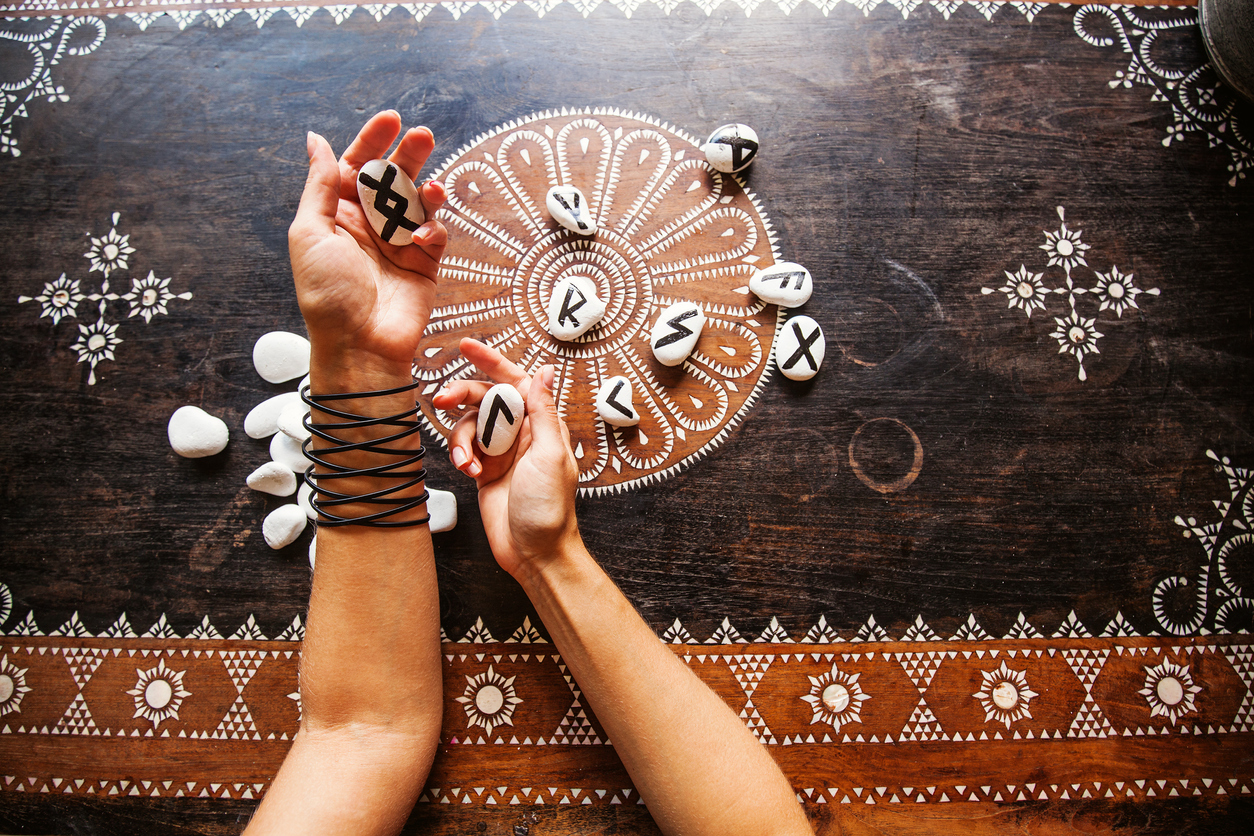
Reading runes today usually means using marked tiles as prompts for reflection, but the layouts sold online are modern conventions—not verified ancient prediction systems. Historical runes were writing characters used in several rows over time. Some inscriptions also appear in magical or ritual contexts, yet that evidence does not establish today’s two-, three-, nine- or twenty-four-tile spreads as inherited instructions.
The safest approach is to choose one documented rune row, define each position before drawing, record the result, consider alternatives and check important decisions against ordinary evidence. More tiles create more prompts; they do not create more certainty.
Start with the rune row and reference
“Runes” does not name one timeless alphabet. Elder Futhark has 24 characters, Younger Futhark has 16, and Anglo-Saxon futhorc has additional characters. Commercial sets sometimes mix rows or add a blank “Odin rune,” which is a modern addition rather than a twenty-fifth Elder Futhark character.
Choose one row and write down the book, museum resource or teacher you are using. Our Elder Futhark reference separates historical names and sound values from modern reflective associations. If your set contains stylized or invented marks, do not label them as authenticated historical runes.
Choose a layout by task, not by promised accuracy
Swipe horizontally if any columns are off-screen.
| Tiles | Useful modern structure | Avoid claiming |
|---|---|---|
| Two | Option A / option B; support / obstacle; assumption / evidence | That matching runes guarantee success or opposing runes cancel each other |
| Three | Context / present choice / next check; situation / response / review | That the third tile reveals a fixed future |
| Four | Facts / feelings / other people’s stated needs / shared next step | That a tile exposes someone’s secret thoughts or consent |
| Five | Question / evidence / missing information / reversible action / review date | That the center tile is an authoritative answer |
| Six or seven | Multiple constraints in a complex but low-risk decision | That extra positions increase supernatural accuracy |
| Nine | A planning grid covering past facts, current conditions and future contingencies | That the top row predicts what will happen |
| Twenty-four | A long-form journal index using every Elder Futhark character once | A full year of certain health, legal, relationship, money or life-and-death outcomes |
A repeatable method for any spread
- Frame an open question. Ask “What should I examine?” rather than “Will this definitely happen?”
- Define the positions first. Write each prompt before drawing so it cannot be changed to fit the result.
- Randomize once. Mix or draw the tiles without repeatedly selecting until a preferred symbol appears.
- Identify the character. Check its form, row, name and sound against the chosen reference.
- Separate layers. Record the historical character information, the modern association and your personal response in separate columns.
- Generate alternatives. Write at least two plausible readings, including one that does not depend on a supernatural cause.
- Check evidence. Note what documents, conversations, measurements or qualified advice would confirm or contradict the idea.
- Choose a reversible step. Set a review date and record what actually happened, including misses.
If a multi-tile spread feels too complicated, use the documented one-rune exercise instead. A smaller layout makes it easier to notice projection, changing definitions and repeated-draw answer seeking.
How to read two and three tiles
In a two-tile draw, treat the pair as a comparison. For example, tile one can prompt “What supports this option?” and tile two “What could obstruct it?” Similar symbols do not prove success, and tension between symbols does not prove failure. The value comes from naming factors you can investigate.
Three-tile layouts are often labeled past/present/future or “Three Norns.” The Norns are figures in Norse myth, but that label does not make a modern spread an ancient predictive method. A safer sequence is:
- Context: What documented past facts still matter?
- Choice: What can I influence now?
- Check: What future sign or deadline will help me review the decision?
A vertical “challenge” layout can use situation / obstacle / practical response. Avoid calling the top tile the inevitable outcome. If the topic involves another person, use their stated words and behavior rather than claiming a tile reveals their mind.
Four- and five-tile layouts
A four-tile diamond can organize a decision without assigning hidden desires:
- top: the question in neutral terms;
- left: evidence supporting the current plan;
- right: evidence against or missing information;
- bottom: one reversible next step.
A five-tile layout adds a center review prompt. Use outer positions for context, resources, constraints and alternatives; use the center for “What needs checking first?” Do not interpret mind/body/spirit positions as a health assessment. A rune cannot measure a physical condition, diagnose mental health or determine whether symptoms have a spiritual cause.
Six-, seven- and nine-tile layouts
Larger spreads can help map a project when every position has a distinct job. A six-tile cross might cover facts, assumptions, stakeholders, resources, risks and the next check. A seven-tile line can cover the question, two contributing factors, two options, one constraint and one review date.
For a nine-tile grid, avoid treating rows as certain past, present and future. Use them as:
Swipe horizontally if any columns are off-screen.
| Row | Planning use | Evidence question |
|---|---|---|
| Bottom | Established context | What records or events support this? |
| Middle | Current conditions | What can be observed or discussed now? |
| Top | Contingencies | What would we do if each possibility occurred? |
Complexity can create an illusion of precision. If positions overlap, stop and simplify instead of inventing connections after the fact.
Twenty-four tiles and annual readings
A full Elder Futhark layout may be used as a long-form writing exercise, but it does not provide a year of fixed answers. Do not assign tiles to disease, death, pregnancy, court outcomes, investments, another person’s sexuality or guaranteed prosperity. Safer categories include learning, routines, relationships you participate in, household tasks, budget questions, creative work, community responsibilities and review dates.
Record all 24 positions before interpreting them. Then group observations into a short list of practical themes. If every tile is made to confirm the same conclusion, the layout is not supplying independent evidence.
When a rune layout should not guide the decision
- medical symptoms, medicines, pregnancy or mental-health assessment;
- immediate danger, abuse, self-harm or locating a missing person;
- legal rights, court strategy, contracts or immigration status;
- investments, debt, gambling or money you cannot afford to lose;
- another person’s consent, fidelity, private thoughts or identity;
- any choice where delay could increase harm.
Use emergency services or an appropriately qualified professional when the stakes require it. A reader should not diagnose, threaten, guarantee an outcome, claim a curse, demand secrecy or sell protection as the only way to prevent harm.
Frequently asked questions
1. Which rune layout is best for a beginner?
Use one or two tiles with positions defined in writing before the draw. A small layout is easier to document, compare with evidence and review without changing meanings afterward.
2. Is the Three Norns spread an ancient documented method?
The Norns are figures in Norse myth, but that does not establish today’s past/present/future spread as an inherited ancient procedure. Label it as a modern convention and avoid fixed-future claims.
3. Do more runes make a reading more accurate?
No. More tiles create more prompts and more opportunities for vague or overlapping interpretations. Use only as many positions as the question genuinely needs.
4. Can a rune spread assess health or another person’s feelings?
No. Runes cannot diagnose physical or mental health, establish consent or reveal someone else’s private thoughts. Use direct communication, evidence and qualified care or advice.

“Ultimately, the effectiveness of rune readings likely hinges on personal belief systems and experiences, which this piece overlooks somewhat.”
“A diverse approach to rune reading is essential, yet not every method seems equally valid or accessible for beginners as stated here.”
The article provides methods but fails to address the significance behind each rune. Understanding individual runes could vastly improve one’s reading experience.
“Rune meanings are often steeped in mythology; acknowledging these layers would enrich readers’ understanding and application of their readings.”
Indeed, the lack of emphasis on the personal interpretation aspect is notable. Each reader might derive different meanings based on their unique contexts.
While the content does cover various methods of rune reading, it appears to miss the depth of interpretations that can be involved with such practices.
The information present in this article is quite intriguing, however, it lacks clarity in some of its methodologies that are suggested for rune readings.
One might wonder about the historical context behind the Elder Futhark and how it became the most popular; a brief exploration could enhance this discussion.
“I find it interesting that multiple layouts are presented without much differentiation between them; a clearer distinction would help guide novices better.”
“Moreover, practical examples or case studies would greatly aid in illustrating how these methods play out in real-life scenarios.”