Quick answer
Using runes for divination is best understood as a modern symbolic reflection practice, not a verified way to obtain facts or predict the future. A rune can prompt a question, association or journaling exercise. It cannot diagnose a condition, reveal another person’s private actions or guarantee what will happen next.
This beginner guide uses one rune at a time. The narrow format makes it easier to record what you actually drew, distinguish a source meaning from your own association and end with a checkable next step.
Choose one rune row and one reference
Many beginner sets use the 24-character Elder Futhark. Viking-Age Scandinavian inscriptions commonly use the 16-character Younger Futhark, while Anglo-Saxon and medieval rows differ again. Pick one row and confirm that every tile belongs to it. Do not treat a mixed commercial set as a universal ancient alphabet.
Use a reference that distinguishes a character’s name and sound from later symbolic keywords. Our Elder Futhark reference guide labels historical information and modern reflection prompts separately. Remove a blank “Odin” tile if your goal is a 24-character Elder Futhark set; the blank is a modern addition.
Write a question that does not demand certainty
A useful question directs attention without asking a tile to establish a hidden fact. Keep it specific enough to guide reflection and open enough to allow more than one answer.
Swipe horizontally if any columns are off-screen.
| Avoid | Use instead | Reason |
|---|---|---|
| Will I get the job? | What part of my preparation needs attention? | The employer controls the outcome |
| Is my partner lying? | What conversation or boundary needs clarity? | A symbol is not evidence about another person |
| What illness do I have? | What symptoms and questions should I record for a clinician? | Runes cannot diagnose |
| Which investment will make money? | Which assumptions and risks have I not checked? | Financial decisions require evidence |
A transparent one-rune exercise
- Set a boundary. Write: “This is a reflection prompt, not a prediction or professional recommendation.”
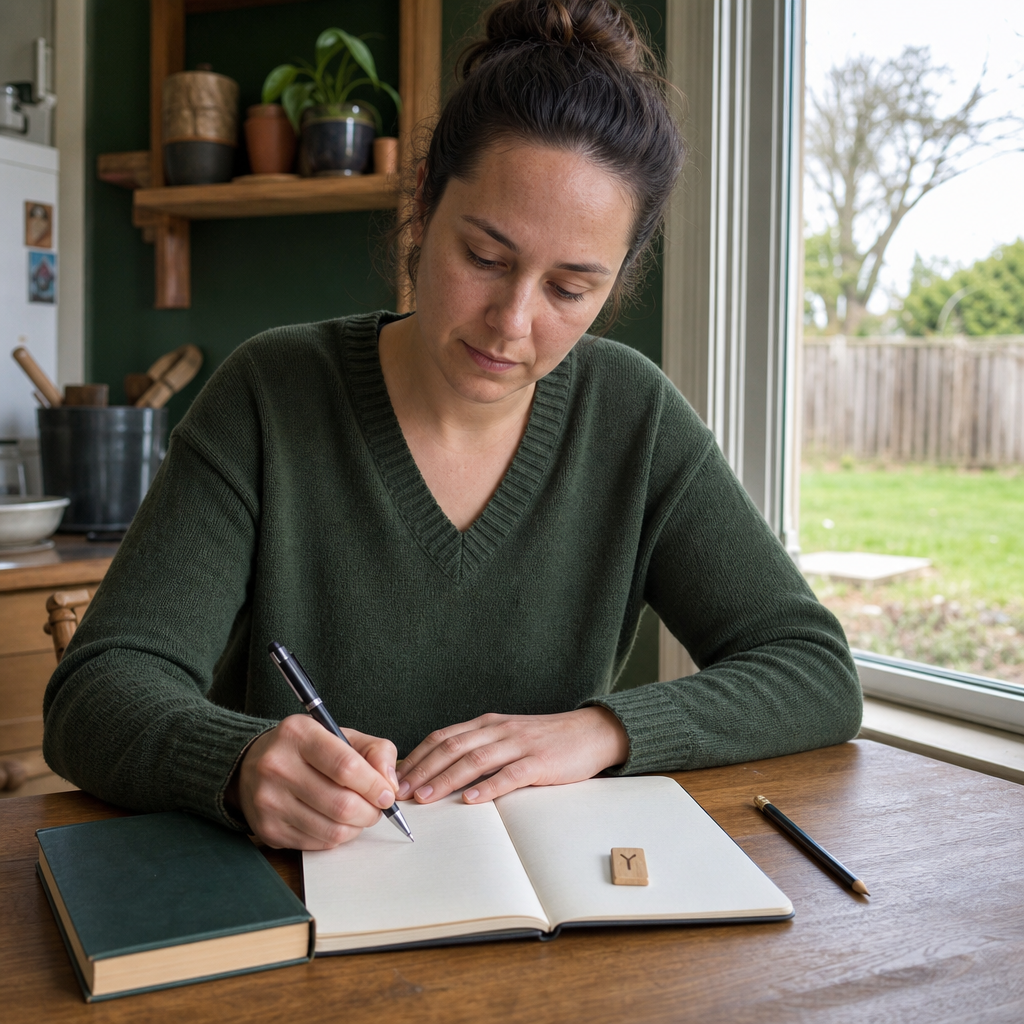
- Record the question. Include the date and why the question matters now.
- Mix once and draw once. Use a method chosen in advance. Do not redraw because you dislike the first tile.
- Identify before interpreting. Copy the rune name, transliteration and source gloss accurately.
- List two associations. Include your first reaction and one plausible alternative.
- Check the fit. Note facts supporting each association and facts that do not fit.
- Choose one small action. Prefer something lawful, consensual, affordable and reversible.
The value of the exercise is the record. Without a dated note, it is easy to remember a vague phrase as more specific after an event occurs.
Keep four columns in your notes
Swipe horizontally if any columns are off-screen.
| Column | What to record |
|---|---|
| Draw | Rune, orientation, date, question and chosen method |
| Reference | Name, sound and source wording without application |
| Associations | At least two possible interpretations, including one that challenges the first |
| Evidence and action | What is known, what remains unknown and one fact to check next |
What “intuition” can and cannot mean
Intuition can describe a rapid impression, emotional response or pattern noticed from experience. It is not automatically a message from an external source, and confidence does not make an impression accurate. Treat the feeling as information about your response, then compare it with facts.
If the rune seems to confirm exactly what you hoped or feared, slow down. Write one alternative interpretation and one observation that would disconfirm your preferred reading. This reduces confirmation bias and keeps the exercise from becoming a loop.
Reversals are optional modern conventions
Readers disagree about inverted or sideways runes. Some use orientation as a contrasting prompt; others ignore it because several characters are symmetrical and inscription direction is a separate historical question. Choose a rule before drawing and document it.
Never treat a reversed rune as proof of illness, infertility, betrayal, death, violence or spiritual danger. If a reading increases fear, stop and move to reliable information or qualified support.
Making or buying a beginner set
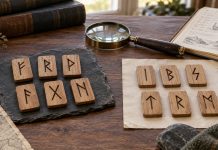
A modern set may be made from wood, stone, ceramic, card, resin or another durable material. The material does not make a reading more accurate. Prioritize complete, legible characters, smooth edges and a consistent size.
If making tiles, use appropriate eye protection and ventilation for cutting, sanding, burning or sealing materials. Keep small pieces away from children and pets. No candle, crystal, sacred tree species, special pouch or cleansing purchase is required.
Historical claims need their own evidence
Runes were not a Bible-times fortune-telling system, and their origins should not be described as Greco-Roman divination. Norse myth connects Odin with the acquisition of rune knowledge, but myth is not an archaeological account of an alphabet being invented. Accounts of lots and signs do not document one continuous method identical to modern tile spreads.
For the evidence boundary—including rune rows, inscriptions, magical material, Tacitus’s reported lots and the limits of claims about ancient casting—read Origins and Ideas Behind Rune Casting.
If another person reads for you
Agree on the rate, format, time limit and method before beginning. Ask the reader to identify each rune and explain how they connect a reference meaning to your question. A responsible reader should not diagnose, threaten, promise certainty, request unnecessary private information or pressure you to buy protection, cleansing or repeated sessions.
Stop immediately if someone claims a curse, says only they can prevent disaster, directs you to abandon medical care or demands off-platform payment. Symbolic practice is not a substitute for emergency, medical, mental-health, legal or financial support.
Frequently asked questions
1. Can one rune answer a yes-or-no question?
A rune cannot verify a yes-or-no outcome. Use it to generate questions or considerations, then decide with relevant facts and the people involved.
2. Should I draw again if I dislike the rune?
No. Repeated drawing can turn the exercise into answer-seeking. Record one draw, consider an alternative interpretation and return only when new information changes the question.
3. Do I need a blank rune?
No. A blank “Odin rune” is a modern addition, not a twenty-fifth Elder Futhark character. Remove it for a 24-character set or clearly define it as an optional modern pause prompt.
4. When should I not use rune divination?
Do not use it to diagnose, accuse someone, locate a missing person, assess immediate danger or make irreversible medical, legal or financial decisions. Use qualified or emergency support instead.

‘Asking oneself questions before drawing a rune seems like an effective method for introspection, yet one must remain open to diverse interpretations.’
Yes! The openness to various meanings can enhance the reading experience significantly.
While the idea that Odin discovered the runes by swinging from a tree adds a mythical aspect, I wonder about the implications of such narratives on modern interpretations.
‘The Elder Futhark Runes’ contains layers of meaning that might not be fully appreciated without understanding their historical context.
The use of different rune alphabets across various regions raises questions about cultural exchanges in early European history.
Indeed, it’s crucial to explore how these symbols might have been influenced by interactions with other civilizations.
‘Rune casting’ as a practice appears to blend both spirituality and tradition, which could offer deeper insights into personal dilemmas.
‘Carving runes into wood or stone also speaks volumes about human creativity and the need for self-expression through symbolic systems.’
The concept of runes in divination are quite intruiging, however, the historical accuracy of their origins seems to be debated among scholars.
The connection between runes and ancient Germanic culture is fascinating; one must consider how these symbols could transcend time and remain relevant today.