Quick answer
Rune casting as practiced today is a modern interpretive activity built around historical writing signs. Runes themselves are well documented as alphabets used for names, memorials, ownership, communication and sometimes ritual or protective language. What is not established is one continuous ancient casting system that matches today’s bags of tiles, fixed positions and keyword charts.
That distinction matters. It lets us study real runic history without dismissing a contemporary reflective practice—or advertising that practice as an authenticated Viking method. A modern spread can be meaningful to the person using it while still being labeled modern.
Begin with runes as writing
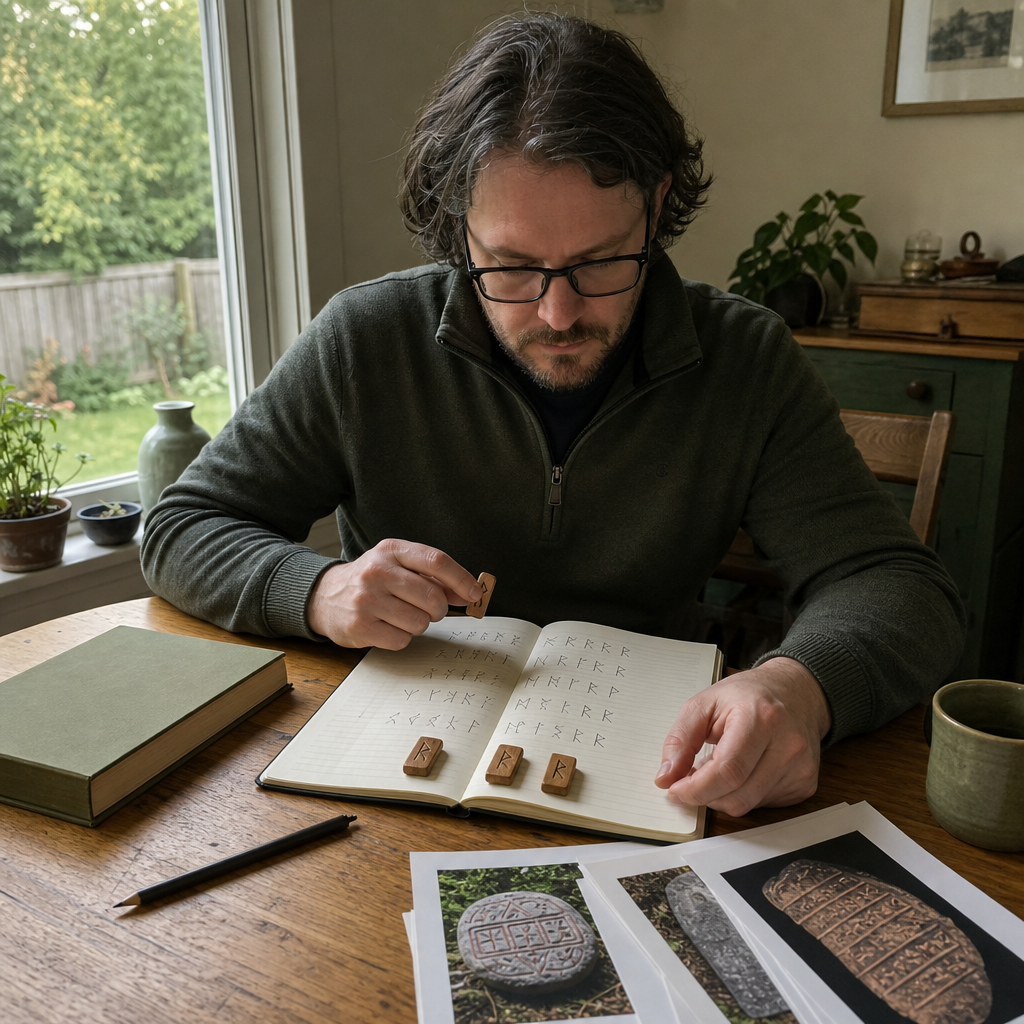
The word rune refers to a character in one of several related writing systems, not to a single timeless alphabet. The 24-character Elder Futhark appears in early inscriptions from the first centuries CE. During the Viking Age, Scandinavian writers commonly used the 16-character Younger Futhark. Anglo-Saxon communities developed the longer futhorc, and medieval writers expanded their inventories again.
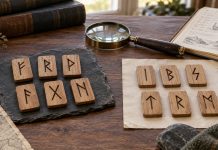
Those rows are related, but they are not interchangeable. A modern set that combines Elder Futhark characters, a blank tile and keywords from several books is a contemporary teaching or divination product. It should not be described as an excavated complete system.
| Layer | What the evidence supports | What requires caution |
|---|---|---|
| Early runic writing | Surviving inscriptions, letter forms, names and linguistic analysis | Assigning one fixed spiritual keyword to every character |
| Viking-Age practice | Younger Futhark inscriptions, memorial stones and written messages | Calling a 24-tile Elder Futhark kit the universal Viking alphabet |
| Magic and ritual | Some inscriptions and later literary sources contain charms, formulas or magical themes | Treating every rune or inscription as occult |
| Modern casting | A current symbolic or journaling practice with many competing methods | Claiming one modern spread is a recovered ancient standard |
What historical sources do—and do not—show
The National Museum of Denmark describes runes as Germanic writing derived from Mediterranean alphabetic traditions. Its overview of runic magic also makes a useful correction: magical material exists, yet most surviving inscriptions communicate practical information. Names, memorial texts and ownership marks are part of rune history too.
Ancient and medieval sources contain accounts of lots, signs, charms and prophecy, but connecting every such account to a bag of rune-marked tiles is an inference. For example, the Roman author Tacitus described Germanic lot casting on marked pieces of wood. His account does not identify a later runic alphabet, provide a rune row or document the three- and nine-position layouts sold today. It is evidence for a reported lot practice, not a complete manual for modern rune casting.
Likewise, the myth in which Odin gains knowledge of runes is a literary and religious source, not an archaeological account of an alphabet being invented or a standardized casting method being taught. Myth can be studied and valued as myth without converting every detail into a historical instruction.
Where modern rune meanings come from
Modern readers often combine several layers:
- the rune’s reconstructed name and sound value;
- imagery from Old English, Norwegian or Icelandic rune poems;
- scholarly interpretation of inscriptions and language;
- modern occult, psychological or self-help keywords;
- the reader’s personal associations.
These layers should be labeled rather than blended. A rune poem may be centuries later than the earliest Elder Futhark inscription. A keyword printed with a modern commercial set may be useful as a prompt but is not automatically an ancient definition. Our Elder Futhark reference guide separates names and sound values from contemporary reflection prompts.
How a modern casting practice can be transparent
A careful practice starts by naming its method. Write down which rune row you are using, which reference supplies the meanings and whether orientation matters. If you use a blank tile, call it a modern addition rather than a twenty-fifth Elder Futhark character.
Next, describe the layout as a chosen structure. A three-tile sequence might be “known facts, overlooked factor, next check.” A larger group might be sorted by proximity or direction. Neither structure becomes ancient merely because the number three or nine appears in Norse literature. State who designed the layout and what each position means before drawing.
- Write the question. Prefer an open prompt that does not demand a guaranteed prediction.
- Record the draw. Note the characters and positions before interpretation.
- Describe the reference meaning. Keep the source wording separate from your application.
- Generate alternatives. List at least two plausible readings and one reason neither may fit.
- Choose a checkable next step. Use ordinary evidence, conversation or professional advice where needed.
The companion modern three-rune reflection process gives a practical record format and clear stop conditions.
Materials are choices, not guarantees
Modern rune sets are made from wood, stone, ceramic, resin, metal or card. No material makes an interpretation more accurate. A safe, legible and complete set is more useful than a claim that a particular tree, crystal or ritual guarantees power.
You also do not need a candle, cloth, special direction or elaborate cleansing routine. If a cloth keeps tiles from rolling, use it for that practical purpose. If a short breathing pause helps attention, treat it as preparation rather than supernatural proof. Follow ordinary fire safety if candles are present, and keep small tiles away from children and pets.
Why fixed future claims are a problem
A tile cannot establish that a partner is unfaithful, a medical condition is present, a lawsuit will succeed, an investment will profit or a missing person is in a particular place. It also cannot verify a curse, spiritual attack or threat. Strong feelings during a reading are real experiences, but they are not independent evidence about an outside event.
For high-stakes decisions, pause the casting and use qualified support. Contact emergency services for immediate danger, a clinician for health concerns, a lawyer for legal questions and a licensed financial professional for consequential money decisions. Never pay someone who says repeated readings, cleansing or protection are the only way to prevent disaster.
Respectful language avoids a fantasy version of history
Runes were used across places, languages and centuries. Avoid reducing all Germanic or Norse history to Vikings, warriors, magic and prophecy. Horned helmets are a later stereotype, and a dramatic costume does not authenticate an interpretation. Museums, inscription databases and runology projects provide better starting points than an unlabeled social-media chart.
Contemporary spiritual practice can still be discussed honestly. Say “in my modern practice” when describing a spread or personal association. Say “this source records” when referring to a poem or inscription. Say “I do not know” when the evidence does not support continuity or certainty.
Frequently asked questions
Is rune casting an ancient Viking method?
Runes are historical writing systems, and historical sources include lots, magic and divination themes. However, there is no single documented ancient method identical to today’s commercial tile sets and fixed spreads. Modern casting should be labeled modern.
Did Odin invent the runes?
Odin’s relationship to runes belongs to Norse myth and literature. It is not an archaeological account of an alphabet being invented. Historical rune development is studied through inscriptions, language and material evidence.
Does a nine-rune cast come from ancient practice?
Nine has significance in Norse literature, but that does not prove a specific modern nine-tile layout is ancient. Treat the layout as a contemporary structure unless a reliable source documents otherwise.
Can rune casting predict a decision’s outcome?
No reliable evidence shows that rune tiles predict future events. They may be used as reflection prompts, while decisions remain grounded in facts, consent, professional advice and ordinary risk checks.

The method of casting runes appears highly flexible, which can be seen as both a strength and a weakness. It encourages creativity but may also contribute to inconsistency in readings.
Understanding the origins of runes adds depth to their use in divination. However, one must ponder whether historical context enhances their relevance or merely romanticizes an ancient practice.
‘Casting happens when there is a problem’—this assertion merits further exploration. Does relying on external symbols for decision-making indicate an avoidance of personal responsibility?
‘It’s interesting that each rune’s meaning is subjective; could this variability actually enhance its effectiveness by aligning with individual contexts?’
‘The runes can be carved sticks’—the tactile aspect seems significant; does the physical connection with runes impact their interpretative value? Perhaps there’s more at play than mere symbolism.
‘Finally, could one argue that any divination tool serves primarily as a catalyst for introspection rather than an ultimate answer-giver? This seems central to understanding their role.’
‘In terms of materiality, what implications arise from using different mediums for creating runes? Do some materials carry more energetic significance than others?’
While rune casting may provide a form of guidance, it is crucial to acknowledge that the outcomes are not definitive. The reliance on intuition could lead to varied interpretations which might not always align with one’s reality.
‘Nine-rune cast’ seems intriguing, though I wonder how the magical aspect attributed to this number influences its interpretation in practice. Does belief in numerology play a role?
The concept of rune casting is fascineting, yet it raises questions about the interpretation and subjective nature of such guidance. It seems to blur the lines between divination and personal insight.
‘Runes are considered sacred’—this statement invites a broader discussion on the ethics surrounding spiritual practices. Should there be limitations on how such tools are employed?