

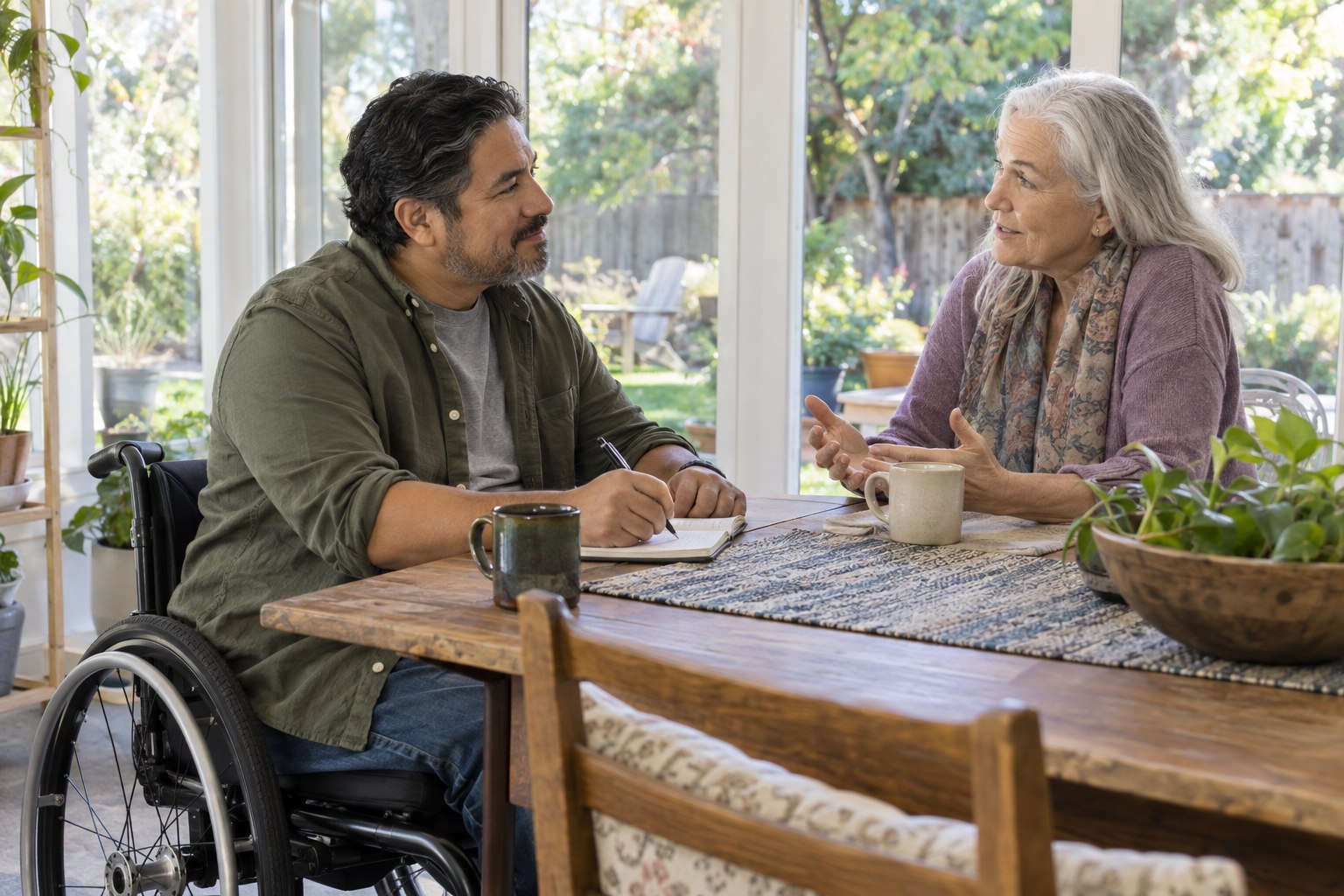
A tool-free psychic reading relies on conversation, observation, memory, imagination, and intuitive impressions rather than tarot cards, runes, pendulums, or other objects. Some people use spiritual language for the experience. That language may be personally meaningful, but an impression is not proof of telepathy, spirit contact, hidden facts, or future events.
Removing tools does not remove bias. It can actually make the source of an interpretation harder to see. A responsible session therefore labels observations, guesses, metaphors, and information supplied by the client. For a broader explanation of fast impressions and evidence checks, see the article on intuition.
What changes when there is no divination tool?
A card or rune gives a session a visible prompt. Without one, prompts may come from the client’s words, tone, clothing, age, setting, public information, the reader’s expectations, or a mental image that appears during conversation. None of these sources is automatically deceptive, but they should not be confused with independent knowledge.
| Experience | Possible ordinary source | Responsible wording |
|---|---|---|
| A sudden image | Memory, imagination, recent media, or association | “I pictured a train; does that prompt anything useful?” |
| A bodily feeling | Posture, stress, hunger, anxiety, pain, or empathy | “I notice tension in myself; I cannot diagnose what it means for you.” |
| A strong hunch | Pattern recognition, expectation, base rates, or wishful thinking | “This is an impression, not a verified fact.” |
| A detail that fits | Client cues, broad wording, coincidence, or prior information | “Please correct me rather than making it fit.” |
| A detail that misses | An incorrect guess | Record it as a miss; do not reinterpret it after the fact. |
Begin with consent and a clear frame
Before a session, explain that the reading is reflective or entertainment-based and may be wrong. Agree on the time, price, refund or cancellation terms, note-taking, privacy, and topics that are off limits. Ask whether the person wants an open conversation, a low-information exercise, or simply help exploring a question.
Do not perform an unsolicited “pre-read” of someone’s name, photograph, social profile, home, or family. Looking up a client without permission and presenting discovered facts as psychic knowledge is misleading. Do not read absent partners, children, employees, patients, or other third parties as though their private thoughts and health are available.
A transparent tool-free session
- Ask for the goal. Use an open, low-stakes question such as “What would make this conversation useful?”
- Separate inputs. Mark what the client stated, what you directly observed, and what arose as an impression.
- Offer, do not declare. Present an image or hunch as a possible prompt and invite a clear yes, no, or uncertain response.
- Record misses. Do not turn “no” into “not yet,” “someone around you,” or a hidden block.
- Generate alternatives. For every interpretation, name at least one ordinary explanation and one different possibility.
- Return agency. End with options the client can verify or choose, not commands based on invisible authority.
Silence can help someone think, but it should not be used to pressure them into revealing details. Likewise, mirroring a person’s words may support listening, but it is not independent confirmation of a psychic message.
Watch for common accuracy illusions
Cold reading uses observation, feedback, broad statements, and rapid adjustment. It can occur deliberately or unconsciously. Warm reading uses generally common themes, such as relationship uncertainty, money stress, or grief. Hot reading uses information found in advance or supplied by another person. These effects can make a session feel more specific than it began.
The Barnum effect is the tendency to recognize ourselves in vague, broadly applicable descriptions. Confirmation bias favors hits over misses, while hindsight can reshape an old statement after an event. A respectful reader does not use these effects to claim certainty or blame the client for a failed prediction.
Practice without making claims about a client
Private exercises can improve observation and source awareness without treating strangers as targets. Try describing a neutral photograph, then list which details were visible and which were inferred. Predict a low-stakes, clearly defined outcome before it occurs, seal the wording, and score it using rules decided in advance. Compare performance with chance and keep every trial.
For partner practice, use consent and a blind protocol. One person selects a target from a prepared set while the reader records impressions before receiving feedback. Avoid health, trauma, pregnancy, death, crime, infidelity, or missing-person targets. The purpose is to test claims and notice bias, not to prove special status.
Meditation may help attention or calm some people, but it does not guarantee accuracy or unblock supernatural channels. Stop if practice increases panic, dissociation, sleeplessness, agitation, or difficulty distinguishing inner experience from outside events. Meditation is optional, and chakra or vibration language should not be used to diagnose a problem.
Use careful language during a reading
Prefer “I have an image,” “this may be a metaphor,” or “I could be wrong” over “spirit says,” “your energy proves,” or “I know what your partner is hiding.” Ask the client not to supply extra details merely to rescue a claim. Permission to disagree should be real and should not end the session in shame or pressure.
Do not frame ordinary skepticism, disability, medication, trauma, religion, culture, or lack of interest as blocked intuition or low vibration. Children are not reliable evidence of supernatural openness, and adults should not question a child repeatedly about spirits or secret messages. Distress or unusual perceptions deserve calm support rather than escalation into a frightening story.
Health, safety, and high-stakes boundaries
A tool-free reading cannot diagnose illness, pregnancy, mental-health conditions, addiction, abuse, curses, crimes, fertility, or cause of death. It cannot confirm that a person is safe, faithful, dangerous, missing, alive, or communicating after death. Urgent symptoms, threats, violence, self-harm risk, or loss of reality testing require appropriate emergency or professional help.
Do not advise a client to stop medication, avoid a clinician, confront a suspected offender, invest money, move, divorce, remain in an unsafe relationship, or ignore legal advice because of an impression. The article on using a psychic reading for relationship reflection explains consent, evidence, safety, price, and decision limits in that common setting.
Reader ethics and payment safeguards
State the fee before beginning, keep the session within the agreed time, and do not manufacture urgency. Warning signs include guaranteed accuracy, secret curses, repeated paid cleansing, claims that only one reader can help, pressure to borrow money, threats of harm, or requests for passwords and financial access.
Keep notes only with permission, store them securely, and delete them according to a stated policy. Do not publish identifiable stories as testimonials without informed consent. A reader should disclose relevant limitations and referral relationships and should never impersonate a licensed health, legal, or financial professional.
Review the session afterward
Write down the original wording before discussing possible matches. Count clear hits, misses, and statements too vague to score. Note information the client supplied, questions the reader asked, and interpretations added later. Useful reflection can occur even when a paranormal claim is unsupported; the value may come from attentive conversation, metaphor, or considering alternatives.
A responsible conclusion is proportionate: “This prompted a question worth checking” rather than “This proves my psychic ability.” Accuracy should never be inferred from confidence, emotion, surprise, or a few memorable matches.
Frequently asked questions
1. Can a psychic reading work without tarot, runes, or a pendulum?
A person can hold a reflective conversation and report impressions without objects, but removing tools does not establish telepathy or prediction. Observation, memory, cues, bias, and coincidence still need to be considered.
2. Is a tool-free reading more accurate?
There is no reliable evidence that avoiding divination tools makes a reading more accurate. Accuracy claims need predefined, testable statements, complete records, and results compared with chance—not confidence or remembered hits.
3. Should a reader research a client before the session?
Not secretly. Public or private information found in advance can create a false appearance of psychic knowledge. Any research, photograph use, or third-party information should be disclosed and consented to.
4. What should I do if a reading becomes frightening?
Stop the session, avoid paying for urgent cleansing or protection, and check the claim with direct evidence and trusted qualified support. Seek emergency help for immediate danger, severe symptoms, or risk of self-harm.



The concept of chakras being blocked due to societal influences raises significant questions about our connection to spirituality. How can we reconcile these differences in belief systems?
‘Intuitive tarot reading’ as a transition to psychic readings is an interesting approach; however, what distinguishes a successful intuitive reading from mere guesswork?
I find the notion of psychic development without tools quite intriguing; it challenges traditional views on intuition. However, I wonder how effective these methods really are in practice.
Indeed, while the idea sounds promising, empirical evidence supporting such claims is often lacking.
‘Grounding meditation’ appears essential for enhancing intuition, yet what specific techniques would one recommend for beginners unsure about their abilities?
‘Psychic only readings’ seem to imply a shift away from traditional practices; does this signal a potential divide within the community regarding methods?
Such divides could foster innovation but might also lead to fragmentation of established practices.
‘Pre-reading’ seems like a valuable tool, yet I question how one can ensure that biases do not interfere with perceived insights.
‘Biases can be challenging, perhaps maintaining a journal could assist in tracking and understanding one’s thought patterns better.’
‘Cleaning’ the spirit pathways seems metaphorical but may have practical applications. Can psychological techniques play a role in this cleaning process?