

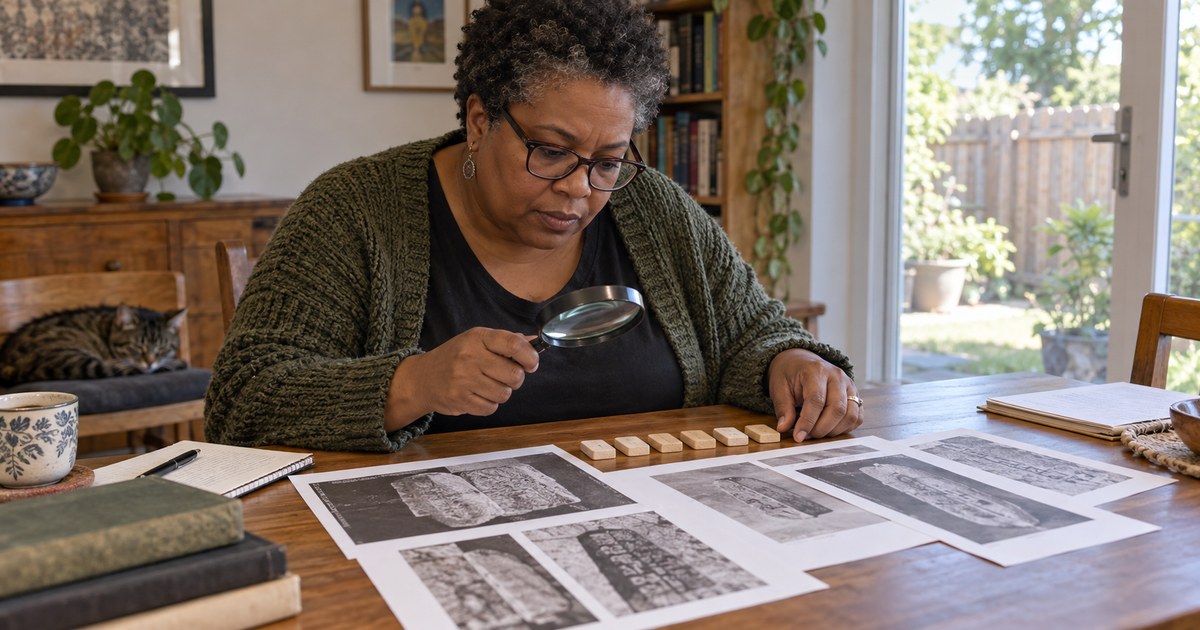
Rune stones used for modern divination usually place runic characters on wood, stone, ceramic, or glass tokens. The characters come from historical writing systems, but a bag of 24 stones with fixed fortune-telling meanings is a modern practice—not an archaeological set that can predict the future.
This guide is a character-reference article. It explains what the 24-character Elder Futhark is, how modern readers build reflective keywords, and where common commercial claims go beyond the evidence. For practical advice on choosing safe materials, making a set, storing it, and drawing or casting transparently, see What to Know About Using Runes for Divination.
Runes were letters before they were reading tools
Runic alphabets were used to write Germanic languages. Elder Futhark is the scholarly name commonly used for the earliest widely attested runic alphabet; its modern name comes from the sounds of its first six characters. Surviving inscriptions occur on objects such as jewelry, weapons, tools, memorial stones, and small artifacts.
Historical inscriptions and later rune poems matter, but they do not provide a single ancient manual for a standardized 24-stone divination system. Modern keyword lists often combine reconstructed rune names, rune-poem imagery, modern occult writing, personal symbolism, and commercial conventions.
The separate article Origins and Ideas Behind Rune Casting looks more closely at the evidence for historical rune use and the limits of claims about ancient casting.
A careful Elder Futhark reference
The table below gives conventional names and broad literal associations often used in modern references. Spellings and reconstructed forms vary. The reflection prompts are contemporary prompts, not translations, prophecies, diagnoses, or universal ancient meanings.
| Rune | Conventional name | Broad association and modern reflection prompt |
|---|---|---|
| ᚠ | Fehu | Livestock or movable wealth; what resource needs responsible care? |
| ᚢ | Uruz | Aurochs; where do strength and limits both matter? |
| ᚦ | Thurisaz | Thorn or giant; what boundary or disruption needs attention? |
| ᚨ | Ansuz | Deity or speech associations; what message needs evidence or clarification? |
| ᚱ | Raidho | Ride or journey; what process, route, or sequence is involved? |
| ᚲ | Kenaz | Torch or ulcer traditions vary by source; what is becoming visible? |
| ᚷ | Gebo | Gift; are exchange, consent, and reciprocity balanced? |
| ᚹ | Wunjo | Joy; what supports belonging or ordinary satisfaction? |
| ᚺ | Hagalaz | Hail; what disruption can be prepared for without predicting disaster? |
| ᚾ | Nauthiz | Need or constraint; what is necessary, and what can wait? |
| ᛁ | Isa | Ice; where would a pause help? |
| ᛃ | Jera | Year or harvest; what depends on time, season, and repeated work? |
| ᛇ | Eihwaz | Yew; what requires endurance and careful source checking? |
| ᛈ | Perthro | Meaning is uncertain; what remains unknown rather than secretly guaranteed? |
| ᛉ | Algiz | Name and interpretation are debated; what practical protection is available? |
| ᛊ | Sowilo | Sun; what brings clarity, energy, or visibility? |
| ᛏ | Tiwaz | Associated with the god Týr; what principle or duty is being weighed? |
| ᛒ | Berkano | Birch; what needs patient care or a fresh start? |
| ᛖ | Ehwaz | Horse; how are trust, movement, and cooperation working? |
| ᛗ | Mannaz | Person or humanity; whose perspective and dignity need consideration? |
| ᛚ | Laguz | Water; what emotion or changing condition should be observed? |
| ᛜ | Ingwaz | Associated with Ing; what is developing but not yet ready? |
| ᛞ | Dagaz | Day; what shift in perspective is possible? |
| ᛟ | Othala | Inherited estate or homeland; what inheritance, belonging, or responsibility is relevant? |
These prompts do not turn a rune into advice by itself. A drawn character can help select a question, much like a writing prompt. The useful work is in examining facts, alternatives, values, and consequences.
The blank rune is a modern addition
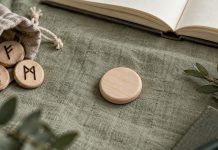
Elder Futhark has 24 characters. A blank tile is not a 25th historical letter. Some modern sets include one as a spare or assign it ideas such as fate, the unknown, or unlimited possibility. Label that as a modern house rule rather than an ancient teaching.
If a set includes a blank, decide before drawing whether it will be excluded, kept as a spare, or used with a clearly stated modern prompt. Changing the rule after seeing the result makes interpretation less transparent.
Rune names are not fixed fortunes
“Fehu means you will receive money” turns a broad association into a prediction. “Fehu prompts me to review resources, work, debt, or stewardship” keeps the exercise reflective. Likewise, Ingwaz does not diagnose pregnancy, Thurisaz does not prove psychic sight, and Othala does not guarantee an inheritance.
Reversed meanings are also a modern convention, not a universal ancient rule. Some characters are symmetrical, and historical inscriptions were not a tarot-style system of upright and reversed cards. A reader may use reversals as a disclosed personal method, but should not present them as compulsory historical fact.
Use a transparent one-rune reflection
- Frame a low-stakes question. Ask “What should I consider about this conversation?” rather than “Will my partner betray me?”
- Choose the source list. Use one documented reference and note whether prompts are historical, reconstructed, or modern.
- Draw one token. Random selection chooses a prompt; it does not reveal hidden facts.
- Write three interpretations. Include at least one ordinary explanation and one interpretation that does not flatter your hopes.
- Check outside evidence. Verify schedules, prices, health facts, consent, and other people’s statements directly.
- Choose a reversible action. Ask, research, pause, or make a small plan rather than an irreversible decision.
Keep misses and awkward fits. Do not redraw until a preferred rune appears or stretch a vague association to match later events. If you are testing predictive claims, decide the target and scoring rule in advance.
Respect living culture and historical uncertainty
Runes are connected to Germanic-language history and to contemporary religious, cultural, artistic, linguistic, and spiritual communities. Avoid collapsing “Norse,” “Viking,” “Germanic,” “Celtic,” “Wiccan,” “shamanic,” and “Indigenous” into one tradition. They are not interchangeable labels.
Do not market a modern spread as an ancient Viking ceremony without evidence. “Runic cross,” “Wiccan star,” chakra layouts, zodiac correspondences, and tarot-like meanings may be meaningful modern combinations, but they should be identified as modern.
Some rune forms have also been appropriated by Nazi and neo-Nazi movements. Context matters: a character in a linguistic chart is not automatically extremist, while a symbol paired with racist slogans or movement-specific styling can signal harm. Do not reproduce extremist adaptations for decoration, and learn the context before displaying a rune publicly.
Materials and handling
Modern tokens can be made from smooth wood, stone, clay, ceramic, card, or another safe material. Avoid toxic finishes, sharp edges, unknown plant materials, protected archaeological objects, and stones collected where removal is prohibited. Keep small pieces away from young children and anyone at choking risk.
You do not need to face east, follow the sun, use a special cloth, charge stones, or perform smoke cleansing for a reflective draw. If you choose a ritual, treat it as optional and consider allergies, asthma, pets, fire rules, ventilation, and household consent.
Decision and reading boundaries
Rune prompts cannot diagnose illness, pregnancy, mental-health conditions, curses, crimes, fidelity, fertility, legal outcomes, investment returns, or another person’s private thoughts. Do not use them to identify suspects, locate missing people, replace emergency care, or decide whether an unsafe relationship is safe.
When reading for someone else, get consent, explain the method, state the price and time limit, protect notes, and allow the person to decline a topic. Do not create fear with claims of doom, blocked ancestry, spirit attack, or required cleansing.
Frequently asked questions
Are rune stones ancient fortune-telling tools?
Runic characters are historical writing-system characters, but the standardized modern bag of 24 stones with fixed fortune-telling meanings is not an archaeologically documented ancient kit. Modern practice mixes historical material with later and contemporary interpretation.
Is the blank rune part of Elder Futhark?
No. Elder Futhark has 24 characters. A blank tile is a modern addition or spare and should be labeled that way.
Does each rune have one correct meaning?
No. Names, translations, rune-poem imagery, scholarly interpretations, and modern divinatory keywords differ. State your source and keep reflective meanings separate from historical claims.
Can rune stones predict the future?
There is no reliable evidence that a random rune draw predicts future events. It can be used as a prompt for reflection, provided outside facts, consent, health care, and qualified advice guide important decisions.

‘The blank rune’ section was particularly intriguing as it suggests limitless possibilities; this concept warrants further exploration.
There seems to be a conflation between different cultural practices here, which might lead to misinterpretations among readers.
Indeed, further distinction between each runes’ significance in various traditions would enhance understanding.
While the descriptions of each rune are compelling, the grammatical inaccuracies detract from the overall credibility of the content.
I agree; precision in language is vital when discussing such esoteric subjects to maintain authority.
‘Esoteric’ is indeed appropriate here; however, a broader audience might struggle with such terminology.
The article presents interesting insights into the use of runes, however, the historical context could’ve been elaborated more clearly.
“It would be beneficial if additional resources or references were provided for those wishing to delve deeper into rune practices.”