Runes are characters from several related writing systems used by Germanic-speaking communities in parts of northern Europe. They were letters before they became the symbols printed on modern divination tiles. In surviving inscriptions, runes record names, ownership, memorials, short messages and other language. Today, people also study them as history, use them in art and popular culture, or place them on tokens for spiritual reflection.
Those uses should not be collapsed into one story. A documented inscription, a modern rune-reading practice and a fantasy-game symbol may look related, but they carry different evidence and purposes. Runes can support learning or thoughtful reflection; they have not been shown to predict the future, diagnose illness, guarantee protection or replace professional advice.
Runes are letters, not one universal set of magic symbols
“Runes” is a broad label for characters in multiple runic alphabets. Elder Futhark, with 24 characters, is the best-known modern reference set. Younger Futhark and the Anglo-Saxon futhorc developed in different places and periods, with different character inventories. A rune therefore has to be identified within an alphabet and historical context rather than treated as a timeless icon with one fixed meaning.
Runes are Germanic writing traditions, not a generic name for every ancient European symbol system. Calling them “Celtic runes” can blur distinct histories, including Celtic-language inscriptions and ogham. Nor does every object with a rune prove a divination ritual. Archaeologists interpret an object through its date, location, material, inscription and find context—not through a modern keyword chart alone.
For a closer look at what surviving evidence can and cannot establish, see our guide to the origins and ideas behind rune casting.
What are runes used for?
Swipe horizontally if any columns are off-screen.
| Context | Typical use | Important limit |
|---|---|---|
| Historical writing | Names, memorials, ownership, short statements and communication | An inscription must be interpreted in its material and linguistic context |
| Language and history study | Transliteration, sound changes, manuscript comparison and cultural research | Modern English keywords are not direct translations of every rune |
| Modern spiritual practice | Journaling, meditation, ceremony or structured reflection | These are contemporary practices, not proof of supernatural prediction |
| Art and design | Jewelry, carving, illustration, tattoos and typography | Check the exact character, inscription and modern associations before displaying it |
| Popular culture | Fiction, games, films and invented magical systems | Entertainment may combine or invent symbols rather than represent history |
Historical inscriptions and language study
Runic writing appears on objects such as stones, wood, bone, metalwork and everyday items. Some inscriptions are long enough to translate with confidence; others are fragmentary, abbreviated or disputed. Scholars compare letter forms, grammar, neighboring finds and dating evidence. This work can illuminate language and social history without requiring every inscription to be religious or magical.
A beginner can explore this use by choosing one alphabet, learning its usual transliteration and checking examples from museums, academic editions or archaeological collections. Copying a documented inscription is different from assigning a modern emotional keyword to each character. Both activities may be meaningful, but the labels should remain clear.
Modern reflection and spiritual practice
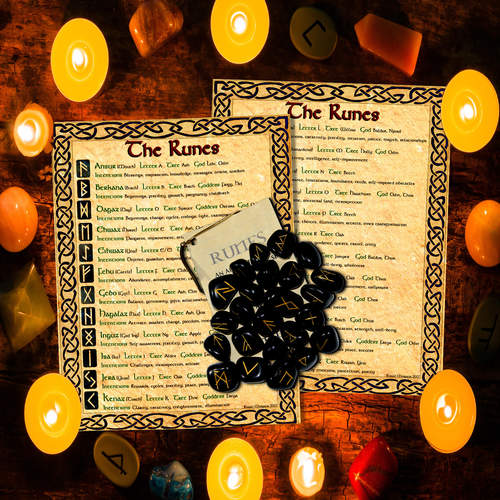
Many contemporary practitioners place rune characters on wood, stone, ceramic, glass or cards, then draw or cast them as prompts. A session might ask, “What factor have I overlooked?” and use the selected character to generate several interpretations. That can slow thinking, surface assumptions and make a journal entry more specific.
The useful part is the structured pause, not a guarantee that an unseen force delivered a fact. Write down the question, source used for the interpretation, at least one alternative explanation and what evidence would change your view. Do not use a draw to decide whether to seek medical care, leave an unsafe situation, invest money, accuse another person or ignore consent.
If you want physical tokens, our beginner’s guide to choosing a set of runes covers alphabet labels, legibility, size, accessibility, material safety and honest product claims.
Art, identity and popular culture
Runes also appear in jewelry, tattoos, logos, crafts, music scenes and fantasy media. Before permanently using a character, verify its orientation and the full text with more than a decorative chart. A single form can resemble a character from another alphabet, and a string copied from entertainment may be invented or grammatically incoherent.
Context matters socially as well. Some runic characters and rune-like designs have been appropriated by extremist movements even though the historical alphabets themselves are much older and broader. Research the specific design and its current local associations. Avoid presenting a modern bindrune or personal sigil as an authenticated ancient inscription.
A practical way to label what you are doing
- Name the alphabet. Identify Elder Futhark, Younger Futhark, Anglo-Saxon futhorc or another documented system.
- Name the source. Distinguish a museum inscription, scholarly transliteration, modern guidebook, personal association or fictional design.
- Name the purpose. Say whether the activity is language study, art, spiritual ritual, journaling or entertainment.
- Name the limit. Do not turn a reflective symbol into evidence about health, another person’s thoughts or a future event.
This simple labeling respects historical evidence while leaving room for personal practice. It also helps readers compare claims instead of assuming that anything called “runic” comes from one ancient tradition.
Frequently asked questions
1. Are runes Celtic?
Runic alphabets are associated primarily with Germanic languages and communities. “Celtic runes” is often a modern marketing label that can confuse runes with distinct traditions such as ogham. Check the named alphabet and the source of any claimed history.
2. Were runes originally used for divination?
Surviving evidence clearly shows runes functioning as writing. Historical sources also contain ritual and magical contexts, but they do not establish that today’s standardized tile sets, keyword charts or spreads were used unchanged across the ancient world. Modern rune reading should be labeled as a contemporary practice.
3. Can runes predict the future or protect me?
There is no reliable evidence that rune tokens predict events or create protection. They may serve as spiritual symbols or reflection prompts, but they should not replace safety planning, healthcare, legal counsel, financial advice or observable evidence.
4. What is the best use of runes for a beginner?
Choose one documented alphabet and one purpose. Learn the characters as letters, study a museum inscription, or use a single token as a journaling prompt. Keep historical facts, modern interpretations and personal associations clearly separated.


The complexities involved in mastering rune reading are duly noted; however, how do we assess the validity of these interpretations?
The claims about rune reading provide insight into its historical usage but lack rigorous scrutiny regarding their supposed predictive capabilities.
‘Secret whisper’ as a meaning of rune does present an alluring notion, yet it raises queries about its translation accuracy across languages.
Understanding how different psychic mediums employ various tools can enhance our comprehension of their respective methodologies.
There seems to be a blend of mysticism and historical artifacts here; it would be beneficial to differentiate between folklore and factual history.
I wonder if the popularity of tarot has overshadowed the significance that runestones once held in various cultures.
It is intriguing how ancient symbols are still being utilized in contemporary practices; however, one must question the subjective nature of such interpretations.
While the article mentions the historical use of runes, it fails to address the cultural context which is essential for a full understanding of their significance.
The relation between ancient runes and modern psychic practices appears to be quite interesting, however, further evidence is required to establish their actual efficacy.
‘Physical tools’ in psychic practices is an interesting take; nonetheless, it’s crucial to explore why these particular tools have endured over time.
‘Visualizing situations’ through symbols can be valuable, but one must consider the psychological aspects at play during such readings.
‘Casting runes’ as a method certainly deserves more empirical evaluation before we fully accept its effectiveness in providing guidance.