
Burning sage can carry spiritual meaning for people who use scent, prayer or ceremony to mark a fresh start. You may be hoping to settle after a difficult day, prepare a reflective space or acknowledge a change in your life. Begin with what the practice means to you and who shares the space.
You do not need smoke to create a meaningful pause. A spoken intention, a small practical reset or a quiet moment can serve that purpose while respecting other people’s preferences and the conditions in your home.
Sage burning and smudging are not interchangeable labels
Smudging has particular Indigenous cultural and ceremonial contexts. The University of Manitoba’s Indigenous culture and protocols guide describes the use of sacred plant medicines, including sage, sweetgrass and cedar, and the responsibilities involved in hosting ceremony.
Do not assume a generic online herb-burning routine represents every community’s teachings. Learn from the relevant community or an invited knowledgeable teacher when participating in its ceremony. You can describe your own personal practice as a quiet reset or intention ritual without claiming an inherited ceremony or inventing a universal prayer.
Set an intention you can act on
Ask what you hope to leave behind and what you want to make room for. Keep it connected to something you can do: “I want a calmer place to rest, so I will clear the chair and set tomorrow’s tasks aside.” If you pray, you might use your own words to acknowledge a worry and ask for steadiness.
A clockwise or counterclockwise gesture can have meaning within a particular practice, but there is no universal direction that establishes an energy change. Neither the amount of smoke nor a complicated route through a house measures whether a ritual has worked.
Consider the shared air before any burning
The EPA identifies burning sources such as candles and incense as contributors to indoor particles. Smoke should not be described as a way to purify indoor air. Opening a window does not turn an optional ritual into a guarantee of harmless exposure.
Check building rules, fire restrictions and the needs of everyone who may be exposed. Choose a smoke-free approach when smoke or fragrance is unwelcome or unsuitable. Do not wave smoke around another person or a pet, including around their bed or sleeping area. A restless or unwell animal needs appropriate care rather than a cleansing ritual.
If you choose a permitted burning practice, follow the product’s fire-safety directions, use an appropriate stable heat-resistant setup away from combustible materials and never leave it unattended. Do not carry a smouldering bundle around bedding or clothing, or disable an alarm for a ritual. Completely extinguish it and confirm that nothing remains hot before disposal. Avoid burning when you may fall asleep.
If a candle is part of your intention setting, a battery-operated version avoids an open flame. The U.S. Fire Administration’s candle guidance recommends flameless alternatives and keeping burning candles away from sleeping areas and anything that can catch fire.
A simple smoke-free reset
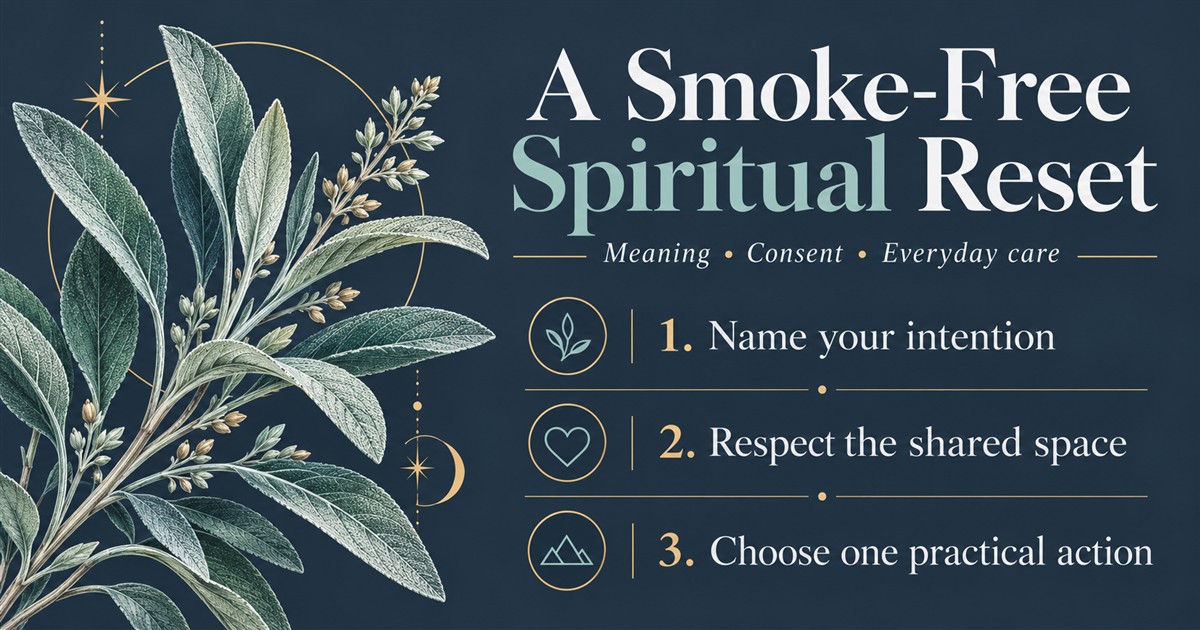
1. Name your intention
Choose a phrase in your own words: “I am making room for rest,” or “I want to respond more patiently.” You do not need to call the room contaminated or assume a frightening cause.
2. Respect the shared space
Ask before changing someone else’s room or belongings. Keep a clear exit and choose a quiet, unscented option if sound, scent or a ritual would be unwelcome.
3. Make one practical change
Put away one item, adjust comfortable lighting or prepare a useful place to sit. Address an actual hazard, repair or conflict directly rather than covering it with a ritual.
4. Close the moment
Pause, pray or listen to a familiar piece of music if you wish. Notice how the space feels without demanding an immediate emotional transformation.
Free personal reset planner
- My purpose: What would I like this pause to mark?
- Other people and animals: Whose comfort, permission or access do I need to consider?
- My option: Words, silence, light, music or one practical change?
- My action: One thing I can do that supports the intention.
- My review: What helped, and what still needs an ordinary solution or support?
Example: “After an argument I want a steadier evening. I will leave the shared room unscented, put away dinner things and arrange a calmer time to talk.” A ritual does not replace the conversation or require anyone to forgive before they are ready.
Objects, frequency and product choices
You do not need to pass jewellery, clothing, rune stones or every household object through smoke. Ordinary care should follow the material’s instructions; some objects do not tolerate heat, moisture or oils. Do not assume that a herb sold for burning is suitable to drink, apply to skin or use with animals.
There is no required daily or monthly cleansing schedule. Choose the frequency of your own reflective practice according to usefulness and circumstances, without feeling compelled to repeat it until uncertainty disappears. Ask sellers about plant identification and sourcing rather than assuming every product with the word sage is identical.
Our spiritual-reset guide connects symbolism with practical action. If you are preparing a reading, the one-rune reflection guide provides a separate way to frame a thoughtful question. Your intention can remain meaningful without smoke, a purchase or a promise that invisible harm has been removed.
Frequently asked questions
1. What does burning sage mean spiritually?
People may use it in an intention ritual or within a particular ceremony. Meaning depends on the tradition and person; smoke itself does not demonstrate that an invisible problem has been removed.
2. Is every sage-burning routine smudging?
Do not assume so. Smudging has particular Indigenous ceremonial contexts. Learn relevant protocols rather than presenting a generic personal routine as everyone’s tradition.
3. Do I need smoke for a spiritual reset?
No. You can use your own words, prayer, silence, comfortable light or a practical change to mark a moment.
4. Does more smoke make a ritual stronger?
There is no basis for using smoke volume as a measure of spiritual effectiveness. More smoke also means more exposure and is not a goal.
5. Does sage smoke purify indoor air?
Do not treat it as an air-cleaning method. Burning materials can add particles to indoor air, so use practical air-quality measures for actual air concerns.
6. Is opening a window enough to make burning harmless?
No. Ventilation does not guarantee that smoke exposure is suitable for everyone. Consider shared air, restrictions and smoke-free alternatives.
7. Should I wave smoke around my pet?
No. Choose a smoke-free approach around animals and do not use a ritual as care for an animal that seems unwell or unusually anxious.
8. Can I cleanse someone else’s room or belongings?
Ask permission before changing their space or involving their property in a ritual. A spiritual intention does not override someone’s boundaries.
9. Must I move clockwise?
A direction may have meaning in a particular practice, but there is no universal direction that proves energy has changed.
10. Is burning near a bed a good bedtime practice?
Avoid burning near bedding or where someone may fall asleep. A smoke-free pause or battery candle is a more suitable way to mark bedtime.
11. Should I turn off an alarm for a ritual?
No. Do not disable safety equipment. Choose an activity compatible with the space and its rules.
12. How often must I cleanse a room?
There is no required schedule for a personal reflection ritual. It need not become a repeated obligation or a way to chase certainty.
13. Can I use burning herbs as tea or skin oil?
Do not assume a product intended for one use is suitable for another. Check its identity, instructions and suitability rather than improvising ingestion or skin use.
14. Do all my crystals and jewellery need smoke?
No. Optional symbolism does not replace ordinary material care, and objects may be damaged by heat, moisture or oils.
15. What if the room still feels uncomfortable afterward?
Consider concrete needs such as lighting, noise, clutter, a repair, a difficult interaction or support. A ritual does not have to solve every feeling to be personally meaningful.