Quick answer
Runes were first writing systems, not a standardized fortune-telling code. Modern readers often give each rune an interpretive keyword, but those keywords should not be confused with a single ancient divination manual. A careful guide keeps historical letters, later rune-poem associations and contemporary reflective practice in separate layers.
Which runic alphabet are you using?
“The runic alphabet” is not one unchanged row. The National Museum of Denmark describes runes as a Germanic method of writing developed in the centuries after the beginning of the Common Era. Forms and sound values changed across regions and periods.
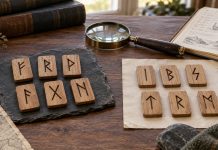
- Elder Futhark: a 24-character row used in early Germanic contexts, generally from the second century into the early medieval period.
- Younger Futhark: a 16-character row associated with the Viking Age.
- Anglo-Saxon futhorc: an expanded row used in England and Frisia.
- Medieval runes: later adaptations used alongside Latin writing.
This article focuses on the 24 Elder Futhark characters because that is the row most modern rune sets use. Calling it “the Norse alphabet” is imprecise: Elder Futhark predates the Viking Age, when Younger Futhark was widely used.
Where “meanings” come from
Runologists study inscriptions, language, archaeological context and later texts. The rune names and glosses familiar to modern readers are reconstructed or compared across sources such as the Old English, Norwegian and Icelandic rune poems. Those poems come from different periods and do not create one universal dictionary.
Modern divination adds another layer: readers turn a name or image—cattle, ice, gift, journey—into a prompt about contemporary life. That can be a reflective exercise. It is not evidence that the symbol predicts an event, diagnoses illness or carries a fixed spiritual force.
Elder Futhark reference: names, sounds and common prompts
The table uses conventional modern transliterations and widely cited name associations. Spellings and reconstructions vary. The final column is a modern reflective prompt, not an ancient guaranteed meaning.
| Rune | Conventional name | Sound / historical association | Modern reflection prompt |
|---|---|---|---|
| ᚠ | Fehu | f; cattle or movable wealth | What resources require responsible care? |
| ᚢ | Uruz | u; aurochs | Where can patient strength help? |
| ᚦ | Thurisaz | th; giant or thorn associations | Which boundary needs attention? |
| ᚨ | Ansuz | a; god or speech associations | What message needs careful checking? |
| ᚱ | Raidho | r; riding or journey | What is the next practical step? |
| ᚲ | Kenaz | k; glosses vary by tradition | What becomes clearer with evidence? |
| ᚷ | Gebo | g; gift | Is an exchange fair and freely chosen? |
| ᚹ | Wunjo | w; joy | What supports durable wellbeing? |
| ᚺ | Hagalaz | h; hail | What disruption can be prepared for? |
| ᚾ | Nauthiz | n; need or constraint | Which need is urgent, and which can wait? |
| ᛁ | Isa | i; ice | Would a pause prevent a rushed choice? |
| ᛃ | Jera | j/y; year or harvest | What process needs time? |
| ᛇ | Eihwaz | ï/ei; yew association | What helps you endure change? |
| ᛈ | Perthro | p; historical gloss uncertain | What uncertainty should stay open? |
| ᛉ | Algiz | z; name and gloss debated | What reasonable safeguard is available? |
| ᛊ | Sowilo | s; sun | Which goal can be stated clearly? |
| ᛏ | Tiwaz | t; the god Týr | What does fairness require? |
| ᛒ | Berkano | b; birch | What needs patient care to begin? |
| ᛖ | Ehwaz | e; horse | Which partnership needs coordination? |
| ᛗ | Mannaz | m; person or humanity | Whose perspective is missing? |
| ᛚ | Laguz | l; water or lake | Which feelings are facts, and which are signals? |
| ᛜ | Ingwaz | ng; the god Ing | What is developing before it is visible? |
| ᛞ | Dagaz | d; day | What new information changes the view? |
| ᛟ | Othala | o; inherited estate | What was inherited, and what may be changed? |
Three modern additions to label clearly
The blank rune
A blank “Odin rune” is a modern addition, not the twenty-fifth letter of Elder Futhark. If a set includes one, treat it as that maker’s optional symbol rather than historical evidence.
Reversed meanings
Upright-versus-reversed keyword systems vary among modern readers. Historical inscriptions can rotate or mirror characters for reasons unrelated to a negative forecast. A reversed tile does not establish illness, infertility, betrayal or another event.
Fixed spreads and yes-or-no rules
Past–present–future layouts, “all upright means yes” and named wheel spreads are contemporary methods unless a source demonstrates otherwise. They can organize reflection, but they cannot verify the future.
A source-aware way to use a modern rune set
- Name the system. Confirm whether the set uses Elder Futhark, Younger Futhark or another row.
- Ask an open question. Try “What factor have I overlooked?” rather than “Will this definitely happen?”
- Draw one to three tiles. Record the symbols before reading a guide so memory does not change the result.
- Use the prompt, not a promise. Write two plausible interpretations, including one that challenges your first reaction.
- Check reality. Verify dates, costs, consent, safety and professional advice independently.
- Stop when distressed. Repeated draws can amplify anxiety rather than improve a decision.
A rune reflection should never diagnose illness, promise pregnancy, tell someone to remain in abuse, predict death, replace legal advice or direct an irreversible financial choice. For broader context on comparing traditions without collapsing them, read Psychic Traditions Across Cultures. You can also browse the Rune Divination Articles archive while applying the historical distinctions above.
Why historical context improves a reading
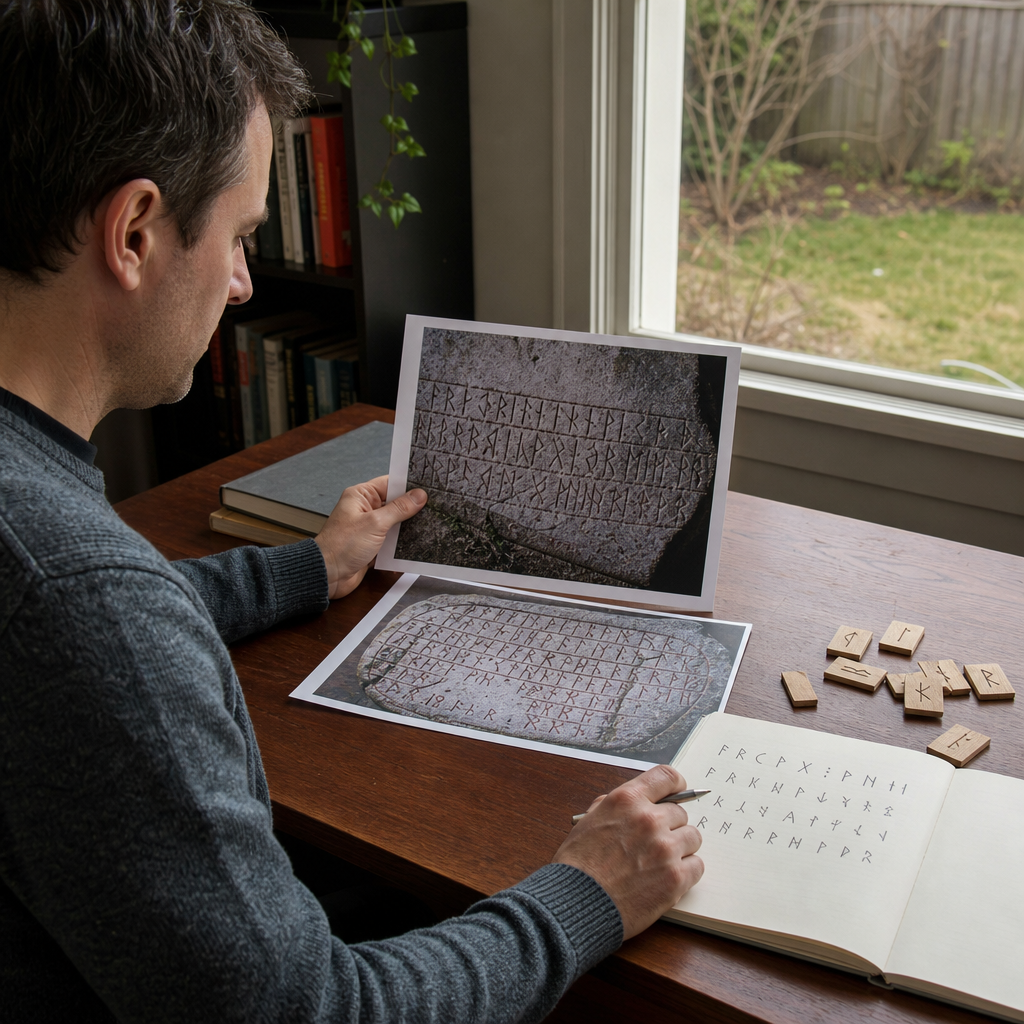
Uppsala University’s Rune Cast describes runes as a central writing system used for purposes ranging from names on objects to memorials and notes. The Swedish National Heritage Board’s Runor platform makes thousands of inscriptions available with images, find locations and readings. These records show real variety rather than one mystical script frozen in time.
The National Museum of Denmark also notes that sagas and later songs describe runic magic, while most surviving inscriptions contain practical, down-to-earth messages. This does not make modern rune practice invalid as personal reflection. It does mean historical claims should be narrower than spiritual interpretations.
Frequently asked questions
Were runes originally a fortune-telling system?
Runes were primarily writing systems used across different regions and periods. Some literary and inscriptional sources connect runes with magic, but most surviving inscriptions are not divination manuals.
Does every Elder Futhark rune have one fixed meaning?
No. Names, glosses and interpretations vary by source, language and period. Modern divination keywords are reflective conventions, not universally attested ancient definitions.
Is the blank Odin rune historically part of Elder Futhark?
No. Elder Futhark has 24 characters. A blank tile is a modern optional addition and should be labeled as such.
Can rune readings predict health, pregnancy or safety?
No rune draw can reliably predict or diagnose those outcomes. Use runes, if desired, for reflection while relying on qualified professionals and verifiable information for high-stakes decisions.

The mention of Norse gods and their association with runes adds an intriguing layer to the understanding of these symbols.
The historical significance of each rune provides context that is essential for meaningful interpretation.
‘The reversals of runes certainly add depth to their interpretation. However, it seems counterintuitive that some have no reverse meaning at all.’
While the historical context provided is valuable, it raises questions about the cultural appropriation of such practices in modern times.
‘Aett’ groupings are an interesting way to categorize runes, but do they truly encapsulate their multifaceted meanings?
‘Utilizing tools like rune spreads invites a sense of mystery and fate into one’s life journey; yet I wonder how much control we actually retain.’
That’s a profound consideration. The balance between fate and free will is often debated in metaphysical discussions.
The concept of interpreting runes as a way to connect with past lives is fascinating. However, one must wonder how subjective these interpretations can be.
That’s an important point. Perhaps a standardized approach could enhance credibility among practitioners.
Indeed, the subjective nature can greatly influence the outcomes. How do we ensure consistency in interpretation?
The exploration of runes as a form of divination, is quite intriguing. It’s interesting to see how ancient symbols can still hold meaning today.