


Quick answer
Runes are used for divination by drawing one or more of the 24 Elder Futhark tiles and using the traditional association of each as a prompt for thinking about a question. The exercise below is a modern reflection method. A tile does not independently reveal unknown facts or reliably predict an outcome. Our full one-rune procedure is here: Using runes for divination. This page gives a worked example so you can see what a good reading looks like on paper.
A worked example
This invented example shows how someone could record a reading; it is not a report of a client session or firsthand test.
| Step | What was written |
|---|---|
| Question (before drawing) | “What am I not seeing about whether to take the part-time course?” |
| Draw (before looking anything up) | Nauthiz ᚾ, upright |
| Traditional association | Need or constraint: a modern prompt informed by the related Nyd stanza in the Old English Rune Poem. The poem belongs to the Anglo-Saxon tradition; it is not an instruction manual for drawing Elder Futhark tiles. |
| Interpretation 1 (first instinct) | “I need this course to get out of my current job.” |
| Interpretation 2 (the one I did not want) | “The constraint is time and money, and I have not actually added up either.” |
| Reality check | In this fictional scenario, the course requires two evenings a week for eight months. The learner checks the actual fees, timetable and payment terms before deciding. |
| Action (small, dated) | “Draft a weekly timetable by Sunday and see if two evenings really exist.” |
Notice what the tile did and did not do. It did not say whether to take the course. Its chosen association supplied a word, need, which the learner turned into two questions and checked against practical information. The value of the exercise depends on those questions and checks, rather than accuracy attributed to the draw.
Three ways readings go wrong
- Closed questions. “Will I pass?” has no honest rune answer. “What would help me prepare?” can invite useful reflection alongside a real study plan.
- Redrawing. If Nauthiz feels unwelcome and you draw again, you are no longer reflecting; you are shopping.
- Treating the tile as a verdict. The reversed Fehu in the drawer is not why the bank said no. Runes describe; they do not cause or predict.
Where to go next
Once the one-rune method is comfortable, a three-tile approach gives you situation, obstacle and direction in one sitting, and the meanings table in Understanding runes and the meanings gives every tile a source-aware prompt.
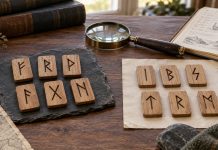
Image note: The featured wooden pendant has a modern decorative composite design. It is not the single Nauthiz character used in this example, a verified ancient object, or evidence of protective power.
Frequently asked questions
Does this example describe a real paid session?
No. It is an invented teaching example that demonstrates a record of a question, symbol, alternatives, evidence check and next step.
Why write down two interpretations?
Two interpretations make it easier to notice an assumption you prefer and a practical constraint you might overlook. Neither interpretation is a prediction; compare both with independent facts.
Should I redraw if I dislike the rune?
Keep the first draw for the exercise and record your reaction. Agree on any redraw rule in advance rather than repeatedly drawing until a preferred answer appears.
Can the rune decide whether I should take a course?
No. Compare the actual fees, timetable, prerequisites, likely benefits and your circumstances. A symbolic prompt can help you ask questions, but it should not replace that decision process.


‘Wyrd’ or Odin as a concept is intriguing; however, the interpretive nature of runes may lead to vastly different conclusions depending on the reader’s perspective.
The practice of rune reading indeed raises questions about intuition versus structured guidance. Is it not possible that both elements play a crucial role in decision-making?
The history of runes is quite fascinating, yet the transition from their use to Latin seems a bit abrupt to me. One wonders how societies adapt to changes in communication methods over time.
Interesting article on runes and their usage in divination. However, I question the extent of their magical properties, as it appears more subjective than objective in nature.
‘The Circle’ and ‘The Cross’ as patterns for interpretation sound like valuable frameworks, but does this not also introduce limitations on one’s understanding of complex situations?
‘Intuition’ plays a vital role here; nonetheless, the ambiguity surrounding rune meanings suggests that clarity might not be as attainable as implied by practitioners.
The connection between ancient artifacts and modern practices is compelling. Yet, one might argue that relying on such tools for guidance could hinder personal growth rather than facilitate it.
It is notable how runes are utilized today by psychics and mediums. Still, there seems to be a lack of empirical evidence supporting their effectiveness in providing insights.