


Quick answer
A rune reading can be understood as a prompt-based conversation: a draw supplies a symbol, a reference supplies associations, and the reader connects them with a question. This may help some people organize their thoughts, but a meaningful interpretation does not establish prediction or supernatural access. The safety and usefulness of a session depend on how it is conducted. Our full one-rune procedure with source labels and evidence checks is here: Using runes for divination. This page compares the observable steps with tarot and hand-held pendulums.
What actually happens in a reading
- You state a question. Writing a specific question can clarify what information or choice you actually need.
- You draw a tile at random. A blind draw can offer an unplanned starting point. It does not guarantee a new insight, and a cast can be influenced by handling and selection rules.
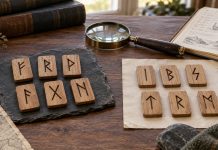
- You meet a symbol with a history. Fehu is cattle and wealth; Isa is ice; Hagalaz is hail. The name, historical source and modern interpretation should be identified separately; a familiar keyword can fit many different situations.
- You interpret. This is where the reading happens. Your knowledge of the situation, your worries and your hopes shape what “ice” means today. A good reading makes that explicit by writing two interpretations, one of which you did not want.
- You decide. The reading ends with an action you choose. The tile did not choose it.
Runes, tarot and pendulums: same family, different mechanics
| Tool | Source of randomness | Symbol set | Main risk |
|---|---|---|---|
| Runes | Blind draw or cast | Often 24 Elder Futhark characters; other alphabets differ. Modern prompts may draw on later rune poems | Reading a reversed tile as a bad omen |
| Tarot | Shuffle and cut | 78 pictures with layered modern symbolism; richer, slower to learn | Ominous cards (Death, the Tower) frightening the reader |
| Pendulum | Movement can arise from small hand motions, including ideomotor responses, and ordinary physical influences | Often yes/no; charts may offer additional options | Attributing movement to an external answer without testing expectation and physical causes |
For a hand-held pendulum, motion itself does not identify its cause. Experimental work on ideomotor pendulum movement shows how thought and expectation can contribute to subtle movements. That finding does not make a pendulum a reliable detector of unknown facts. A rune or card draw also needs an evidence check: surprise is not accuracy.
What this means for how you use them
- Ask open questions (“what am I overlooking?”), not closed ones (“will it work out?”).
- Write the tile before the meaning, and the meaning before the decision.
- Use it for choices between acceptable options, never for health, money, legal or safety decisions.
- If a reading frightens you, pause it and review the interpretation with someone you trust. The draw does not establish a threat, curse or inevitable event.
For a concrete record of alternatives and a practical next step, see the worked one-rune example.
Image note: The balanced stones are decorative imagery for reflection. They are not rune tiles or evidence of spiritual energy.
Frequently asked questions
Why can a random rune feel relevant?
Broad symbolic associations can connect with concerns already on your mind. Personal relevance can be useful for reflection, but it does not prove that the draw detected a fact or predicted an event.
Does randomness make a reading accurate?
No. A random starting point and a correct factual answer are different things. Check interpretations against independent information and record misses as well as apparent matches.
Why might a pendulum move without deliberate effort?
Small hand movements, including ideomotor responses associated with expectation, can produce visible motion. Balance, handling and other physical influences can also matter; movement alone does not show an external message.
What makes the exercise easier to evaluate?
Write the question, exact draw, source, two interpretations and a practical evidence check before acting. Keep the original record so you can compare outcomes without rewriting the prediction afterward.


‘Reading down from left to right’ signifies an orderly thought process; perhaps this mirrors cognitive approaches in other fields such as psychology?
‘Returning all stones to bag for rephrasing question’ reflects a deeper philosophical engagement with inquiry itself, which is often overlooked in spiritual practices.
It appears that traditional meanings and personal interpretations coexist in the practice of rune reading; how can one discern which holds more validity?
‘Overall energies/lessons’ is an intriguing notion; it raises questions about determinism and free will.
‘Receptive hand’ is a term that seems somewhat vague; perhaps it could benefit from further elaboration.
‘Date, time and place’ documentation serves to ground the mystical experience within reality; this raises questions about the intersection of spirituality and empirical observation.
Indeed, it prompts discussions on how we define validity in both spiritual and empirical frameworks.
There seems to be various interpretations of the symbols, which complicates the reading process.
The utilization of rune stones in divining does raise inquiries regarding the empirical basis for such practices, however, there is undeniable cultural significance.
Indeed, the intersection of cultural practices and personal interpretation is fascinating, yet we must consider how subjective experiences shape these understandings.
I agree with both points, it’s imperative to approach these topics with an open yet critical perspective.
The concept of rune stones as divination tools, it’s intersting to see their history and application.
‘Focus your mind’ appears to be a common theme in many divination practices, suggesting its significance.
The methodolgy outlined for single stone reading is quite thorough; however, clarity may vary.
‘Four Stone Reading’ could arguably offer a more comprehensive insight into one’s life events. Yet, what of those who may lack understanding of the symbols?
I wonder if the process of shuffling stones can truly influence the outcome in any meaningful way.
‘Single Stone Reading’ presents an interesting methodological approach; however, I wonder about the potential biases introduced by selecting only one stone.
‘Clear and focus your mind’ seems to be a mantra throughout many spiritual practices; its importance cannot be understated in achieving clarity during readings.