


Quick answer
A mantra can structure attention, memory, prayer or meditation, but repeating a sound does not guarantee healing, remove a curse or make the universe deliver an outcome. The word is used across several South Asian religious and contemplative traditions as well as in modern secular wellness. Those uses should not be collapsed into a generic “high vibration” technique.
If you want to use repetition in daily life, first decide which kind of practice you mean: a traditional sacred recitation learned in context, a nonreligious meditation sound, or an ordinary cue phrase that reminds you of a chosen action. The source, purpose and boundaries are different.
Mantra, affirmation and cue phrase are not the same
| Practice | Main purpose | Respectful boundary |
|---|---|---|
| Traditional mantra | Recitation within a religious, ritual or contemplative lineage | Learn pronunciation, meaning, deity or textual context from a qualified community source |
| Mantra meditation | Repeated sound or phrase used as an attentional anchor | Do not assume every method is interchangeable or promises the same outcome |
| Affirmation | A meaningful statement intended to influence self-talk | Use believable language; a sentence is not proof that an outcome will occur |
| Cue phrase | A brief reminder linked to a specific behavior | Pair it with an observable action, such as pausing before replying |
The Smithsonian’s National Museum of Asian Art describes a mantra as powerful sacred syllables and a mala as prayer beads used during recitation. That museum context is a useful reminder: these objects and sounds are not merely accessories for “raising energy.” Traditions vary, and a bead count such as 108 or 27 can carry specific meanings and practices rather than functioning as a universal dose.
Choose one of three responsible pathways
1. A traditional or devotional practice
If you are drawn to japa, deity mantras, the Gayatri mantra, bija syllables or a practice associated with Hindu, Buddhist, Sikh or Jain communities, begin with a teacher, temple, center, text or scholar connected to that tradition. Ask about pronunciation, translation, initiation expectations, when the recitation is used and whether public sharing is appropriate.
Do not copy a sacred formula because a lifestyle page assigns it to a body part, chakra or consumer goal. “Deity mantra” does not mean a sound that anyone can detach from worship and repurpose for money, romance or medical treatment. Respect also means not reproducing a full sacred verse merely to fill a keyword page.
2. A nonreligious repetition meditation
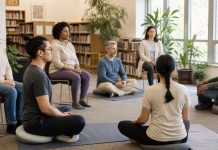
Choose a neutral sound or short word that has no claimed sacred provenance. Sit in a stable chair or supported position; floor sitting is optional. Set a short timer, repeat quietly, and return gently when attention wanders. Start with two to five minutes rather than forcing a 20-minute session. Record comfort, mood and unwanted effects without treating calmness as proof of altered “vibration.”
A branded method may have its own instruction system. For example, Transcendental Meditation should not be reconstructed from random mantra lists; our evidence and safety guide to official TM explains that distinction.
3. A practical cue phrase
Write a short, believable reminder tied to a behavior you control:
- “Pause, then answer” before a difficult conversation
- “One page now” before a study block
- “Feet on the floor” during an ordinary grounding pause
- “Ask before assuming” when relationship anxiety rises
Repeat the phrase once or a few times, then perform the action. Review the result later. This is a habit cue, not a sacred mantra and not a promise that repetition alone changes external events.
What research can support
The National Center for Complementary and Integrative Health (NCCIH) describes mantra repetition as one of several meditation approaches. Its evidence overview says some meditation practices may help with certain stress, anxiety, depression, pain or sleep outcomes, but study methods vary, results can be mixed and findings are sometimes interpreted too optimistically.
A systematic review of mantra-based meditation reported small-to-moderate improvements in several mental-health measures. The authors also emphasized risk of bias, limited psychiatric samples, little long-term follow-up and inadequate study of adverse effects. That supports cautious language: a practice may help some people with attention or stress, but it does not reliably cure a disease, repair an organ, prevent illness or replace treatment.
Claims to remove from a mantra routine
- “Low vibration causes bad events.” Hardship is not proof of spiritual failure, and positive emotion does not create immunity from illness or loss.
- “A sound heals a body part.” Humming may feel soothing, but syllables assigned to the sinuses, ears, eyes, throat or jaw are not medical treatment.
- “Chakra imbalance causes disease.” Chakras can be meaningful within spiritual frameworks, but they are not anatomical diagnoses.
- “A mantra cures snakebite.” A snakebite is an emergency. The CDC advises seeking medical attention immediately and not delaying for folk remedies.
- “More repetitions guarantee a result.” Counts can serve ritual or attentional purposes; they are not a biological dose.
- “The correct phrase manifests money or love.” Repetition cannot override another person’s consent or guarantee external events.
Safety and stop conditions
Meditation is often low risk, but unwanted experiences occur. NCCIH notes that few studies assess harms and cites reported effects including anxiety and depression. Stop or shorten practice if you become panicked, disoriented, unusually agitated, detached from reality or unable to sleep or function afterward.
Seek prompt professional help for persistent distress, major sleep change, mania, paranoia, hallucinations or command-like experiences. Do not chant while driving or in water. If vocal repetition causes pain, dizziness or shortness of breath, stop; do not force prolonged breath holding or volume. A short sensory grounding option with clearer mental-health stop conditions is available in our grounded meditation safety guide.
A seven-day observation plan
- Choose one pathway: traditional study, neutral meditation or a cue phrase.
- Write the purpose in one sentence without promising an outcome.
- Set a modest duration or repetition count that does not cause strain.
- Record the time, context and what you actually did.
- Note one immediate effect and one unwanted effect, including “none.”
- Track the behavior you hoped to support, not mystical signs.
- After seven days, continue, adapt or stop based on fit—not sunk cost or fear.
Frequently asked questions
Can a mantra heal a body part or cure an illness?
No specific sound has been established as a cure for the sinuses, ears, eyes, throat, jaw, snakebite or another condition. Repetition may feel calming for some people, but it should not replace diagnosis, emergency care or treatment.
Is a positive affirmation a traditional mantra?
Not necessarily. An affirmation is usually a meaningful self-statement, while many traditional mantras are sacred syllables or formulas embedded in particular religious and ritual contexts. Name the practice accurately.
Do I need 108 beads or repetitions?
No universal count applies to every practice. Counts and malas can have specific meanings within a tradition. For a secular attention exercise, use a short, comfortable duration and avoid presenting it as traditional japa.
What if repeating a mantra makes me anxious or detached?
Stop, orient to your surroundings and use ordinary support. If distress persists or includes severe anxiety, major sleep change, mania, paranoia, hallucinations or impaired functioning, contact a qualified health professional.



‘Mantra vowels’ provide an intriguing perspective on phonetics within healing practices. However, exploring why specific sounds resonate with certain emotions would add depth to this discussion.
‘Japa’ as a practice invites curiosity regarding its historical significance across cultures. Understanding its origins could enhance contemporary applications.
‘Healing mantras’ as a concept seems appealing, yet I find it necessary to approach such assertions with a critical lens. Anecdotal evidence does not equate to scientific proof.
The mention of chakras and their influence on physical health raises questions about the validation of such systems in modern medicine. More rigorous studies would be beneficial.
‘Sound healing’ has gained traction in wellness communities, yet one must consider the psychological components involved in these experiences beyond mere sound frequencies.
The concept of mantras as tools for healing and energy alignment appears to be rooted in various cultural practices. However, the scientific basis behind these claims remains somewhat elusive.
Indeed, the intersection of spirituality and science is a complex field. While subjective experiences may validate the practice, empirical evidence is often lacking.
It’s interesting how vibrations are framed within this context. One might wonder how subjective perceptions of sound correlate with measurable frequencies.
‘Deity mantras’ illustrate the blend of culture and spirituality but also prompt inquiries about their efficacy outside religious contexts. How do we assess their impact?