
Quick answer
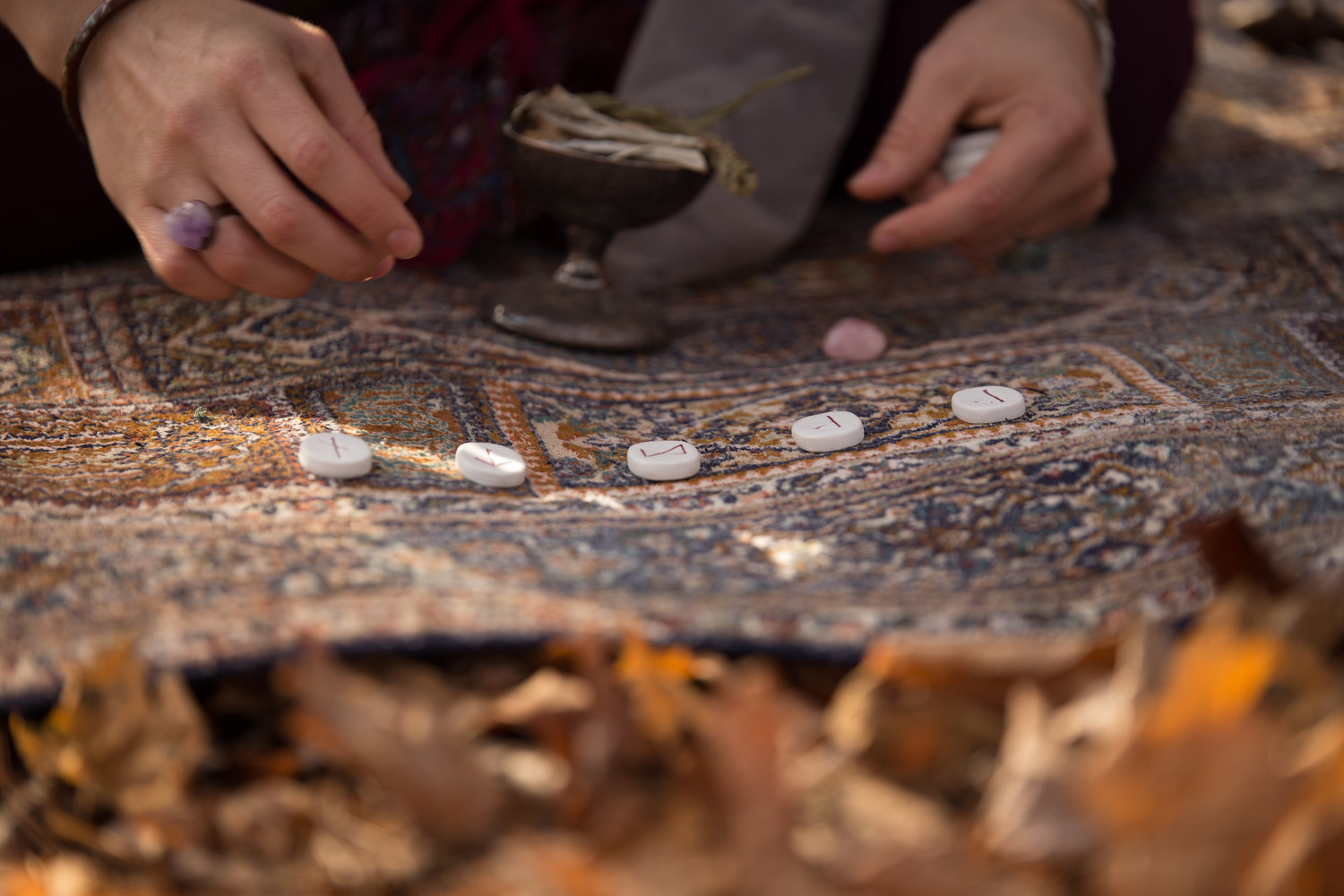
Rune casting means scattering tiles onto a cloth and reading the ones that land face up inside a marked area; drawing means pulling one to three tiles from a bag. Both are modern reflection methods using the 24 Elder Futhark characters, not a way to see the future or make “life-altering decisions” for you. Our full guide gives the complete procedure with boundaries, inclusion rules and recording steps: Casting runes. This page is a first-session checklist and a comparison of casting with drawing.
Casting or drawing: which to start with
| Drawing from a bag | Casting onto a cloth | |
|---|---|---|
| Number of tiles read | One to three, chosen by you | Whatever lands face up inside the boundary; can be none or ten |
| Consistency | High: same method every time | Low unless you fix rules in advance (boundary, orientation, touching tiles) |
| Best for | Beginners; a daily prompt; one clear question | Experienced users who enjoy pattern-reading and have written rules |
| Main risk | Redrawing until you like the answer | Reading whatever pattern confirms what you already thought |
| Recording | Write the tile before looking up a meaning | Photograph the cloth before touching anything |
Start with drawing. Move to casting only once you have a written rule sheet, because without rules a cast can be read to mean anything, which is the same as meaning nothing.
First-session checklist
- Confirm the set. Count 24 tiles and check they are Elder Futhark (ᚠ ᚢ ᚦ ᚨ ᚱ ᚲ …). A blank tile is a modern extra; set it aside or keep it as a spare. See the blank rune debate.
- Write one open question. “What am I not seeing about the job offer?” works. “Will I get the job?” does not; runes cannot answer it.
- Draw one tile without looking. Write down which one, and whether it is upright or reversed, before opening any guide.
- Read the traditional name and association. Fehu is cattle and movable wealth; Isa is ice; Raidho is riding. Use the table in Understanding runes and the meanings.
- Write two interpretations, one of which disagrees with your first instinct.
- Choose one small, reversible action and date it. Then put the tiles away; do not redraw.
Three claims from the old version of this page, corrected
- “Rune casting helps individuals make life-altering decisions.” It can help you think. Life-altering decisions need facts, advice from people who know the field, and time.
- “Runes show what is likely to happen.” No controlled test has found any divination method predicting events beyond chance. Treat every reading as a prompt.
- “The cast is not random; your unconscious chooses.” A cast is random. The interpretation is where your mind contributes, which is exactly why it is useful for reflection and useless for forecasting.
The full casting procedure
Boundaries, inclusion and orientation rules, exact recording, evidence checks and decision limits, step by step.


I find it curious how runes can symbolize different meanings yet still maintain a degree of ambiguity. This duality might be essential to their appeal as a divination tool.
It appears that the interpretations of runes vary widely among practitioners. This variability might indicate that personal intuition plays a significant role in the reading process.
The concept of runes as guides rather than definitive answers is intriguing. However, one must consider the psychological effects of relying on such tools for decision making.
‘Mystery’ is a fitting description for runes. It seems they embody both ancient wisdom and personal interpretation, creating an enigmatic experience for users.
The way you describe casting runes suggests an intricate connection between one’s subconscious and the choices made during the reading process.
‘Biases’ indeed play a role in many interpretative practices, not just in rune readings but also in more conventional forms of analysis.
‘Subconscious choices’ is an interesting phrasing; does this imply that our biases influence our interpretations, perhaps unconsciously?
The mention of rune stones being adopted from Germanic alphabets raises questions about cultural appropriation and the evolution of such practices over time.
‘Guide us through problems’ is a potent statement; it suggests that even tools deemed mystical can have practical applications in modern life.
‘Blank runes’ present an interesting debate on validity; they could symbolize limitless possibilities or merely uncertainty—how does one approach such ambiguity?