

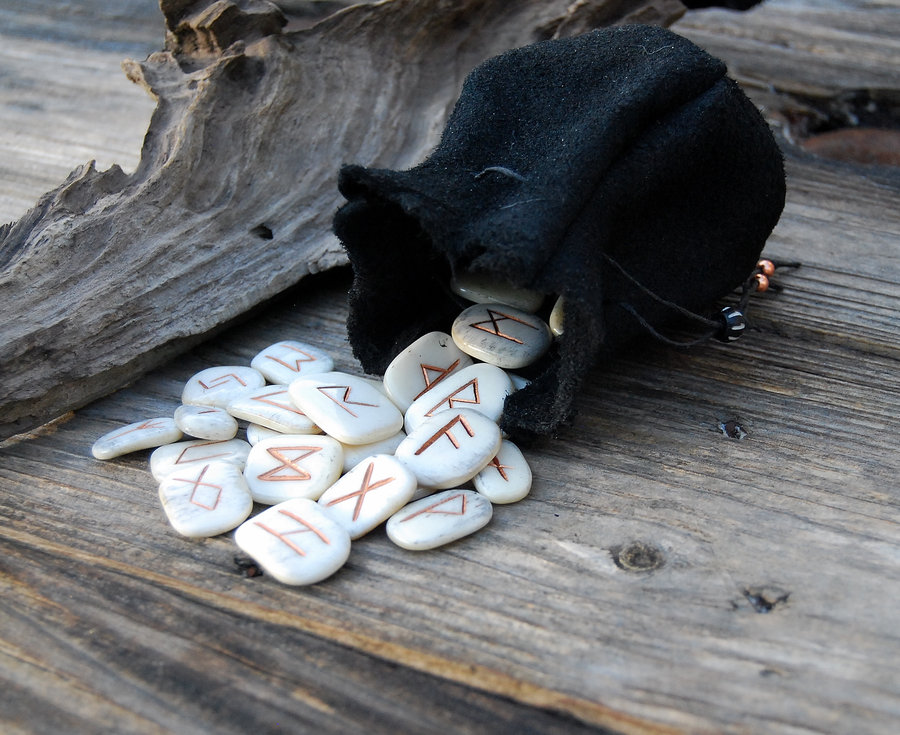
Quick answer
There are four simple ways to read runes as a reflection practice: a single daily draw, a three-tile row, a small cast onto a cloth, and a written question-and-answer using the meanings table. The examples use the 24 Elder Futhark characters as modern prompts, not reliable forecasts. Our full step-by-step procedures, with recording and evidence checks, are here: 4 easy procedures of how to read runes. This page is the short version, with a short historical clarification.
The four methods in one table
| Method | Suggested time | How | Best for |
|---|---|---|---|
| 1. Single draw | 5 minutes | One open question, one tile from the bag, one line written before you look up a meaning, one small action | Daily practice; building a journal |
| 2. Three-tile row | 10 minutes | Positions fixed in advance (situation · obstacle · direction); draw left to right; write two interpretations for each | A bounded, low-stakes question |
| 3. Small cast | 15 minutes | Draw five to seven tiles, drop them onto a cloth with a marked boundary, read only face-up tiles inside it, photograph before touching | Open-ended reflection on a long situation |
| 4. Table reading | 10 minutes | No draw. Read down the meanings table and note which three runes describe your situation best; write why | When you want the vocabulary without the randomness |
Rules that apply to all four
- Write the question before you draw and the tile before you interpret.
- Set a stopping rule before starting. Repeated draws can encourage answer-shopping; another tile is not stronger evidence.
- Write at least one interpretation that disagrees with your first instinct.
- End with a small, dated, reversible action. Then stop.
- Keep health, money, legal and safety questions for professionals. A rune reading is a prompt, not advice.
A historical clarification
Early runic inscriptions belong to the first centuries CE, but the exact invention place and route of adoption are debated. Do not assign the entire script to one people from an unsupported origin story. Christian runic objects and inscriptions also survive: the National Museum of Denmark discusses medieval Christian as well as magical contexts. Their survival does not prove there was never local hostility, nor one simple reason Latin writing became dominant. For an approximate chronology see The history of runes.
Use the record, not just the story
Keep the question, selected characters and interpretations together. Add a relevant ordinary fact, an alternative explanation and something that would change your mind. Table reading deliberately selects symbols rather than testing an oracle; note that distinction. You may skip the exercise if it adds no value. Do not use it to diagnose illness, make consequential decisions or infer someone else’s private intentions.
Frequently asked questions
Do I need to draw tiles to use these methods?
No. The table-reading option deliberately selects symbols for vocabulary and reflection. Record that it is a chosen comparison, not a random draw or a test of prediction.
Which method is the simplest?
A single draw has the fewest moving parts. Use one low-stakes open question, record the tile and an alternative interpretation, then choose an ordinary reversible action or no action.
Are the suggested times and casting rules ancient requirements?
No. They are modern example rules and suggested limits. Declare the method before starting; a different duration or arrangement does not reveal greater spiritual power.
Should I repeat a draw until it makes sense?
Set a stopping rule first and avoid repeated reassurance-seeking. Confusion or fear is a reason to stop and check facts, not evidence of a curse or a need for paid remedies.


It seem that runic systems do have a significant impact on modern esoteric traditions, perhaps more then we realize.
Indeed, the shift from paganism to mainstream acceptance is quite interesting and warrants further examination.
I wonder how these ancient practices can be reconciled with contemporary beliefs in spirituality and divination.
The history of runes, if one consider it deeply, reveal much about cultural evolution and spiritual practices.
‘Methods of using runes can be subjective; however, it’s crucial to approach them with an open mind for better clarity.
‘Blank’ as a characteristic of Elder Futhark shows how ambiguity plays a role in interpretation of runes.
‘Secret’ or ‘mystery’ as meanings behind the word rune is quite fitting given their elusive nature in historical context.