

Quick answer
The truth about runes is less mysterious and more interesting than most websites suggest: they are a family of historical writing systems with names, memorials, messages and some magical uses. Contemporary bag-drawing practices should not be assumed to reproduce an ancient method. Our full introduction is here: What are runes and what’s their use?. This page sets ten common claims against what the evidence shows.
Ten claims, checked
| Claim | Verdict | What the evidence shows |
|---|---|---|
| “Rune” means mystery or secret | Partly true | The word is related to Germanic terms for secret, whisper or counsel. That tells you how the word was used, not what the letters were for. |
| Runes are an ancient divination system | Too broad | Runes are historical letters. Magical uses and later literary accounts do not establish that every modern rune-reading method is an ancient practice. |
| Tacitus described rune casting in 98 CE | Unproven | Tacitus describes Germanic lot-casting with marked wooden strips. He does not identify the marks as runic letters. His account alone cannot establish an unbroken method connecting that rite to a modern bag draw. |
| Odin discovered the runes by hanging on the World Tree | True as myth | The Hávamál, a poem preserved in a 13th-century Icelandic manuscript, tells this story. It is a myth about the origin of wisdom, not a historical account. |
| Runes were used for magic | Partly true | Inscriptions include ordinary writing and expressions interpreted as protective or magical. Sagas are a further, later literary source; neither kind of source demonstrates that the claimed magic worked. |
| The blank rune is the 25th rune of the Futhark | False | An unmarked tile is not a character in the 24-letter Elder Futhark. It may be a modern reading choice or spare token, not evidence of a historical 25th letter. |
| Reversed runes have opposite meanings | Modern convention | Optional modern reading conventions are not universal historical rules. An inscriptional orientation does not by itself establish an opposite divinatory meaning. |
| Each rune has a fixed meaning | False | The alphabet family, language and source matter. Later poems offer varied images, not a single keyword list covering every rune tradition. |
| The Vikings wrote in Elder Futhark | False | The 16-character Younger Futhark is characteristic of Viking-Age Scandinavia. The change was a historical transition, not a universal overnight replacement of every older form. |
| Runes can predict the future | Not established | The historical sources do not demonstrate reliable prediction. Personal matches are not controlled evidence; modern prompts may be meaningful without being forecasts. |
Why the truth is still worth your time
None of this makes rune practice pointless. A set of symbols with historical associations may be an optional tool for stating a question and looking at it from another angle, as long as you know what you are holding: letters with stories attached, and a modern method for using them. The honest version is described in Using runes for divination.
Where to check a claim
For lot-casting, compare Tacitus, Germania chapter 10 with the claim being made: marked pieces are not explicitly identified as runes. For writing and magic, the National Museum of Denmark’s account separates inscriptional evidence from later literary stories. Ask which source, alphabet and period are involved before accepting a universal rule.
Frequently asked questions
Were runes letters or magical symbols?
They were letters in related historical writing systems. Some inscriptions and later stories have magical contexts, but that does not make all runic writing magical or prove supernatural effects.
Did Tacitus describe the same rune casting used today?
His account describes marked pieces used for lots, without identifying the marks as runic letters. It does not establish that a modern bag-drawing method is the same practice.
Is a blank tile an ancient 25th Elder Futhark rune?
No. It is not a letter in the 24-character Elder Futhark. A modern set may include an unmarked tile as a reading choice or spare, which should be labelled accordingly.
Can runes still be meaningful without prediction?
Yes, personally. You may use historical study, craft or clearly labelled reflection without claiming a reliable forecast. Keep important decisions grounded in ordinary evidence and appropriate advice.


‘Divination sticks’ and their relation to playing cards prompt a discussion about cross-cultural influences in divination methods throughout history.
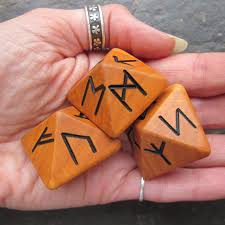
‘Rune dice’ sounds fascinating but trivializes the profundity these symbols carry. Is that a valid interpretation?
It is quite intriguing to see the evolution of runes from their ancient uses to modern practices. Yet, I wonder if the authenticity of their meanings are still preserved.
Indeed, the transition from wood to ceramic and cards raises questions about authenticity and original context.
I agree, the cultural appropriation of ancient symbols for contemporary use can distort their meanings significantly.
‘Each rune has many possible interpretations’, yet how can one be sure to access the correct meaning? This ambiguity fascinates me.
The concept of runes as divinatory tools is intresting. However, one must ask how much of this is rooted in historical fact rather than modern interpretation.
‘The clarity and definition’ offered by runes seems compelling, yet I question whether such clarity can be universally accepted among practitioners.
‘Runestones’ being described as not stones at all is a bit perplexing. What are we to make of that in terms of historical accuracy?
‘Manifest qualities that are archetypal’ suggests a profound connection between human experience and these symbols. Can they truly encapsulate such depth?