

Quick answer
One common contemporary rune practice uses tiles marked with the 24 Elder Futhark characters as prompts for thinking about a question. Interpretations combine historical names with modern conventions. The layouts below are declared modern options, not a verified reconstruction of one ancient rite or a reliable way to learn what will happen. Our full guide to layouts, from one tile to a full cast, is here: Reading runes. This page summarises three example layouts for beginners, the three-, five- and nine-rune casts, and what each is for.
Three layouts, compared
| Layout | Positions | Good for | Watch out for |
|---|---|---|---|
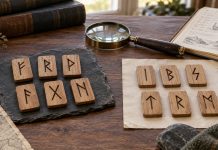
| Three runes in a row | Situation · challenge · possible action (or past · present · direction) | A bounded, low-stakes question | Reading the third tile as “what will happen”; it is a suggestion, not a forecast |
| Five-rune cross | Centre: the matter · left: past · right: what could help · top: what to accept · bottom: an assumption to check | A decision with several moving parts | Five tiles produce five stories; write the positions down before you draw |
| Nine-rune cast | Nine tiles scattered on a cloth; you may predefine centre tiles as the main topic and touching tiles as linked prompts; omit face-down tiles or assign a role in advance, without treating them as hidden outside forces | Open-ended reflection on a long situation | Almost any pattern can be made to fit; only use it with written rules and a photograph |
A larger layout gives you more prompts, not more accuracy. If a three-rune reading has already covered the question, stop there.
What a set includes, briefly
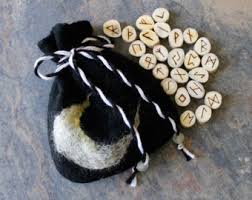
- 24 tiles in wood, stone, glass, clay or bone. Choose for handling, durability, cost and clear markings, not promised supernatural power.
- A bag or box so tiles are not lost.
- A cloth, optional, mainly to define a boundary for casting and to protect the tiles.
- A booklet of meanings, which may mix source material with a modern author’s keywords. Use our source-aware meanings table alongside it.
- Sometimes a blank tile, which is not a letter in the 24-character Elder Futhark. Declare it an optional modern choice or use it as a spare.
Two interpretation limits
- “Runes show you what is likely to happen.” A cast is not reliable evidence of a future event. You may find it helpful for stating a question or considering alternatives, but personal matches do not establish predictive accuracy.
- “The cast is not random; your subconscious chooses.” Shuffling and handling may introduce chance and bias. Neither proves that a subconscious or spiritual agent selected the tiles. Your interpretation supplies associations, which may or may not be useful.
Before and after a draw
Write the question, position roles and stopping rule first. Afterward, record at least one alternative interpretation and one fact that could contradict your preferred story. Choose an ordinary, reversible next step; do not redraw until the answer feels reassuring. Keep medical, legal, financial and safety decisions outside the cast, and do not infer another person’s private intentions.
The National Museum of Denmark’s discussion distinguishes inscriptional uses from later magical stories. Neither supplies historical authority for the exact three-, five- or nine-position rules above.
Frequently asked questions
Which layout should a beginner try?
A small three-position layout can keep a low-stakes question bounded. Define the roles before drawing; the third position is a possible action or question, not a forecast.
Is a nine-rune cast more accurate?
More tiles offer more possible stories, not established predictive accuracy. Use fixed rules and a record, and stop if the exercise becomes confusing or compulsive.
Do these layouts come from one ancient method?
The examples are contemporary reflective options. Historical writing and later magical accounts do not establish these exact positions as one unchanged ancient practice.
What if a draw frightens me?
A frightening interpretation is not evidence of danger, illness or a curse. Stop the exercise, check ordinary facts and seek appropriate support for ongoing distress; do not pay for fear-based remedies.

‘Runes can be used in many different situations,’ suggests versatility in their applications, making them relevant across contexts.
The guide suggests starting with one rune is insightful; simplicity often aids comprehension when exploring complex topics.
Starting simple allows for gradual understanding; it’s much like learning any new skill or concept.
One must appreciate the symbolism behind each rune to develop deeper insights into personal issues.
The material of runes seems crucial, as it adds a personal touch to their significance; one might even say it’s part of their energy.
The mention of different runic alphabets is a key point. The adaptation from Elder Futhark to Anglo-Saxon is particularly notable, as it shows linguistic growth.
‘When you cast the runes, it’s not fortune-telling.’ This distinction is important for those seeking genuine insights rather than mere predictions.
‘Looking for possible causes and effects’ aligns with many philosophical perspectives on free will versus determinism.
‘Each rune has symbolic meanings too,’ which emphasizes the need for personal interpretation and connection to the symbols.
‘Rune’ meaning mystery adds depth to its usage in divination. It’s intriguing how language shapes belief systems and practices.
I find it fascinating that the runes have such a rich history in various cultures. It would be interesting to explore how these practices have evolved over time.
Indeed, the evolution of divination methods reflects cultural shifts and adaptions, which is worthy of further study.
‘Runic readers acknowledge that future isn’t fixed’ is a compelling statement; it underlines the human capacity for choice and change.