

Quick answer
A modern rune set can be bought or made as a writing, study or reflection tool, but the material does not absorb magical power and the tiles do not provide verified predictions. Historical runes were characters in several writing systems. Modern drawing, casting, reversal and spread rules vary, so a responsible practice labels its sources and conventions instead of presenting one commercial method as ancient fact.
Before choosing a set, decide what you want to do: learn a historical rune row, copy inscriptions, run a reflective journaling exercise or collect a crafted object. That purpose determines the number of pieces, reference, material and storage you need.
Choose the rune row before the material
| Question | What to check | Why it matters |
|---|---|---|
| Which rune row? | Elder Futhark, Younger Futhark, Anglo-Saxon futhorc or another documented row | Rows have different dates, places, character counts and sound values |
| How many pieces? | Match the chosen row | A 24-piece set fits Elder Futhark; a blank tile is not its twenty-fifth character |
| Are the marks accurate? | Compare every character with a museum or runology reference | Commercial sets may rotate, merge, stylize or invent forms |
| What do keywords represent? | Separate historical name or sound from a modern association | A modern keyword is not automatically an ancient divinatory meaning |
| What method is offered? | Ask whether drawing, casting, reversals and positions are modern conventions | Transparent labels prevent an invented method from being sold as recovered history |
The evidence-boundary overview in our rune casting history guide distinguishes writing, attested magical material, later interpretation and contemporary practice. Use the same labels in your notes.
Buying a modern rune set
Wood, clay, card, stone, glass and resin can all function as tile materials. None is inherently more accurate or powerful. Choose pieces that are readable, durable, comfortable to handle and safe in your setting.
- Listing accuracy: confirm the rune row, character count, dimensions and included reference.
- Claims: avoid sellers promising healing, protection, guaranteed luck, wealth, love or “activated” power.
- Materials: check for sharp edges, breakable pieces, allergens, undisclosed coatings or strong odors.
- Provenance: do not assume a “Viking,” “Celtic,” “shamanic” or “ancient” label is historically documented.
- Ethics: avoid material advertised as archaeological, illegally collected, endangered or taken from a sacred site.
- Return terms: document the total price, shipping, condition and refund policy before paying.
A pouch or box protects pieces from loss; it does not charge them. You do not need a seller to cleanse, bless, attune or repair a set before it can be used for study or reflection.
Making a set safely at home
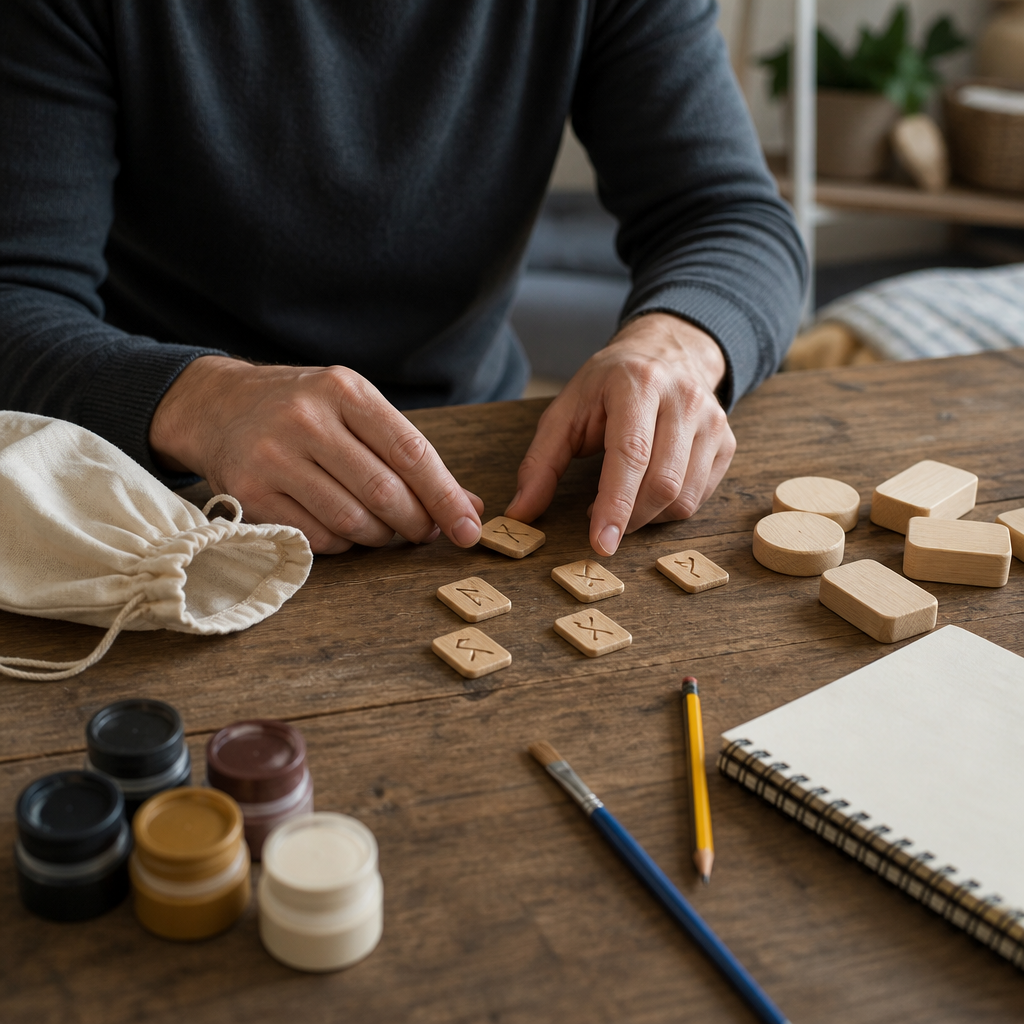
Paper or heavy card is the simplest low-cost option: cut equal rectangles, copy one verified character per card and add the row name to your notes rather than crowding the face with invented symbols. Air-dry clay and pre-cut wooden blanks are also practical when used according to the manufacturer’s instructions.
- Print or draw a verified character checklist.
- Count the blank pieces and remove extras, including any optional blank rune you do not plan to define.
- Mark each piece with pencil before applying water-based paint or a suitable nontoxic marker.
- Let coatings dry and cure as directed.
- Compare the finished set with the checklist and correct rotated or duplicated marks.
- Store the set away from young children and pets because small pieces can be choking hazards.
Use ventilation and eye or respiratory protection when a material or product label requires it. Do not burn, smoke, ingest or apply unknown pigments, resins, woods, stones or powders to the body. Avoid carving toward your hand; beginners can choose paint, card or pre-cut blanks instead of knives or power tools.
Drawing and casting are different procedures
Drawing means selecting one or more pieces from a concealed or shuffled set. Casting means releasing pieces onto a defined surface and deciding which ones will be read. Neither process guarantees randomness or access to hidden information.
| Method choice | Define before starting | Do not add afterward |
|---|---|---|
| Draw from a pouch | Number of pieces and order of positions | Extra draws until a preferred answer appears |
| Cast on cloth | Height, surface, boundary and which pieces count | New zones or directional meanings invented after seeing the fall |
| Use reversals | Which characters can reverse and what the convention means | A negative or dangerous meaning simply because a mark is rotated |
| Read clusters | A repeatable distance or grouping rule | A “map” that changes to fit the desired story |
Orientation, face-down pieces, direction and proximity can be recorded as modern prompts, but they are not self-evident messages. Many rune forms look the same when reversed; others may rotate during handling. Write the rule first or omit it.
A transparent first session
- Write one low-stakes, open question.
- Name the rune row, reference and modern method.
- Define the number and positions before mixing the set.
- Draw or cast once.
- Record the exact characters and physical arrangement before interpretation.
- Write the historical character information, modern keyword and personal response separately.
- List at least one alternative interpretation and one ordinary source of evidence.
- Choose a small reversible action and a date to review what actually happened.
For multi-tile position prompts, use the rune layout selection guide. It explains how two- through twenty-four-tile structures can organize questions without becoming fixed predictions.
Respect history without treating myth as archaeology
Myths involving Odin can be discussed as literary and religious tradition, not as a dated account of who invented runic writing. Runic rows changed across time and place; they were not simply one alphabet that migrated unchanged around the world. Similar-looking marks on a modern set do not establish historical continuity.
Likewise, a generic cloth with compass points, elements, astrology signs or unrelated religious symbols should not be called an authentic Norse reading board without evidence. Describe it as a modern design and avoid blending distinct cultures into a single “ancient mysticism.”
Boundaries for decisions and paid readings
Do not use a rune set to diagnose health, assess pregnancy, identify a mental-health condition, locate a missing person, determine immediate danger, predict court or immigration outcomes, choose investments, accuse someone, or infer another person’s consent or private thoughts. Use emergency services or appropriately qualified professional help when the stakes require it.
A seller or reader should not claim that only their set works, that your tiles are cursed, or that repeated cleansing, replacement or paid activation is necessary. Stop if someone threatens harm, guarantees an outcome, demands secrecy, discourages care or pressures payment for protection.
Frequently asked questions
Is a handmade rune set more powerful than a purchased set?
No. Making a set can support learning and familiarity, but the material does not absorb proven magical power. Accuracy depends on careful identification and transparent interpretation, not who made the tiles.
Should an Elder Futhark set include a blank rune?
No. Elder Futhark has 24 characters. A blank “Odin rune” is a modern addition; remove it or label it clearly as an optional modern pause prompt.
Do face-down, reversed or clustered runes have fixed meanings?
No. These are method choices that vary among modern readers. Define any rule before the draw or cast, apply it consistently and do not treat orientation as proof of danger or a future event.
Can runes spell a hidden message or predict an outcome?
A random arrangement may resemble a pattern or word by chance, but it does not verify a hidden source or future event. Record the result, consider alternatives and check consequential decisions with evidence.

The concept of runes being reflective of one’s inner power is intriguing, yet its more nuanced aspects seem often overlook.
‘Breathing deeply’ as part of rune drawing may enhance focus, yet one wonders if this practice aligns with other established forms of meditation.
Despite the claimed efficacy of runes in divination, a critical examination reveals a lack of empirical support for their purported capabilities.
‘Subjective validation’ is an interesting perspective but it does raise questions about broader implications on belief systems and their impact on individuals.
Empirical evidence may not be necessary in spiritual practices; subjective validation can hold significant weight for practitioners.
‘Patterns and maps’ in rune casting suggest complexity, however there remains ambiguity in how these patterns can be consistently interpreted.
Ambiguity indeed adds layers to interpretation; perhaps that is where the true magic lies—within each individual’s understanding.
‘Runes are merely tools’ seems to downplay their historical significance; understanding their origins could enrich our interpretation of them today.
While the DIY aspect appeals to many, one must ponder if the subjective experience truly enhances the divination process or merely serves as a placebo effect.
It is rather curious how cultural influences have shaped the evolution of runes throughout history, though some might argue the historical accuracy of these claims.
‘Gateway to the distant past’ invokes romantic imagery but one must be cautious about projecting modern interpretations onto ancient practices.