

Clairvoyance is often described in spiritual communities as receiving information through images, scenes, colors, or symbols that do not seem to come from ordinary sight. People may find that language meaningful, but a vivid mental picture does not by itself prove perception of a hidden event, another person’s thoughts, a spirit guide, or the future.
A grounded practice can still be useful. It can help you notice how your imagination works, separate observations from interpretations, test guesses fairly, and decide when an experience needs an ordinary health explanation. The goal is not to force a “gift” or become certain. It is to become more accurate about what you experienced and what the evidence can support.
Start by naming the experience precisely
The APA Dictionary of Psychology defines visual imagery as the sense of having pictures in the mind. These pictures may draw on earlier visual experiences or be produced by imagination. Some people picture scenes sharply, some experience faint outlines or concepts, and others have little or no voluntary visual imagery. None of those differences establishes psychic ability or personal failure.
Before using the word clairvoyance, ask which experience you mean:
| Experience | Possible ordinary sources | Useful record |
|---|---|---|
| A picture formed intentionally | Imagination, memory, rehearsal, or creative association | What prompt did you use, and could you change the image? |
| A spontaneous mental image | Recent media, worry, memory, expectation, or dream residue | What happened just before it, and how long did it last? |
| A guess about a hidden target | Chance, cues, prior knowledge, broad wording, or selective recall | Write the guess before seeing the target and count misses |
| Lights, shapes, or movement in eyesight | Eye conditions, migraine, medication effects, fatigue, or other health causes | Note whether it appeared with eyes open, its duration, and other symptoms |
| A vivid scene that seems external | Sleep transition, illness, substances, stress, or a mental-health condition | Note sleep, substances, distress, functioning, and whether others saw it |
This distinction protects curiosity. “I pictured a blue door” is an observation. “A guide showed me the home I must buy” is an interpretation with a much larger claim. Record both separately.
Use a fair, low-stakes image exercise
If you want to test a clairvoyant interpretation, choose a method that makes success and failure visible. Do not test with emergencies, relationships, pregnancy, health, crime, money, or another person’s private life.
- Prepare simple targets. Ask someone else to place one of four clearly different, ordinary photographs—such as a bridge, a tree, a bicycle, or a bowl—inside an opaque envelope. You should not see the selection process.
- Set a short timer. Sit comfortably for five minutes. You may close your eyes if that feels safe, but you do not need to meditate deeply.
- Record before revealing. Write or sketch exact shapes, colors, textures, movement, and confidence. Avoid flexible labels such as “energy,” “change,” or “something natural.”
- Reveal once. Compare the complete record with the target. Score preselected features rather than inventing a match afterward.
- Count every trial. Keep hits, partial matches, misses, and blank impressions. Do not discard a trial because you felt distracted.
- Repeat enough times. A striking match can occur by chance. Look for a pattern across many planned trials, not one memorable result.
- Keep the conclusion modest. Better-than-expected results are a reason to improve controls and repeat the test, not proof of a supernatural source.
A similar observation–alternative–outcome method is explained in the guide to testing intuition without treating a hunch as certainty. Use it when an image influences a real decision.
Practice imagery, not certainty
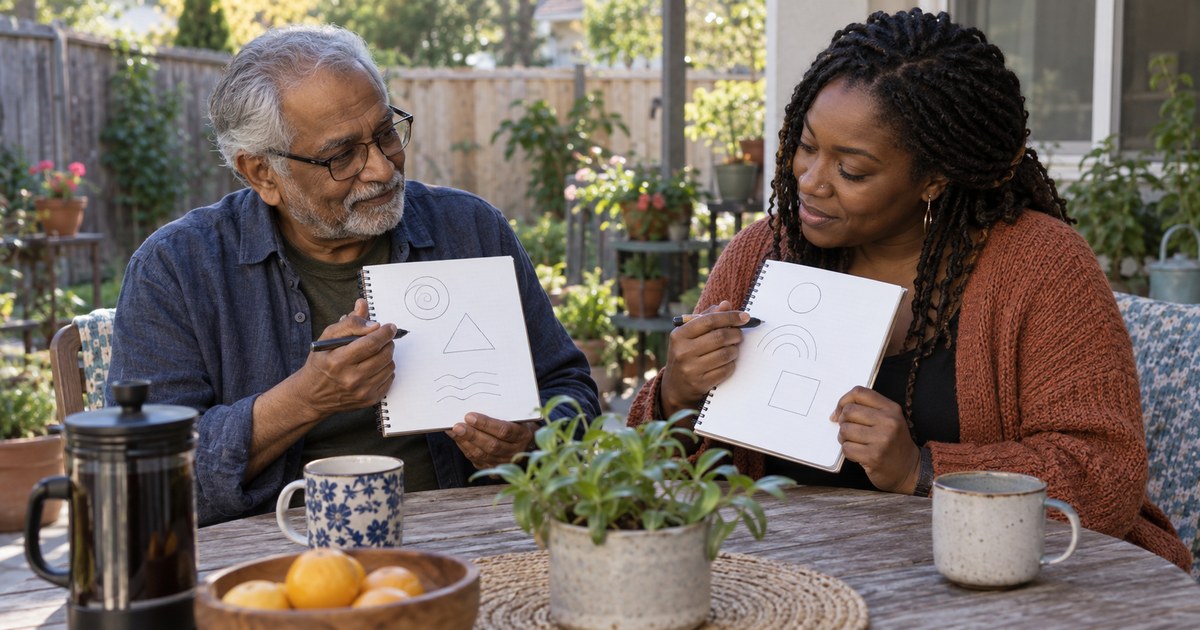
You can strengthen attention to mental imagery without claiming clairvoyance. Look at an ordinary object for thirty seconds, put it away, then sketch its shape, color, orientation, and details. Compare the sketch with the object and mark both accurate and missing features. Try again with a different object. This practices observation and recall.
Another exercise is deliberate transformation. Picture a plain circle, then imagine changing its size, color, and position. If you can direct those changes, you are observing voluntary imagery. If the picture changes unexpectedly, that still does not identify its source; write what happened without assigning a guide, ancestor, angel, or prediction.
Dreams can also produce vivid pictures. Record the dream before checking messages, news, or social media, and avoid turning broad similarities into exact predictions. A dream about a crowded room does not prove a future event simply because you later attend a meeting.
Silence, music, and meditation have limits
Quiet can make inner imagery easier to notice because fewer outside events compete for attention. It does not switch off the conscious mind or give a subconscious mind control. Music may help some people settle, while lyrics, memories, volume, or rhythm may shape what they picture.
The National Center for Complementary and Integrative Health notes that meditation includes varied practices and that research has sometimes interpreted benefits too optimistically. Negative experiences have also been reported. Keep sessions brief, stay in a physically safe place, and stop if a practice increases panic, intrusive thoughts, dissociation, agitation, or loss of sleep.
If sound is the main experience, do not relabel it as visual perception. The article on clairaudience, inner speech, auditory imagery, and tinnitus provides more appropriate source checks.
Keep tools optional and physically safe
Crystals, cards, candles, fragrance, or symbolic objects may support a personal ritual, but they have not been shown to transmit hidden information or protect someone from spirits. Describe them as prompts or tradition-specific symbols, not detectors or shields.
Do not ingest essential oils, put them in or near the eyes, or assume “natural” means safe. Avoid smoke, flame, or strong fragrance around children, pets, respiratory conditions, shared spaces, or anyone who has not consented. A notebook, timer, and ordinary household object are enough for the exercises in this guide.
Know when an image needs health care
Images in the mind are different from changes in eyesight. The National Eye Institute advises urgent eye care for a sudden increase in floaters, flashes of light, or a curtain-like shadow or blurry area because these can signal a retinal tear or detachment. Do not interpret those symptoms as an awakening or “third-eye” activity.
Seek qualified medical advice for new, recurring, or disruptive visual experiences, especially with severe headache, weakness, confusion, fever, injury, medication changes, substance use, or reduced vision. Do not stop prescribed treatment because a reader says the cause is spiritual.
Seeing scenes or figures as if they are outside you, feeling watched or commanded, losing sleep, becoming unable to check what is real, or changing behavior because of private messages deserves prompt professional support. The National Institute of Mental Health explains that hallucinations and fixed beliefs can occur with psychosis and may interfere with recognizing reality. This does not mean every unusual image is psychosis; it means distress, safety, and functioning matter more than a psychic label. If there is immediate danger or a command to harm yourself or someone else, contact local emergency or crisis services now.
Protect consent, privacy, and decisions
A mental image does not give you access to another person’s thoughts, body, history, fidelity, diagnosis, pregnancy, or future. Ask rather than announce. Do not confront, investigate, contact, accuse, or publicize information because of an impression. A person’s refusal or boundary overrides a reading.
Do not use clairvoyant practice to choose medical care, replace legal advice, identify a suspect, gamble, invest, send money, leave employment, move, or decide whether a relationship is safe. Use ordinary evidence and relevant professionals for those decisions.
Be cautious with anyone who guarantees activation, says doubt blocks your gift, declares that only they can remove interference, asks for secrecy, or sells repeated clearings after creating fear. Get the total price and scope in writing. Leave if the service depends on catastrophe, certainty, or escalating payment.
A four-week grounded practice
- Week 1: Observe voluntary imagery with ordinary objects and compare memory with the original.
- Week 2: Record spontaneous images with time, context, sleep, mood, possible sources, and no conclusion.
- Week 3: Run ten or more blinded, low-stakes target trials and keep every result.
- Week 4: Review hit rates, vague wording, misses, cue leakage, changes made after revealing, and any effect on sleep or distress.
At the end, ask what actually improved. Perhaps you became better at describing images, noticing uncertainty, remembering details, or designing a fair test. Those are valuable skills even if the record does not support a paranormal explanation.
Frequently asked questions
Does vivid visual imagery prove clairvoyance?
No. A vivid picture can come from imagination, memory, dreams, expectation, or other ordinary processes. Record the experience separately from its proposed cause and test specific claims before drawing a conclusion.
Can meditation strengthen clairvoyant ability?
Meditation may help some people notice thoughts and imagery, but that does not prove hidden perception. Keep practice brief and stop if it increases distress, intrusive thoughts, dissociation, agitation, or sleep loss.
How can I test a clairvoyant impression fairly?
Use low-stakes hidden targets, prevent sensory cues, write exact features before revealing the target, predefine scoring, count misses and blank trials, and repeat. Treat surprising results as a reason for better-controlled repetition, not immediate proof.
When should a visual experience be checked by a professional?
Seek appropriate care for new or disruptive experiences, sudden flashes or floaters, a curtain-like shadow, reduced vision, severe headache, confusion, loss of sleep, difficulty checking reality, commands, or any risk of harm. Do not treat urgent symptoms as spiritual development.



‘Understanding how one receives information’ is a key point; it raises questions about personal awareness and perception.
‘Reframing intuition’ as simple symbols may lessen the pressure associated with seeking profound insights, which is an interesting perspective.
‘Clairvoyance’, along with other ‘clairs’, seems to be a multifaceted topic that deserves further exploration.
The idea of intuitive skills is fascinating, yet its complex. I often wander whether these abilities are innate or cultivated through experience.
I agree with you, it is perplexing how intuition can vary significantly from person to person.
‘Music can help calm your mind’ resonates with me; there’s evidence suggesting that sound influences cognitive processes.
This article highlights the role of silence in enhancing psychic abilities, which I find intriguing yet difficult to implement in a noisy world.
Ultimately, embracing these practices could lead to a more profound understanding of oneself and the universe.