
Quick answer
A modern rune reading is an interpretive exercise, not a verified way to see the future. The useful question is not whether a tile contains a magical answer, but how a symbol can help you name assumptions, compare options and decide what information to check next.
Historical runes were writing systems used across different regions and periods. Contemporary readers often place rune-marked tiles in spreads and use reconstructed names, rune-poem associations or modern keywords as prompts. Labeling those layers makes a session clearer and more respectful.
Before a reading: define the system and the boundary
Start by identifying the rune row. Many commercial sets use the 24-character Elder Futhark, while Viking-Age inscriptions often use the 16-character Younger Futhark. Do not mix rows without noting it. The companion guide to Understanding Runes and The Meanings provides a 24-character reference and explains which “meanings” are modern reflection prompts.
Then write one sentence describing the boundary of the session:
This reading is for reflection. It cannot predict, diagnose or replace medical, legal, financial or safety advice.
If the question involves immediate danger, self-harm, abuse, a medical symptom, legal deadline or irreversible financial action, pause the reading and use the appropriate qualified or emergency support instead.
Ask a question that leaves room for evidence
Questions work best when they invite observation rather than demand certainty.
| Instead of | Try | Why |
|---|---|---|
| Will I get this job? | What factor should I prepare for in this application? | Keeps the hiring outcome with the employer |
| Is my partner cheating? | What conversation or boundary needs clarity? | Avoids treating a symbol as evidence about another person |
| Am I sick? | What facts should I record before contacting a clinician? | Does not turn a reading into diagnosis |
| Which investment will make me rich? | Which risks and assumptions have I not checked? | Keeps financial decisions tied to verifiable information |
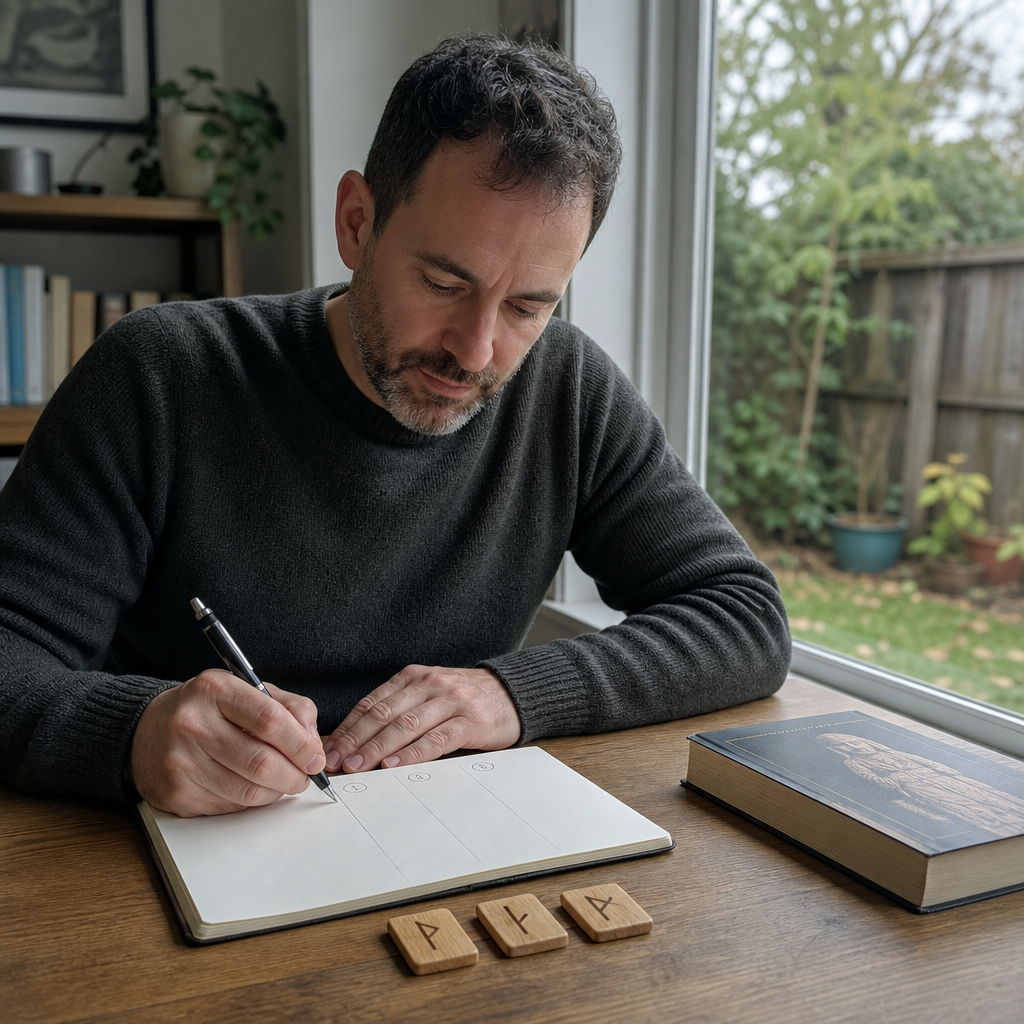
A transparent three-rune process
This layout is a modern journaling structure. It is not presented as a recovered ancient method.
Position 1: What is known?
List the facts before drawing. After drawing, use the rune’s prompt to notice which fact receives your attention. Do not add an event that has no evidence.
Position 2: What may be overlooked?
Write at least two interpretations: one that fits your first reaction and one plausible alternative. This reduces the temptation to turn the first association into certainty.
Position 3: What can be checked or tried next?
Choose a small, reversible action: ask a question, compare a price, review a document, set a boundary or wait for more information. The tile does not guarantee an outcome.
Record the symbols exactly as drawn before consulting a book. Note the date, question, layout, reference source and your interpretation. This creates an honest record and makes it harder to rewrite the reading after events unfold.
What about reversed or sideways runes?
Modern readers disagree about reversals. Some use an inverted tile as a contrasting prompt; others ignore orientation because many runes are symmetrical or because historical inscription direction is a separate issue. Choose one method before the draw and document it. Do not treat a reversed rune as proof of illness, infertility, betrayal, death or danger.
A blank “Odin rune” is also a modern addition rather than a twenty-fifth Elder Futhark character. You may remove it or define it as an optional pause prompt, but label that choice clearly.
How to read without forcing a match
- Describe first. Write the rune name and the reference gloss without applying it.
- Generate alternatives. List two or three ways the prompt could relate—or not relate—to the question.
- Look for disconfirming facts. What would show your favored interpretation is wrong?
- Separate feeling from evidence. A strong emotional reaction is information about your response, not proof about the outside world.
- Choose one grounded next step. Prefer an action that is lawful, consensual, affordable and reversible.
Do not keep redrawing until you receive the answer you want. Set a limit—one layout for one question—and revisit only after new facts appear. Repetition can amplify anxiety and selective interpretation.
Preparing the physical space
No special pouch, cloth, candle, crystal or direction is required. Use materials that are safe and practical:
- a complete, clearly marked set from one rune row;
- a neutral reference with its sources identified;
- paper or a private digital note;
- enough light to identify each character accurately;
- a quiet time limit so the session does not become repetitive.
If candles help concentration, follow ordinary fire safety. Objects may carry personal meaning, but they do not become evidence of prediction or protection.
If another person gives the reading
Before paying, confirm the rate, time limit, format, privacy practice, cancellation or refund terms and whether the reader records the session. A responsible reader should be willing to say:
- the method is interpretive rather than guaranteed;
- which rune row and reference system they use;
- that they will not diagnose, threaten or direct high-stakes decisions;
- that you may stop without buying cleansing, protection or extra minutes.
Leave if someone claims a curse, predicts catastrophe, demands secrecy, pressures repeated payment, asks you to abandon care or says only they can keep you safe. For other source-aware material, browse the Rune Divination Articles archive and keep the same evidence boundaries in place.
Historical context in brief
The National Museum of Denmark describes runes as Germanic writing derived from Mediterranean alphabetic traditions. Its discussion of runic magic notes that sagas and later songs contain magical material, while most surviving inscriptions carry practical messages. Uppsala University’s Rune Cast likewise presents runes as writing used for names, memorials and everyday communication across centuries.
That history does not forbid contemporary symbolic practice. It does require accuracy: a modern three-tile spread should be called modern, and a reflective keyword should not be advertised as a fixed ancient prediction.
Frequently asked questions
Can a rune reading predict my future?
No reliable method shows that rune tiles predict future events. A reading can be used as a structured reflection exercise while decisions remain grounded in evidence.
What is a good question for a rune reading?
Use an open question such as “What assumption should I check?” or “What small next step is available?” Avoid questions that ask a symbol to diagnose, accuse another person or guarantee an outcome.
Do I have to read reversed runes?
No. Reversal systems vary among modern readers. Choose and document a method before drawing, and never treat an inverted tile as proof of danger or illness.
When should I stop a rune reading?
Stop if you feel distressed, repeat the same question, face a high-stakes decision or encounter pressure to pay for protection. Move to verifiable information or qualified support.

‘Understanding Runes’ section could benefit from more clarity regarding their meanings and uses in contemporary contexts, especially for novices.
The ancient Proto-Germanic traditions are truly fascinating, yet the origins of rune casting seem to remain elusive. One must ponder the evolutions of such practices over centuries.
Indeed, it raises questions about cultural transmission and the influence of oral traditions on these mystical practices.
The symbolism behind each rune appears rich and multifaceted; still, do modern interpretations stray too far from historical understandings?
I find it quite intriguing how runes are perceived as having magical abilities. Is there any empirical evidence that supports these claims?
Meditation prior to a reading seems essential; however, what methods might enhance one’s connection to the runes specifically?
Perhaps guided meditations focusing on intention setting could provide deeper insights.
‘Carrying a rune can keep a person safe.’ This assertion merits further examination regarding psychological or placebo effects involved.
‘Final Thoughts’ suggests exploring both rune casting and tarot cards. However, how distinct are these practices really in terms of methodology?
‘Three Rune Reading’ is a compelling process; however, I wonder if personal biases influence the interpretations one might derive from the readings.