

Home Blog Page 2

PsychicOz Review: Rune Readers, Methods & Session Guide

Adult reviewing a rune-reading session with notes, a phone and three rune tiles at a modest home table
A written session record helps separate service facts, symbolic interpretation and later evidence.

Rune-method guide · formats, costs and session records

Choose the method before you interpret the message

Our PsychicOz review is built for visitors seeking rune-oriented guidance: confirm the advisor’s method, understand the format, record what was actually said and keep symbolism separate from real-world evidence.

Method statedQuestion preparedBudget fixedOutcome unproven

Adult reviewing a rune-reading session with notes, a phone and three rune tiles at a modest home table
A written session record helps separate service facts, symbolic interpretation and later evidence.

Choose a clear method

A rune label is not enough to describe a session

Advisors can combine symbolic tools with intuitive impressions, tarot or conversational guidance. If rune work matters to you, the useful question is not merely whether “runes” appear on a profile. Ask how the symbols are selected, whether they will be identified and how the advisor connects an interpretation to your question.

Before paying, check the account requirements, advisor profile, reading format and billing terms. After a session, compare the receipt and service received with what you agreed to purchase.

A three-layer reading record

Keep the service, interpretation and outcome in separate stones

1

Service facts

Advisor selected, format, profile rate, amount authorized, session duration and whether the promised format was delivered.


2

Interpretation

Symbols named, explanation given, information you supplied, alternative meanings discussed and advice offered.

3

Outcome status

Immediately checkable, pending, too vague to test, contradicted or later supported by independent evidence.

Advisor-fit questions

Clarify the method before the clock starts

ToolWill runes be the primary method or one tool among several?
ExplanationWill you identify the symbols and explain how you reached the interpretation?
FormatDoes this phone, written or other listed format support the detail I want?
ScopeWhich part of my question can this session reasonably explore?

Symbols with room for discussion

What would you like to explore through the runes?

A symbolic reading can be most engaging when the method and the question belong together. On PsychicOz, begin with an advisor’s current profile and confirm that rune work is offered before selecting that reader.

A turning point
Ask how the symbols might frame a choice you are already considering. Describe the options without asking the reader to decide for you.
A recurring theme
Bring a pattern you have noticed in your own life and ask which symbols the advisor connects with it.
An unfamiliar symbol
Invite the reader to name the rune and explain its role in the interpretation. This makes the conversation easier to follow and revisit.

Look for your reading method on PsychicOz →

Review criteria

What to check in a PsychicOz reading

Method clarity

Whether profile and conversation make the advisor’s tools and approach understandable.

Format fit

Whether the purchased format supports questions, explanation and the record you expect.

Interpretive transparency

Whether the advisor explains how a symbol or impression relates to the question.

Boundary respect

No guarantees, fear pressure, diagnosis, off-platform payment or attempts to create dependency.

Cost control

Clear eligibility, currency, profile rate, session duration and authorized amount.

After-session trace

A receipt, support path and enough detail to compare the interpretation with later evidence.

Current public offer

Budget for the explanation, not a guaranteed outcome

These introductory options are advertised for new clients in U.S. dollars. Restrictions apply. Confirm the signed-in checkout, advisor rate, method and available format before authorizing payment.

Check the current offer and conditions

US$9.9913 minutes total: 10 + 3 free
US$14.9918 minutes total: 15 + 3 free
US$4.99one email question

The current introductory page adds three free minutes to each listed live-reading package. Check your chosen reader’s available format and eligibility before purchasing; standard rates apply to later readings.

Leave the path

Stop when interpretation becomes pressure

Guaranteed certainty: a symbol does not make a future relationship, health, career or financial outcome inevitable.
Fear-based extension: claims of curses, disaster or spiritual danger should not be used to sell more time.
Hidden method: you may ask how an interpretation was reached and decline explanations that do not address your question.
Boundary crossing: do not share unnecessary identifying information or move payment and contact off-platform.

After the reading

Record the path without rewriting it

Wait until the emotional effect has settled, then review the reading in its original terms.

  1. Write the symbols or tools the advisor actually identified.
  2. Record the interpretation without improving it from memory.
  3. Mark information you supplied before a statement was made.
  4. Separate practical advice from supernatural or future claims.
  5. Give each checkable claim a fair status and date.
  6. Review the transaction and contact support promptly for a service issue.

Support for the reading you purchased

Keep the reader’s name and the date if you need help with a session. PsychicOz accepts satisfaction requests within 48 hours after a reading finishes; email requests use the completed reply’s delivery time. This process covers eligible first and later readings. Customer care assesses each request and may arrange a refund, account credit or another resolution.

Read PsychicOz’s satisfaction policy

Related RuneDivination guides

For a transparent way to record a draw, use our modern three-rune reflection process. To check names, sounds and historically labeled versus modern associations, consult the Elder Futhark reference guide.

Quick answers

PsychicOz rune-reading FAQ

1. Does every PsychicOz advisor use runes?

No. Check the current individual profile and clarify the method before purchasing. A general psychic listing does not establish rune experience.

2. What should a rune-focused review describe?

State whether runes were actually used, whether the symbols were identified, how clearly the interpretation was explained, the format, approximate duration and billing clarity.

3. Do positive ratings prove divination accuracy?

No. Ratings can describe customer satisfaction but do not scientifically validate rune divination or guarantee a future event.

4. How should I phrase a question?

Use an open, decision-focused prompt such as “What competing priorities should I consider?” Avoid questions that demand a guaranteed outcome or private facts about someone else.

Visitor experiences

Review your PsychicOz experience

Use the new form only for an experience you personally had. Method, format, explanation and service details are more useful than an unsupported prediction claim.

4.9 based on 11 reviews

Only approved comments with a star rating count toward this average.

Choose 1–5 stars and describe your own experience. New visitor reviews wait for admin approval before publication.

Write a review

The original WordPress discussion remains below for continuity. Earlier comments retain their original dates, and some predate the star-rating form.

Origins and Ideas Behind Rune Casting

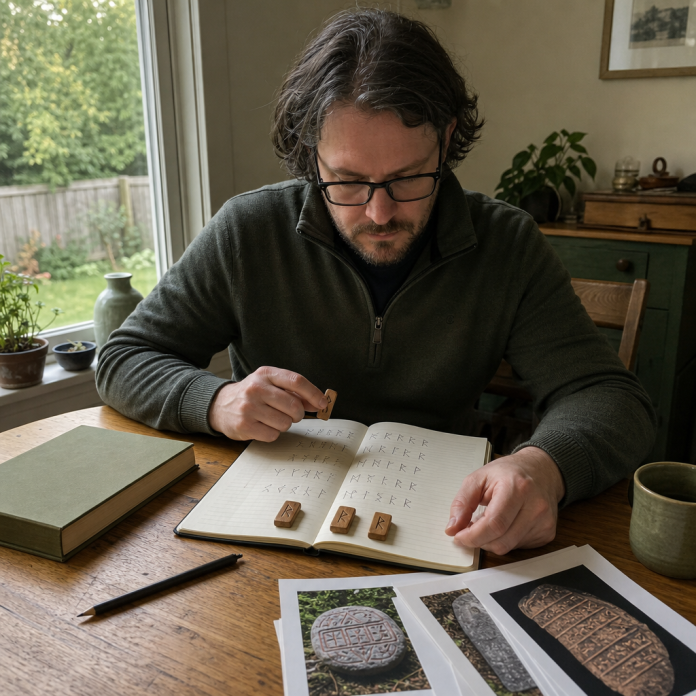
Adult comparing rune reference notes and modern wooden tiles at a modest home table

Quick answer

Rune casting as practiced today is a modern interpretive activity built around historical writing signs. Runes themselves are well documented as alphabets used for names, memorials, ownership, communication and sometimes ritual or protective language. What is not established is one continuous ancient casting system that matches today’s bags of tiles, fixed positions and keyword charts.

That distinction matters. It lets us study real runic history without dismissing a contemporary reflective practice—or advertising that practice as an authenticated Viking method. A modern spread can be meaningful to the person using it while still being labeled modern.

Begin with runes as writing

The word rune refers to a character in one of several related writing systems, not to a single timeless alphabet. The 24-character Elder Futhark appears in early inscriptions from the first centuries CE. During the Viking Age, Scandinavian writers commonly used the 16-character Younger Futhark. Anglo-Saxon communities developed the longer futhorc, and medieval writers expanded their inventories again.

Those rows are related, but they are not interchangeable. A modern set that combines Elder Futhark characters, a blank tile and keywords from several books is a contemporary teaching or divination product. It should not be described as an excavated complete system.

Layer What the evidence supports What requires caution
Early runic writing Surviving inscriptions, letter forms, names and linguistic analysis Assigning one fixed spiritual keyword to every character
Viking-Age practice Younger Futhark inscriptions, memorial stones and written messages Calling a 24-tile Elder Futhark kit the universal Viking alphabet
Magic and ritual Some inscriptions and later literary sources contain charms, formulas or magical themes Treating every rune or inscription as occult
Modern casting A current symbolic or journaling practice with many competing methods Claiming one modern spread is a recovered ancient standard

What historical sources do—and do not—show

The National Museum of Denmark describes runes as Germanic writing derived from Mediterranean alphabetic traditions. Its overview of runic magic also makes a useful correction: magical material exists, yet most surviving inscriptions communicate practical information. Names, memorial texts and ownership marks are part of rune history too.

Ancient and medieval sources contain accounts of lots, signs, charms and prophecy, but connecting every such account to a bag of rune-marked tiles is an inference. For example, the Roman author Tacitus described Germanic lot casting on marked pieces of wood. His account does not identify a later runic alphabet, provide a rune row or document the three- and nine-position layouts sold today. It is evidence for a reported lot practice, not a complete manual for modern rune casting.

Likewise, the myth in which Odin gains knowledge of runes is a literary and religious source, not an archaeological account of an alphabet being invented or a standardized casting method being taught. Myth can be studied and valued as myth without converting every detail into a historical instruction.

Where modern rune meanings come from

Modern readers often combine several layers:

  • the rune’s reconstructed name and sound value;
  • imagery from Old English, Norwegian or Icelandic rune poems;
  • scholarly interpretation of inscriptions and language;
  • modern occult, psychological or self-help keywords;
  • the reader’s personal associations.

These layers should be labeled rather than blended. A rune poem may be centuries later than the earliest Elder Futhark inscription. A keyword printed with a modern commercial set may be useful as a prompt but is not automatically an ancient definition. Our Elder Futhark reference guide separates names and sound values from contemporary reflection prompts.

How a modern casting practice can be transparent

A careful practice starts by naming its method. Write down which rune row you are using, which reference supplies the meanings and whether orientation matters. If you use a blank tile, call it a modern addition rather than a twenty-fifth Elder Futhark character.

Next, describe the layout as a chosen structure. A three-tile sequence might be “known facts, overlooked factor, next check.” A larger group might be sorted by proximity or direction. Neither structure becomes ancient merely because the number three or nine appears in Norse literature. State who designed the layout and what each position means before drawing.

  1. Write the question. Prefer an open prompt that does not demand a guaranteed prediction.
  2. Record the draw. Note the characters and positions before interpretation.
  3. Describe the reference meaning. Keep the source wording separate from your application.
  4. Generate alternatives. List at least two plausible readings and one reason neither may fit.
  5. Choose a checkable next step. Use ordinary evidence, conversation or professional advice where needed.

The companion modern three-rune reflection process gives a practical record format and clear stop conditions.

Materials are choices, not guarantees

Modern rune sets are made from wood, stone, ceramic, resin, metal or card. No material makes an interpretation more accurate. A safe, legible and complete set is more useful than a claim that a particular tree, crystal or ritual guarantees power.

You also do not need a candle, cloth, special direction or elaborate cleansing routine. If a cloth keeps tiles from rolling, use it for that practical purpose. If a short breathing pause helps attention, treat it as preparation rather than supernatural proof. Follow ordinary fire safety if candles are present, and keep small tiles away from children and pets.

Why fixed future claims are a problem

A tile cannot establish that a partner is unfaithful, a medical condition is present, a lawsuit will succeed, an investment will profit or a missing person is in a particular place. It also cannot verify a curse, spiritual attack or threat. Strong feelings during a reading are real experiences, but they are not independent evidence about an outside event.

For high-stakes decisions, pause the casting and use qualified support. Contact emergency services for immediate danger, a clinician for health concerns, a lawyer for legal questions and a licensed financial professional for consequential money decisions. Never pay someone who says repeated readings, cleansing or protection are the only way to prevent disaster.

Respectful language avoids a fantasy version of history

Runes were used across places, languages and centuries. Avoid reducing all Germanic or Norse history to Vikings, warriors, magic and prophecy. Horned helmets are a later stereotype, and a dramatic costume does not authenticate an interpretation. Museums, inscription databases and runology projects provide better starting points than an unlabeled social-media chart.

Contemporary spiritual practice can still be discussed honestly. Say “in my modern practice” when describing a spread or personal association. Say “this source records” when referring to a poem or inscription. Say “I do not know” when the evidence does not support continuity or certainty.

Frequently asked questions

1. Is rune casting an ancient Viking method?

Runes are historical writing systems, and historical sources include lots, magic and divination themes. However, there is no single documented ancient method identical to today’s commercial tile sets and fixed spreads. Modern casting should be labeled modern.

2. Did Odin invent the runes?

Odin’s relationship to runes belongs to Norse myth and literature. It is not an archaeological account of an alphabet being invented. Historical rune development is studied through inscriptions, language and material evidence.

3. Does a nine-rune cast come from ancient practice?

Nine has significance in Norse literature, but that does not prove a specific modern nine-tile layout is ancient. Treat the layout as a contemporary structure unless a reliable source documents otherwise.

4. Can rune casting predict a decision’s outcome?

No reliable evidence shows that rune tiles predict future events. They may be used as reflection prompts, while decisions remain grounded in facts, consent, professional advice and ordinary risk checks.

Sources

Using Runes for Divination

Adult recording a one-rune reflection in a notebook at a modest home table
A one-rune draw can be used as a documented reflection prompt; it does not verify a prediction.

Quick answer

Using runes for divination is best understood as a modern symbolic reflection practice, not a verified way to obtain facts or predict the future. A rune can prompt a question, association or journaling exercise. It cannot diagnose a condition, reveal another person’s private actions or guarantee what will happen next.

This beginner guide uses one rune at a time. The narrow format makes it easier to record what you actually drew, distinguish a source meaning from your own association and end with a checkable next step.

Choose one rune row and one reference

Many beginner sets use the 24-character Elder Futhark. Viking-Age Scandinavian inscriptions commonly use the 16-character Younger Futhark, while Anglo-Saxon and medieval rows differ again. Pick one row and confirm that every tile belongs to it. Do not treat a mixed commercial set as a universal ancient alphabet.

Use a reference that distinguishes a character’s name and sound from later symbolic keywords. Our Elder Futhark reference guide labels historical information and modern reflection prompts separately. Remove a blank “Odin” tile if your goal is a 24-character Elder Futhark set; the blank is a modern addition.

Write a question that does not demand certainty

A useful question directs attention without asking a tile to establish a hidden fact. Keep it specific enough to guide reflection and open enough to allow more than one answer.

Swipe horizontally if any columns are off-screen.

Avoid Use instead Reason
Will I get the job? What part of my preparation needs attention? The employer controls the outcome
Is my partner lying? What conversation or boundary needs clarity? A symbol is not evidence about another person
What illness do I have? What symptoms and questions should I record for a clinician? Runes cannot diagnose
Which investment will make money? Which assumptions and risks have I not checked? Financial decisions require evidence

A transparent one-rune exercise

  1. Set a boundary. Write: “This is a reflection prompt, not a prediction or professional recommendation.”
  2. Record the question. Include the date and why the question matters now.
  3. Mix once and draw once. Use a method chosen in advance. Do not redraw because you dislike the first tile.
  4. Identify before interpreting. Copy the rune name, transliteration and source gloss accurately.
  5. List two associations. Include your first reaction and one plausible alternative.
  6. Check the fit. Note facts supporting each association and facts that do not fit.
  7. Choose one small action. Prefer something lawful, consensual, affordable and reversible.

The value of the exercise is the record. Without a dated note, it is easy to remember a vague phrase as more specific after an event occurs.

Keep four columns in your notes

Swipe horizontally if any columns are off-screen.

Column What to record
Draw Rune, orientation, date, question and chosen method
Reference Name, sound and source wording without application
Associations At least two possible interpretations, including one that challenges the first
Evidence and action What is known, what remains unknown and one fact to check next

What “intuition” can and cannot mean

Intuition can describe a rapid impression, emotional response or pattern noticed from experience. It is not automatically a message from an external source, and confidence does not make an impression accurate. Treat the feeling as information about your response, then compare it with facts.

If the rune seems to confirm exactly what you hoped or feared, slow down. Write one alternative interpretation and one observation that would disconfirm your preferred reading. This reduces confirmation bias and keeps the exercise from becoming a loop.

Reversals are optional modern conventions

Readers disagree about inverted or sideways runes. Some use orientation as a contrasting prompt; others ignore it because several characters are symmetrical and inscription direction is a separate historical question. Choose a rule before drawing and document it.

Never treat a reversed rune as proof of illness, infertility, betrayal, death, violence or spiritual danger. If a reading increases fear, stop and move to reliable information or qualified support.

Making or buying a beginner set

A modern set may be made from wood, stone, ceramic, card, resin or another durable material. The material does not make a reading more accurate. Prioritize complete, legible characters, smooth edges and a consistent size.

If making tiles, use appropriate eye protection and ventilation for cutting, sanding, burning or sealing materials. Keep small pieces away from children and pets. No candle, crystal, sacred tree species, special pouch or cleansing purchase is required.

Historical claims need their own evidence

Runes were not a Bible-times fortune-telling system, and their origins should not be described as Greco-Roman divination. Norse myth connects Odin with the acquisition of rune knowledge, but myth is not an archaeological account of an alphabet being invented. Accounts of lots and signs do not document one continuous method identical to modern tile spreads.

For the evidence boundary—including rune rows, inscriptions, magical material, Tacitus’s reported lots and the limits of claims about ancient casting—read Origins and Ideas Behind Rune Casting.

If another person reads for you

Agree on the rate, format, time limit and method before beginning. Ask the reader to identify each rune and explain how they connect a reference meaning to your question. A responsible reader should not diagnose, threaten, promise certainty, request unnecessary private information or pressure you to buy protection, cleansing or repeated sessions.

Stop immediately if someone claims a curse, says only they can prevent disaster, directs you to abandon medical care or demands off-platform payment. Symbolic practice is not a substitute for emergency, medical, mental-health, legal or financial support.

Frequently asked questions

1. Can one rune answer a yes-or-no question?

A rune cannot verify a yes-or-no outcome. Use it to generate questions or considerations, then decide with relevant facts and the people involved.

2. Should I draw again if I dislike the rune?

No. Repeated drawing can turn the exercise into answer-seeking. Record one draw, consider an alternative interpretation and return only when new information changes the question.

3. Do I need a blank rune?

No. A blank “Odin rune” is a modern addition, not a twenty-fifth Elder Futhark character. Remove it for a 24-character set or clearly define it as an optional modern pause prompt.

4. When should I not use rune divination?

Do not use it to diagnose, accuse someone, locate a missing person, assess immediate danger or make irreversible medical, legal or financial decisions. Use qualified or emergency support instead.

Sources

Opening the Third Eye

Adult pausing for a short grounding exercise in a modest home living room
Third-eye language can be treated as a spiritual metaphor; a short grounding pause should remain optional and stop if it increases distress.

Quick answer

“Opening the third eye” is spiritual and symbolic language, not a medical event with a standard set of symptoms. People may use the phrase for insight, conscience, imagination, meditation or a change in perspective. It does not verify clairvoyance, spirit contact or the ability to read another person’s thoughts.

A grounded approach respects the phrase’s religious and modern spiritual contexts while keeping health, safety and outside facts separate from personal meaning.

Metaphor, belief and anatomy are different layers

Third-eye language appears in more than one philosophical, religious and modern spiritual setting, so it should not be reduced to one universal definition. A personal practice may connect the phrase with inner observation or wisdom. That is a belief or interpretive framework, not proof of a new physical organ or paranormal perception.

The pineal gland is a real endocrine structure in the brain, but calling it the “third eye” does not show that it produces supernatural sight. Pressure at the brow, tingling, visual effects, headaches or changes in sleep can have ordinary causes. Persistent, severe or sudden symptoms deserve appropriate medical evaluation rather than a spiritual diagnosis.

What a short reflective practice can reasonably do

A brief pause can help someone notice breathing, body tension, thoughts and emotions. Research on meditation and mindfulness addresses varied practices and outcomes; it does not test or establish a literal third eye. The National Center for Complementary and Integrative Health also warns that research is often preliminary or difficult to interpret and that negative experiences can occur.

For an evidence-aware comparison of group practice, see Community Meditation and Collective Stress: What We Know. Keep any third-eye interpretation separate from measured meditation outcomes.

A five-minute grounding option

This exercise does not attempt to activate a power. It is simply a short attention check.

  1. Orient. Sit in a stable position and name the room, date and time.
  2. Keep the eyes comfortable. Use a soft gaze or close the eyes only if that feels safe. Never stare at the sun or another bright light.
  3. Notice contact. Feel the chair, floor or another ordinary point of support.
  4. Label three experiences. Name one body sensation, one emotion and one thought without calling any of them a message.
  5. Check the outside world. Ask what facts are known, what remains uncertain and what can be verified.
  6. Choose an ending. Stretch, drink water, look around the room and stop at five minutes.

Skip breath holding, forced breathing, sleep deprivation, fasting, substances, prolonged isolation and pain. More intensity is not evidence of more insight.

Use a three-column reflection record

Swipe horizontally if any columns are off-screen.

Experience Personal interpretation External check
“I felt pressure near my brow.” “I associate this area with concentration.” Relax the face; note headache, vision or sinus symptoms; seek care if concerning
“An image appeared in my mind.” “It reminds me of a current worry.” Do not treat the image as evidence about another person or event
“I felt calm after sitting.” “The pause was useful today.” Avoid claiming the same effect for everyone or replacing care
“I sensed someone was upset.” “I may be reacting to tone or my own concern.” Ask respectfully rather than claiming to know their mind

Do not convert strong feelings into facts

A vivid image, dream, coincidence or bodily sensation can feel important. Record it as an experience. Do not use it to accuse a partner, diagnose illness, locate a missing person, predict death, choose an investment or make an irreversible legal or medical decision.

Likewise, feeling “energy” may be a personal description of mood, attention or atmosphere. It does not establish what a plant, animal or another person thinks. Consent and direct communication still matter.

Stop conditions are part of the practice

Stop the exercise if it increases panic, dissociation, confusion, sleeplessness, agitation or a sense that ordinary events contain commands meant only for you. Ground with familiar surroundings and contact a qualified health professional. If there is immediate danger or risk of self-harm, use emergency or crisis support in your location.

The National Institute of Mental Health describes hallucinations, delusions and disorganized thought or behavior as possible features of psychosis and emphasizes that early treatment matters. Spiritual language should never be used to dismiss distressing voices, visions, paranoia or major changes in functioning.

Meditation is not a substitute for conventional care. NCCIH advises people not to postpone seeing a health provider because of a complementary practice. A skilled instructor should welcome questions, opt-outs and referral to appropriate care.

Eye safety: do not gaze at the sun

Some third-eye imagery places bright light near the forehead. Treat that as visual symbolism only. The National Eye Institute warns that looking directly at the sun can damage the retina and may cause permanent vision loss; dark sunglasses do not make direct viewing safe.

Use indirect indoor light and a comfortable gaze. If bright-light exposure is followed by blurred vision, light sensitivity, dark spots or color changes, seek prompt evaluation from an eye-care professional.

Respect the source context

Avoid presenting one modern internet exercise as the universal teaching of Hinduism, Buddhism or Tantra. Traditions have their own texts, teachers, languages and debates. Do not borrow sacred symbols as decorative proof of psychic ability.

When comparing practices across cultures, identify the specific source and distinguish historical records, living practice and personal belief. Our source-aware traditions guide explains why broad labels and supernatural certainty can flatten very different communities.

Choosing a teacher or guided session

Ask what the exercise involves, how long it lasts, what training the facilitator has and what happens if someone becomes distressed. Leave if a teacher promises guaranteed awakening, pressures sleep deprivation or substances, discourages medical care, demands secrecy or says only they can remove a blockage for additional payment.

A responsible facilitator allows ordinary language, shorter sessions, eyes-open options and stopping without penalty. They do not diagnose a “closed third eye” or turn fear into a sales tool.

Frequently asked questions

1. Is the third eye a physical organ?

No separate anatomical eye opens in the forehead. “Third eye” is spiritual and symbolic language. The pineal gland is real anatomy, but that does not establish supernatural sight.

2. Does brow pressure mean my third eye is opening?

Brow pressure is not proof of a spiritual event. Relax the face and consider ordinary causes. Seek medical or eye care for severe, sudden, persistent or concerning symptoms.

3. Can meditation cause difficult experiences?

Yes. Meditation is often described as low risk, but negative experiences including anxiety and depression have been reported. Stop if distress increases and seek qualified support when needed.

4. Should I look at the sun during third-eye practice?

No. Direct sun gazing can damage the retina and may permanently impair vision. Use comfortable indirect light and never treat bright-light exposure as a spiritual requirement.

Sources

Knowing Someone is Thinking About You

Adult reflecting at home with a mug and laptop
Wondering can reveal your own feelings; it does not provide access to another person’s private thoughts.

Quick answer

There is no reliable bodily sign that proves another person is thinking about you. Sneezing, hiccups, warm ears, goosebumps, eye twitching, dreams and sudden emotions can feel meaningful, but they do not identify who is thinking what—or whether anyone is thinking about you at that moment.

The grounded question is not “Which sign guarantees their thoughts?” It is “What am I noticing, what ordinary explanations fit, and is respectful communication appropriate?”

Separate experience, story and evidence

An experience can be real without the first interpretation being correct. Use three columns:

Swipe horizontally if any columns are off-screen.

Experience Possible story What can verify it
“I suddenly thought of them.” “They must be thinking of me.” A direct message or conversation, not the thought alone
“My eyelid twitched.” “Someone is talking about me.” Check fatigue, stress, caffeine and persistence; seek care if concerning
“I dreamed about them.” “We communicated telepathically.” A dream shows your experience; it does not independently establish theirs
“They viewed my post.” “They want to restart the relationship.” Clear, consensual words and consistent behavior

Why coincidences can feel personal

When someone matters to us, reminders of that person stand out. A song, place, name or notification may capture attention because the relationship is already emotionally important. We also remember striking matches more easily than the many thoughts that are followed by nothing.

This does not make the moment meaningless. It may tell you that you miss the person, feel uncertain or need closure. It simply does not reveal their private mind.

Body sensations have ordinary explanations

Sneezing

Sneezing is a reflex caused by irritation in the nose or throat. MedlinePlus lists allergies, colds, flu, COVID-19, dust, dry air, pollution, medicines and other triggers. The number of sneezes does not classify someone else’s thoughts as positive or negative.

Hiccups

Hiccups involve an involuntary diaphragm movement followed by quick vocal-cord closure. They can begin without an obvious reason and may follow eating quickly, overeating, spicy food, carbonated drinks, alcohol, excitement, medicines or other conditions. Hiccups do not identify a critic or “psychic attack.”

Warm ears or cheeks

Warmth and flushing can follow temperature change, exercise, emotion, skin irritation, infection, medication or other physical factors. Do not confront someone on the assumption that a warm ear proves they were praising or criticizing you.

Goosebumps

Goosebumps are a normal body response that can occur with cold, fear, awe, music or strong emotion. They do not verify a psychic bond.

Eye twitching

Eyelid twitching is often brief and may be associated with tiredness, stress, caffeine, alcohol or some medicines. NHS guidance recommends medical advice when twitching persists, affects more than one place, or is accompanied by weakness or stiffness. It does not depend on gender or which eye twitches.

Choking, coughing or pain while eating

Do not interpret choking or sudden eating pain as evidence that someone is talking about you. Stop eating and address the immediate physical problem. Use emergency assistance for severe choking or breathing difficulty, and seek medical care for recurring swallowing problems.

Dreams and mental images describe your experience

Dreaming about someone can reflect memory, emotion, recent reminders or unresolved concerns. A vivid dream is not proof that the other person sent a message. Likewise, feeling touched when no one is present should not automatically be framed as remote contact.

For a broader method of separating spiritual metaphor, body sensation and outside evidence, see Opening the Third Eye: grounded meaning and safety.

Ask whether contact is respectful

If there is no safety, legal or no-contact boundary, one simple message may be appropriate:

“You crossed my mind today. No pressure to reply—I hope you’re doing well.”

Send it once. Do not treat silence as a hidden yes, a test or proof of secret feelings. Do not use alternate accounts, track location, monitor friends, interpret online status or keep contacting someone who has asked for space.

If reaching out would violate a boundary or expose you to harm, write the message privately and do not send it. Closure can involve accepting uncertainty.

Look for behavior, not imagined access

Evidence that someone is interested comes from observable, consensual behavior: they initiate contact, respond clearly, make plans, respect limits and act consistently. A feather, repeating number, dream or body sensation cannot substitute for those actions.

Even a psychic reading cannot establish another person’s private thoughts. If you pay for a reading, use the service boundaries in our rune-reader methods and session guide: agree on cost and format, ask how an interpretation was reached, and leave if fear or guaranteed certainty is used to sell more time.

When uncertainty becomes a loop

Pause if you repeatedly search for signs, check profiles, redraw divination tools, lose sleep or reorganize daily life around an unconfirmed connection. Try a time-limited plan:

  1. Write the known facts in two sentences.
  2. List what you cannot know without the other person’s participation.
  3. Choose either one respectful message or no contact.
  4. Mute repeated checking for a set period.
  5. Talk with a trusted person or mental-health professional if distress persists.

Urgent help is appropriate if you feel unsafe, cannot function, believe you are receiving commands, or are at risk of harming yourself or another person.

Frequently asked questions

1. Can sneezing prove someone is thinking about me?

No. Sneezing is a physical reflex with ordinary triggers such as allergies, infection, dust or dry air. The number of sneezes does not identify another person’s thoughts.

2. Does dreaming about someone mean they miss me?

A dream may show that the person or relationship matters to you. It does not independently establish what they feel or whether they were thinking about you.

3. Is an eye twitch a positive or negative sign?

It is not a reliable relationship sign. Eye twitching often has ordinary physical triggers. Seek medical advice if it persists, spreads or occurs with other concerning symptoms.

4. Should I contact someone who suddenly crossed my mind?

Only if contact is safe, welcome and consistent with existing boundaries. One low-pressure message may be reasonable; silence or a request for space should be respected.

Sources

How to Do Transcendental Meditation

Adult meditating comfortably at home

Quick answer

Transcendental Meditation (TM) is a specific, branded form of silent mantra meditation—not a general name for any practice that uses a positive phrase. The official organization describes TM as a technique learned through personal instruction from a certified teacher and generally practiced while sitting comfortably with the eyes closed. That means an online article can explain the format, questions to ask and safety boundaries, but it should not pretend to replace the official course or assign you a “secret” mantra.

If you are deciding whether to learn TM, start by separating three questions: What does the organization say the method is? What does independent health evidence say about meditation more broadly? What do you personally notice during and after practice? Keeping those questions separate helps you make a choice without treating advertising, spiritual interpretation or one calm session as medical proof.

What makes TM different from generic mantra meditation?

Many meditation styles use a repeated sound, word or phrase. TM is one particular system associated with Maharishi Mahesh Yogi and a standardized teaching program. The official TM FAQ says the method is taught over four sessions by a certified teacher, uses a personally selected sound rather than an affirmation, and is commonly practiced for about 20 minutes twice daily. Those are descriptions from the provider, not independent guarantees of a health outcome.

Swipe horizontally if any columns are off-screen.

Question Official TM description Evidence-aware boundary
How is it learned? Personal instruction and follow-up from a certified TM teacher An article or video can describe the program but is not the official course
What is repeated? A personally assigned sound used silently Do not buy or trust online lists claiming to reveal your “correct” TM mantra
How is attention used? The provider describes the method as effortless rather than concentrated Experiences vary; difficulty or distraction does not prove failure
What does it treat? The provider markets wellness and stress-related benefits Meditation does not diagnose, cure or replace medical or mental-health care

The earlier version of this article described TM as coming from Egypt and China and equated it with several religions. That is not a sound account of this branded modern program. Meditation practices have many histories across cultures, but grouping them together erases important differences. The TM organization traces its current teaching system to Maharishi Mahesh Yogi beginning in the 1950s.

A responsible way to learn the official technique

  1. Read the provider’s current description. Check what instruction, follow-up, scheduling and fees include. Terms can change, so use the current course page rather than an old blog or social post.
  2. Attend an introduction before paying. Ask who teaches the course, what certification means, what refund or satisfaction terms actually say, and whether accommodations are available.
  3. Describe relevant health needs. Ask about seating, sensory needs and whether shorter sessions are appropriate. A chair is a valid option; the cross-legged pose in a stock photo is not a requirement.
  4. Learn the method from the instructor. Do not substitute a random mantra list or an influencer’s reconstruction and then assume you are practicing official TM.
  5. Keep a simple observation log. Record duration, comfort, sleep, mood and any unwanted effects. Avoid rewriting every change as proof that the technique “worked.”
  6. Review before continuing. Decide whether the schedule, cost and actual experience fit your life. Past payment does not obligate you to keep practicing.

If you want a free, non-branded grounding exercise instead, use a clearly labeled alternative: sit comfortably, notice ordinary breathing for two to five minutes, let attention return gently when it wanders, and stop if distress increases. That is not TM. For another short practice with explicit stop conditions, see this grounded meditation and safety guide.

What research can and cannot show

The U.S. National Center for Complementary and Integrative Health (NCCIH) says meditation is a broad family of practices, and research findings are difficult to combine because techniques, study quality and outcomes vary. Some studies suggest benefits for certain stress, anxiety, depression, pain or sleep outcomes, but findings are mixed and are sometimes interpreted too optimistically. A systematic review of mantra-based meditation reported small-to-moderate improvements in several mental-health measures, while also warning that bias, limited psychiatric samples and sparse long-term follow-up weaken confidence.

Those findings do not establish that TM will work for every person, that it prevents disease, or that it is superior to treatment, exercise, sleep care or other meditation methods. A calm feeling after practice is a valid personal experience, but it is not proof of a cure or a supernatural state. Group practice may also offer routine and belonging without demonstrating effects on a neighborhood or distant population; that distinction is explored in our evidence review of community meditation and collective stress.

Safety and stop conditions

Meditation is often low risk, but it is not risk-free. NCCIH notes that relatively few studies assess harms and cites a review in which some participants reported negative effects, most commonly anxiety and depression. Practice should not be used to delay medical care, psychotherapy, prescribed medication or urgent help.

  • Stop the session if you become panicked, disoriented, unusually agitated, detached from reality or unable to function afterward.
  • Contact a qualified clinician if distress persists, sleep deteriorates markedly, or meditation seems to intensify trauma symptoms, mania, paranoia or hallucinations.
  • Do not meditate while driving, operating equipment or in water.
  • Avoid smoke or incense if it worsens asthma, migraine or sensory symptoms; candles are optional and require ordinary fire safety.
  • Choose a stable chair or supported position if floor sitting causes pain, numbness or balance problems.

A teacher should welcome reasonable questions and health accommodations. Pressure to stop treatment, disclose private information, buy costly add-ons immediately or interpret distress as spiritual failure is a reason to pause and seek independent advice.

Questions to ask before enrolling

  • What is the total current price, and what follow-up is included?
  • Is the teacher’s certification verifiable through the organization?
  • Can sessions be adapted for disability, trauma history, work schedule or caregiving?
  • What happens if the practice increases anxiety or other symptoms?
  • Are health claims presented as possibilities, or as guaranteed outcomes?
  • Can you leave without pressure to recruit, donate or purchase another service?

Frequently asked questions

1. Can I learn official Transcendental Meditation from this article?

No. This article explains the program, evidence limits and safety questions, but the TM organization says its official technique is learned through personal instruction from a certified teacher.

2. Is a positive affirmation the same as a TM mantra?

No. The official program describes its mantra as a personally assigned sound rather than a meaningful affirmation. Other mantra or affirmation practices may be useful to some people, but they should not be mislabeled as TM.

3. Does Transcendental Meditation cure anxiety, pain or disease?

No cure is guaranteed. Meditation research reports possible benefits for some outcomes, but study quality and results vary. TM should not replace diagnosis, medication, psychotherapy or other care from a qualified professional.

4. What should I do if meditation makes me feel worse?

Stop the session, orient to your surroundings and use ordinary support. If distress persists or includes severe anxiety, major sleep change, mania, paranoia, hallucinations or impaired functioning, contact a qualified health professional; use urgent services for immediate danger.

Sources

Spirits and Spirituality, What Does It All Mean?

Person reflecting in a field at sunset

Quick answer

“Spirits,” “spirituality,” “psychic” and “medium” are not interchangeable terms. People use them within religions, family traditions, personal reflection, commercial readings and accounts of unusual experiences. A respectful guide can explain those uses without declaring that spirit contact, energy reading or future prediction has been scientifically verified.

Start with the person’s own meaning. For one person, spirituality may involve God and a religious community; for another it may mean nature, purpose, ethics, ancestors, meditation or a sense of connection. Pew Research Center’s national survey deliberately did not impose one definition because respondents described spirituality in many overlapping religious and nonreligious ways.

Four ideas that are often blended together

Swipe horizontally if any columns are off-screen.

Term Common use Evidence boundary
Spirituality A personal or shared search for meaning, connection, values or the sacred No single definition fits every person or culture
Spirit A soul, ancestor, unseen being, sacred presence or symbolic idea, depending on the tradition Belief and reported experience are not the same as independently verified contact
Psychic A person who says they perceive information beyond ordinary senses A reading should not be treated as established fact, diagnosis or guaranteed prediction
Medium A person who says they communicate with people who have died or other spirits No reader can prove identity or private facts merely by asserting a spiritual source

Some practitioners use both “psychic” and “medium,” while others use only one label. The old slogan that every medium is necessarily a psychic is a community convention, not an objective classification. Ask a practitioner what they mean, what service they actually provide and how they handle uncertainty.

Belief, experience, interpretation and evidence

A spiritual experience can feel profound without forcing one explanation. A dream about a deceased relative, a familiar scent, a sudden memory or an inner voice may be understood as comfort, grief, coincidence, imagination, prayer or contact, depending on the person. The experience belongs to the person; the explanation remains an interpretation unless it can be checked independently.

  1. Record the experience plainly. What did you see, hear, feel or remember before adding a cause?
  2. Notice the context. Include sleep, stress, grief, medication, substance use, illness and recent reminders.
  3. List more than one interpretation. Include ordinary explanations as well as the spiritual meaning you are considering.
  4. Identify what could be checked. Separate details known beforehand from information learned later, and avoid counting vague matches while ignoring misses.
  5. Choose a low-risk response. Journal, pray, speak with a trusted community leader, or seek health support if the experience is distressing.

This approach does not ridicule belief or diagnose a person from one story. It protects room for meaning while reducing pressure to accept the first or most dramatic explanation.

Psychic and mediumship readings

A reading may function as storytelling, ritual, reflection or entertainment. It does not provide reliable authority over medical treatment, mental health, legal disputes, finances, missing people, pregnancy, abuse, death or another person’s private thoughts. Do not change medication, send money, confront someone or make a major life decision only because a reader says a spirit instructed it.

Before paying, ask for the price, length, format, refund terms and privacy policy. A responsible reader should allow notes, acknowledge uncertainty and accept “no” without pressure. For a fuller cost-and-service framework, see our psychic reading review and session guide.

Warning signs

  • A guarantee that a deceased person, spirit guide or specific future event will appear
  • A claim that you are cursed, possessed or in danger unless you buy another service
  • Urgent requests for gift cards, cryptocurrency, wire transfers or payment-app transfers
  • Instructions to stop medication, therapy, legal help or contact with supportive people
  • Repeated paid sessions presented as necessary to keep a loved one safe or “at peace”
  • Requests for passwords, government numbers, banking access or intimate images

The U.S. Federal Trade Commission advises slowing down when someone creates urgency and warns that demands for hard-to-reverse payment methods are a common scam sign. Spiritual language does not make those payment tactics safer.

Children, voices and unusual perceptions

Do not automatically label a child psychic because they report a dream, an imaginary companion, a frightening image or a voice. Listen calmly, ask open questions and avoid coaching a story. Consider sleep, stress, grief, fever, medication and development, and involve a pediatric or mental-health professional when the experience is persistent, frightening, commanding or disrupts daily life.

The same nonjudgmental rule applies to adults. Hearing or seeing something others do not can have many contexts; a webpage cannot determine the cause. The National Institute of Mental Health identifies hallucinations and delusions among possible psychosis symptoms, especially when accompanied by impaired functioning, confusion or fixed false beliefs. New, escalating, threatening or command-like experiences warrant prompt professional assessment. Use emergency services if there is immediate danger.

Culture and family background require specificity

No ethnicity or religion makes a person inherently psychic, and a family story does not prove a hereditary supernatural ability. Traditions also cannot be reduced to a single “mystical” technique. For example, Kabbalah refers to varied streams of Jewish mystical thought and practice; it should not be presented as a generic psychic-development system or detached from Jewish history and communities.

When writing or speaking about a practice, name the community, time and source when possible. Distinguish a historical text from a contemporary adaptation, and let living practitioners describe their own tradition. Our cross-cultural psychic traditions guide explains why broad labels such as “shaman,” “Eastern,” “tribal” or “ancient wisdom” often hide important differences.

A grounded personal spirituality check

Spirituality can support reflection and belonging without requiring certainty about spirits. Ask:

  • Does this belief help me act with care, honesty and respect for other people’s consent?
  • Can I hold the belief without treating disagreement as danger or proof of a curse?
  • Can I revise my interpretation when evidence changes?
  • Does the practice coexist with sleep, relationships, work, health care and financial limits?
  • Is a teacher or reader transparent about uncertainty, price and boundaries?

A practice becomes concerning when fear, isolation, repeated spending or loss of functioning grows around it. Seek support from a licensed health professional, a trusted cultural or faith leader, or both. These roles are different: a faith leader can discuss belief and community practice, while a clinician assesses health and safety.

Frequently asked questions

1. Is spirituality the same as religion?

Not always. Some people understand spirituality through an organized religion, while others connect it with nature, purpose, ethics, ancestors or personal meaning. There is no single definition that fits every person or culture.

2. Can a medium prove they are speaking with someone who died?

A medium may report impressions and a client may find them meaningful, but the claim of spirit contact is not established merely by the reading. Record specific statements, avoid supplying extra details and do not treat vague matches as proof.

3. Does hearing a voice mean someone is psychic or experiencing psychosis?

Neither conclusion can be made from one report. Context, health, sleep, grief, substances, culture and daily functioning all matter. New, distressing, threatening, command-like or disruptive experiences should be assessed promptly by a qualified health professional.

4. How can I explore spirituality without being pressured?

Choose low-cost practices, name your limits, compare sources and pause before paying. Avoid anyone who guarantees supernatural results, creates fear, demands secrecy, discourages health care or requires gift cards, cryptocurrency or wire transfers.

Sources

Using Mantras to Change Your Life

Hands turning a page in an aged manuscript

Quick answer

A mantra can structure attention, memory, prayer or meditation, but repeating a sound does not guarantee healing, remove a curse or make the universe deliver an outcome. The word is used across several South Asian religious and contemplative traditions as well as in modern secular wellness. Those uses should not be collapsed into a generic “high vibration” technique.

If you want to use repetition in daily life, first decide which kind of practice you mean: a traditional sacred recitation learned in context, a nonreligious meditation sound, or an ordinary cue phrase that reminds you of a chosen action. The source, purpose and boundaries are different.

Mantra, affirmation and cue phrase are not the same

Swipe horizontally if any columns are off-screen.

Practice Main purpose Respectful boundary
Traditional mantra Recitation within a religious, ritual or contemplative lineage Learn pronunciation, meaning, deity or textual context from a qualified community source
Mantra meditation Repeated sound or phrase used as an attentional anchor Do not assume every method is interchangeable or promises the same outcome
Affirmation A meaningful statement intended to influence self-talk Use believable language; a sentence is not proof that an outcome will occur
Cue phrase A brief reminder linked to a specific behavior Pair it with an observable action, such as pausing before replying

The Smithsonian’s National Museum of Asian Art describes a mantra as powerful sacred syllables and a mala as prayer beads used during recitation. That museum context is a useful reminder: these objects and sounds are not merely accessories for “raising energy.” Traditions vary, and a bead count such as 108 or 27 can carry specific meanings and practices rather than functioning as a universal dose.

Choose one of three responsible pathways

1. A traditional or devotional practice

If you are drawn to japa, deity mantras, the Gayatri mantra, bija syllables or a practice associated with Hindu, Buddhist, Sikh or Jain communities, begin with a teacher, temple, center, text or scholar connected to that tradition. Ask about pronunciation, translation, initiation expectations, when the recitation is used and whether public sharing is appropriate.

Do not copy a sacred formula because a lifestyle page assigns it to a body part, chakra or consumer goal. “Deity mantra” does not mean a sound that anyone can detach from worship and repurpose for money, romance or medical treatment. Respect also means not reproducing a full sacred verse merely to fill a keyword page.

2. A nonreligious repetition meditation

Choose a neutral sound or short word that has no claimed sacred provenance. Sit in a stable chair or supported position; floor sitting is optional. Set a short timer, repeat quietly, and return gently when attention wanders. Start with two to five minutes rather than forcing a 20-minute session. Record comfort, mood and unwanted effects without treating calmness as proof of altered “vibration.”

A branded method may have its own instruction system. For example, Transcendental Meditation should not be reconstructed from random mantra lists; our evidence and safety guide to official TM explains that distinction.

3. A practical cue phrase

Write a short, believable reminder tied to a behavior you control:

  • “Pause, then answer” before a difficult conversation
  • “One page now” before a study block
  • “Feet on the floor” during an ordinary grounding pause
  • “Ask before assuming” when relationship anxiety rises

Repeat the phrase once or a few times, then perform the action. Review the result later. This is a habit cue, not a sacred mantra and not a promise that repetition alone changes external events.

What research can support

The National Center for Complementary and Integrative Health (NCCIH) describes mantra repetition as one of several meditation approaches. Its evidence overview says some meditation practices may help with certain stress, anxiety, depression, pain or sleep outcomes, but study methods vary, results can be mixed and findings are sometimes interpreted too optimistically.

A systematic review of mantra-based meditation reported small-to-moderate improvements in several mental-health measures. The authors also emphasized risk of bias, limited psychiatric samples, little long-term follow-up and inadequate study of adverse effects. That supports cautious language: a practice may help some people with attention or stress, but it does not reliably cure a disease, repair an organ, prevent illness or replace treatment.

Claims to remove from a mantra routine

  • “Low vibration causes bad events.” Hardship is not proof of spiritual failure, and positive emotion does not create immunity from illness or loss.
  • “A sound heals a body part.” Humming may feel soothing, but syllables assigned to the sinuses, ears, eyes, throat or jaw are not medical treatment.
  • “Chakra imbalance causes disease.” Chakras can be meaningful within spiritual frameworks, but they are not anatomical diagnoses.
  • “A mantra cures snakebite.” A snakebite is an emergency. The CDC advises seeking medical attention immediately and not delaying for folk remedies.
  • “More repetitions guarantee a result.” Counts can serve ritual or attentional purposes; they are not a biological dose.
  • “The correct phrase manifests money or love.” Repetition cannot override another person’s consent or guarantee external events.

Safety and stop conditions

Meditation is often low risk, but unwanted experiences occur. NCCIH notes that few studies assess harms and cites reported effects including anxiety and depression. Stop or shorten practice if you become panicked, disoriented, unusually agitated, detached from reality or unable to sleep or function afterward.

Seek prompt professional help for persistent distress, major sleep change, mania, paranoia, hallucinations or command-like experiences. Do not chant while driving or in water. If vocal repetition causes pain, dizziness or shortness of breath, stop; do not force prolonged breath holding or volume. A short sensory grounding option with clearer mental-health stop conditions is available in our grounded meditation safety guide.

A seven-day observation plan

  1. Choose one pathway: traditional study, neutral meditation or a cue phrase.
  2. Write the purpose in one sentence without promising an outcome.
  3. Set a modest duration or repetition count that does not cause strain.
  4. Record the time, context and what you actually did.
  5. Note one immediate effect and one unwanted effect, including “none.”
  6. Track the behavior you hoped to support, not mystical signs.
  7. After seven days, continue, adapt or stop based on fit—not sunk cost or fear.

Frequently asked questions

1. Can a mantra heal a body part or cure an illness?

No specific sound has been established as a cure for the sinuses, ears, eyes, throat, jaw, snakebite or another condition. Repetition may feel calming for some people, but it should not replace diagnosis, emergency care or treatment.

2. Is a positive affirmation a traditional mantra?

Not necessarily. An affirmation is usually a meaningful self-statement, while many traditional mantras are sacred syllables or formulas embedded in particular religious and ritual contexts. Name the practice accurately.

3. Do I need 108 beads or repetitions?

No universal count applies to every practice. Counts and malas can have specific meanings within a tradition. For a secular attention exercise, use a short, comfortable duration and avoid presenting it as traditional japa.

4. What if repeating a mantra makes me anxious or detached?

Stop, orient to your surroundings and use ordinary support. If distress persists or includes severe anxiety, major sleep change, mania, paranoia, hallucinations or impaired functioning, contact a qualified health professional.

Sources

How to Know if Your Soul is Speaking to You

Older adult reflecting beside a lake

Quick answer

“My soul is speaking” can be a meaningful metaphor for values, conscience, memory, intuition or a spiritual belief—but the feeling does not by itself prove that a guide, chakra or supernatural source is sending instructions. Treat an inner message as information to examine, not an order that must be obeyed.

The safest question is not “How do I prove this came from my soul?” It is “What did I notice, what else could explain it, and what low-risk action fits my values and the available evidence?” That approach leaves room for spiritual meaning while protecting health, consent and practical decision-making.

What an “inner voice” can mean

Swipe horizontally if any columns are off-screen.

Experience Possible description Useful next check
A quiet sense of preference Intuition shaped by past experience Compare it with facts, alternatives and likely consequences
A repeated thought Concern, goal, memory, anxiety or rumination Ask whether it becomes clearer after sleep, writing or discussion
A dream or image Memory and imagination during sleep or reflection Record it before interpreting; do not treat symbolism as prediction
A moral pull Conscience, values, faith or community teaching Check whether the action respects consent and avoids harm
A voice heard as external An experience with several possible health and situational causes Seek medical advice, especially when new, distressing or commanding

These categories can overlap, and a webpage cannot diagnose the source. For a broader distinction among spirituality, spirits, psychics and mediums, read our evidence-aware spirituality vocabulary guide.

A six-step soul-message check

  1. Write the exact message. Use plain words rather than “the universe told me.” Note whether it felt like a thought, bodily sensation, dream, memory or externally heard voice.
  2. Record the context. Include sleep, grief, stress, conflict, medication, substances, fasting, illness and recent media or conversations.
  3. Name the value underneath it. Is the message about safety, honesty, belonging, creativity, rest, fairness or change?
  4. Generate at least three explanations. Include a spiritual interpretation if it matters to you, but also consider habit, fear, desire, coincidence and information you already noticed.
  5. Test a reversible action. Gather information, schedule a conversation, try one small task or wait overnight. Avoid irreversible decisions based only on the feeling.
  6. Review the outcome. Did the action support the named value? What evidence changed? What did not happen?

Intuition can be useful because people learn patterns without always being able to explain them. It can also be distorted by strong emotion, incomplete information and cognitive bias. The American Psychological Association describes intuitive judgment as a decision based on subjective feelings that may not be fully conscious; that definition does not make intuition supernatural or automatically accurate.

Green, yellow and red flags

Green: reflective and flexible

  • The message can be written as a value or question.
  • You can consider other explanations without panic.
  • The next step is small, legal, consensual and reversible.
  • You remain able to sleep, work, study and maintain relationships.
  • You can decide not to act without fearing punishment.

Yellow: slow down and reality-check

  • You are sleep-deprived, grieving, intoxicated, ill or under intense stress.
  • You keep checking signs, colors, numbers or dreams for certainty.
  • The message flatters you as uniquely chosen or insists that ordinary disagreement proves others are spiritually blocked.
  • You feel pressure to spend money, quit work, relocate or end a relationship immediately.
  • Meditation increases anxiety, detachment or confusion.

Red: get prompt help

  • A voice commands you to harm yourself or someone else.
  • You suddenly cannot distinguish the experience from external reality.
  • You are severely agitated, confused, unable to sleep or unable to function.
  • You believe ordinary media or strangers are sending you special threats or instructions.
  • Symptoms are new, rapidly worsening or follow a medication or substance change.

The National Institute of Mental Health explains that psychosis can involve hallucinations, delusions and difficulty recognizing what is real. The NHS notes that hallucinations can have many causes, including sleep deprivation, migraine, fever, medicines, substances and several health conditions. Neither source says every vivid inner experience is psychosis; both support taking new or disruptive symptoms seriously. Use local emergency services for immediate danger.

Meditation without forced meaning

Try this five-minute reflection only if quiet attention feels safe:

  1. Sit in a stable chair and notice three ordinary things you can see.
  2. Let breathing continue naturally; do not force breath holds.
  3. Write: “The thought I keep returning to is…”
  4. Write: “The value underneath it may be…”
  5. Choose one reversible action and one reason not to rush.

Stop if meditation increases panic, agitation, dissociation, paranoia or sleep disruption. NCCIH says meditation is often considered low risk but that harms are understudied and negative experiences have been reported. Meditation does not open a medically recognized “third eye,” guarantee guide contact or manifest wealth.

High-stakes decisions need outside evidence

Do not use an inner message as the only basis for changing medication, refusing care, diagnosing yourself or another person, investing money, taking on debt, confronting suspected abuse, leaving a safe place, pursuing someone who said no, or deciding that a missing person is alive or dead. Bring those decisions to qualified professionals and people who can examine facts.

A sudden thought about another person does not establish that they are thinking about you. If respectful contact is appropriate, use one clear message and accept nonresponse; our guide to body signs, evidence and communication boundaries explains why repeated checking and tracking are not verification.

Turn the message into a values-based plan

Replace “My soul guarantees this will happen” with a plan you can evaluate:

  • Value: creativity
  • Observation: I keep imagining a writing project after work.
  • Alternative explanations: genuine interest, avoidance of another task, recent inspiration.
  • Small test: write for 20 minutes on three evenings.
  • Evidence to review: energy, enjoyment, completed pages and impact on sleep.
  • Boundary: no quitting work or buying a costly course during the test.

The same structure works for relationships, career exploration and spiritual practice. It honors the message without surrendering judgment to it.

Frequently asked questions

1. How can I tell whether my soul is speaking or I am just thinking?

There is no objective test that proves a thought came from a soul. Record the experience, context and value; consider several explanations; and test only a small, reversible action against outside evidence.

2. Does a vivid dream predict what I should do?

No. A dream can be emotionally important, but vividness does not make it a prediction or instruction. Write it down, explore personal meaning and check decisions against waking facts and consent.

3. Should I obey an inner voice that feels spiritual?

Do not obey a message automatically. Slow down, assess safety and consequences, and seek outside help for high-stakes choices. A commanding, threatening, rapidly worsening or disruptive voice warrants prompt professional assessment.

4. Can meditation make my inner guidance more accurate?

Meditation may help some people notice thoughts and feelings, but it does not guarantee accuracy, spirit contact or manifestation. Stop if practice increases distress, confusion, detachment, paranoia or sleep problems.

Sources

How Can a Clairaudient Psychic Help You?

Adult looking upward in a wooded setting

Quick answer

A clairaudient psychic says they receive information through words, sounds, music or an inner voice, but that claim is not scientifically established and a reading cannot diagnose the source of anyone’s voice-hearing experience. The safest way to use this service is as reflection or entertainment—with clear price, consent, uncertainty and health boundaries.

A reader may offer prompts about grief, relationships or choices. They cannot verify contact with a deceased person merely by saying a message came from a guide, angel or spirit. They also cannot determine whether a new or distressing voice is spiritual rather than related to sleep, medication, substances, hearing changes or a physical or mental-health condition.

Clairaudient reading versus health assessment

Swipe horizontally if any columns are off-screen.

Question A clairaudient reader may offer What requires another source
What might this image, word or song mean to me? A symbolic or reflective interpretation Your own context and willingness to accept or reject it
Why am I hearing a voice? No reliable diagnosis A qualified clinician who can assess health, sleep, medicines and substances
What career or home should I choose? Questions for reflection Finances, contracts, safety, household needs and professional advice
Is this deceased person really speaking? A claimed impression No reading alone establishes identity or after-death communication
Am I safe right now? No substitute for emergency assessment Local emergency services when there is immediate danger

What a bounded session can do

A well-framed session can help a client name emotions, consider alternatives and write questions they want to explore elsewhere. It may feel ritualistic or comforting. Those are experiences, not proof that the reader accessed another mind, Cupid, a spirit guide or a deceased relative.

  • Reflection: turn a vague concern into a specific question.
  • Story: explore a metaphor without treating it as fact.
  • Memory: notice what a word or song brings up for you.
  • Next step: identify a small action that can be checked in ordinary life.

A reader should say when they do not know. They should not guarantee closure, true love, the right job, the safest neighborhood or a message from a particular person. Our psychic reading cost-and-service guide explains how to document price, time, claims and outcomes without blending them into a misleading rating.

Before booking: ask six questions

  1. What is the total price, session length and refund policy?
  2. How does the reader distinguish a spiritual interpretation from a factual claim?
  3. Are medical, mental-health, legal and financial questions refused or redirected?
  4. Can you take notes and decline any topic?
  5. Will the reader accept “that does not fit” without pressuring you?
  6. What personal data is collected, recorded or retained?

Do not supply a large biography before the session if you want to evaluate specificity. Record exact statements and misses, not only later matches. A common name, broad personality description or popular life concern is not strong verification.

Hearing voices needs a nonjudgmental health boundary

Calling every voice “clairaudience” can delay care; calling every spiritual belief an illness is also inappropriate. The National Institute of Mental Health explains that psychosis can include hallucinations, delusions and difficulty recognizing what is real. The NHS lists many possible causes of hallucinations, including sleep deprivation, migraine, fever, medicines, alcohol or drugs, neurological conditions and mental-health conditions.

A single webpage or reader cannot determine the cause. Seek medical advice for a voice or sound that is new, persistent, worsening, frightening or disruptive. Get urgent help when a voice commands harm, you are severely agitated or confused, symptoms worsen rapidly, or you cannot keep yourself or someone else safe. Do not ask a psychic to rule out a health condition.

If the experience feels like an ordinary inner thought rather than an external voice, use the record/context/alternatives/reversible-test method in our inner-message safety guide. That method still does not prove a supernatural source.

Grief and claimed messages from the dead

Grief can create a strong wish for reassurance or one more conversation. A reading may feel personally meaningful, but it cannot guarantee contact or assign the deceased person’s wishes. Avoid decisions about estates, treatment, family conflict, guilt or repeated spending based on a claimed message.

A responsible reader will not say a loved one is trapped, angry or unsafe unless you pay for cleansing, prayer, additional minutes or another session. They will not threaten spiritual consequences if you stop. If grief is overwhelming daily functioning or safety, seek qualified bereavement or mental-health support.

Love, career, home and money

Replace a predicted answer with a checkable process:

  • Love: use direct communication, consent and observed behavior—not a claim that “Cupid” or a guide selected someone.
  • Career: compare role duties, pay, training, references and a realistic budget.
  • Home: review inspection, contract, neighborhood data, commute, accessibility and household safety.
  • Money: use regulated financial information and never send funds because a reader predicts loss, luck or a curse.

The U.S. Federal Trade Commission warns that urgency and demands for gift cards, cryptocurrency, wire transfers or payment-app transfers are common scam signs. A spiritual explanation does not make those payment methods safer.

A simple post-session review

  1. Write the exact claim before searching for a match.
  2. Label it fact, interpretation, advice or prediction.
  3. Note what information the reader already had.
  4. Record misses and vague statements as carefully as hits.
  5. Choose only low-risk, consent-respecting next steps.
  6. Set a spending limit and do not book again from fear.

The value of a session should be judged by transparent service and your own reflective use—not by escalating certainty about spirits or substituting a reading for evidence.

Frequently asked questions

1. Can a clairaudient psychic diagnose why I hear voices?

No. A psychic reading cannot diagnose the source of voice-hearing or rule out a health condition. New, persistent, worsening, frightening, commanding or disruptive experiences should be assessed by a qualified health professional.

2. Can a clairaudient guarantee contact with someone who died?

No. A reader may report impressions and a client may find them meaningful, but a session alone does not establish the identity or source of a message. Avoid guaranteed-contact claims and fear-based repeat sessions.

3. Should I follow career, relationship or moving advice from a reading?

Use it only as a reflection prompt. Check consent, observed behavior, contracts, finances, safety and qualified professional advice before making a consequential decision.

4. What are warning signs in a clairaudient reading?

Leave if a reader guarantees outcomes, claims a curse or emergency, discourages health care, pressures repeated spending, demands secrecy, or requires gift cards, cryptocurrency or wire transfers.

Sources