
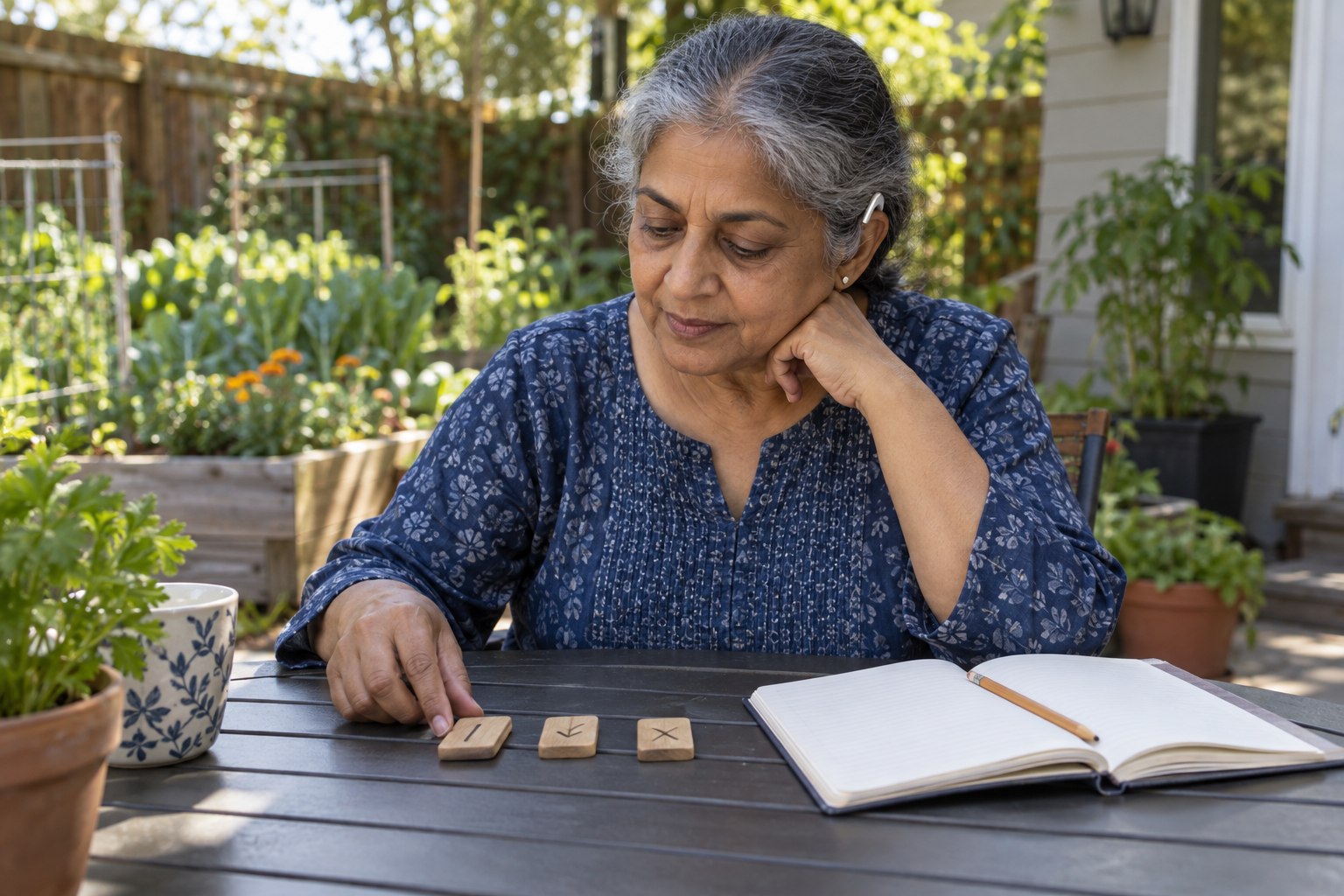
Modern rune-stone divination places characters from historical runic writing systems on small tokens and uses a random draw or layout as a prompt for reflection. The characters are historical; a standardized bag of stones, fixed fortune-telling meanings, and promised timelines are modern practices rather than a single documented ancient system.
This article offers a compact worksheet for comparing a one-rune prompt with a three-rune prompt. It does not treat either layout as a way to discover hidden facts or guarantee future events. For the evidence behind ancient-casting claims and the limits of modern reconstructions, read Origins and Ideas Behind Rune Casting.
Set the method before drawing
Choose one documented character set and one reference list. Elder Futhark has 24 characters and is common in modern practice, but it should not be mixed casually with Younger Futhark, Anglo-Saxon Futhorc, or modern symbol systems. A blank tile is a modern addition or spare, not a historical 25th Elder Futhark letter.
Write down the question, layout positions, source, treatment of reversals or face-down pieces, and stopping rule before touching the bag. Changing the rules after seeing a result makes the exercise easier to fit to a preferred story.
| Choice | One-rune prompt | Three-rune prompt |
|---|---|---|
| Best use | One focused question or journaling theme | Compare three defined aspects of one situation |
| Positions | One prompt | For example: facts, options, next check |
| Complexity | Lower; easier to record without stretching meanings | Higher; more opportunities for vague connections |
| Main risk | Turning one broad keyword into a command | Creating a dramatic story from unrelated prompts |
| Useful record | Original question, rune, source, three possible readings | Position definitions, three runes, alternatives, outside evidence |
| Stopping rule | One draw; no redraw for a preferred answer | Three draws; no extra clarifier unless declared in advance |
Frame a reflective question
Use questions that preserve choice: “What should I consider before this conversation?” or “What information is missing from my plan?” Avoid questions that demand unverifiable access to another person, such as “Is my partner cheating?” or “What does my coworker secretly think?”
Do not ask rune stones to diagnose illness, pregnancy, mental-health conditions, curses, crimes, addiction, abuse, fertility, or cause of death. They cannot determine whether someone is safe, faithful, dangerous, missing, alive, or communicating after death. High-stakes decisions require direct evidence and qualified help.
One-rune reflection worksheet
- Write the question. Keep it specific, low stakes, and within your control.
- Draw once. Random selection chooses a prompt; it does not select a verified answer.
- Check the source. Separate the character’s historical name or associations from modern divinatory keywords.
- Generate three readings. Include one ordinary explanation, one interpretation that challenges your preference, and one “not enough information” option.
- Check facts. Verify dates, prices, consent, health information, and other people’s statements directly.
- Choose a reversible next step. Ask, research, pause, or test a small action.
A rune associated in modern references with “journey,” for example, does not predict travel. It might prompt questions about sequence, preparation, movement, delay, or whether the metaphor fits at all.
Three-rune reflection worksheet
Define each position before drawing. “Past, present, future” is popular in modern practice but can encourage prediction and hindsight. A more testable set is known facts, available options, and next evidence check. Another is what supports the plan, what challenges it, and one reversible action.
- Write the three position labels at the top of a page.
- Draw one token for each position without replacing or redrawing it.
- Record the character and the exact source wording.
- Write at least two interpretations for each position, including a mundane alternative.
- List what evidence would support or contradict each interpretation.
- End with an action that remains sensible even if the symbolic reading is wrong.
The article Understanding Rune Readings develops the three-position method in more detail, including open questions, documented interpretations, evidence checks, consent, and session boundaries.
You do not need a prescribed direction or cloth
There is no need to toss stones east to west, toward the sun, or onto a white cloth to obtain an accurate result. A cloth may protect a table, reduce noise, or stop pieces from rolling. Direction can be part of a disclosed modern ritual, but it should not be presented as a universal historical requirement.
Drawing from a bag is often easier to record than throwing pieces. If casting, use a clear surface with enough space and do not throw hard objects near people, pets, glass, screens, food, or breakable items. Small tokens are a choking hazard.
Face-down pieces and reversals are house rules
Face-down stones do not reliably reveal the future, hidden enemies, storms, or events at six- or twelve-month intervals. Reversed interpretations are also not a universal ancient system, and several rune forms are symmetrical.
You may decide in advance to ignore orientation, turn every piece upright, or use an explicitly modern contrast prompt. Apply the same rule consistently. Do not add a negative meaning after seeing an inconvenient result.
Meaning should not become certainty
Historical inscriptions, reconstructed rune names, later rune poems, modern occult books, commercial booklets, and personal associations are different sources. A responsible note identifies which source is being used. Broad ideas such as “gift,” “need,” “ice,” or “harvest” are not automatic predictions about money, deprivation, delay, or reward.
Keep misses, awkward fits, and vague statements in the record. Do not redraw until a preferred rune appears, add unlimited clarifiers, or reinterpret a failed prediction after the event. If testing a prediction, define the outcome and time window first and compare results with chance.
Cultural and historical care
Runes are connected to Germanic-language history and to living religious, cultural, linguistic, artistic, and spiritual communities. “Norse,” “Viking,” “Germanic,” “Celtic,” “Wiccan,” “shamanic,” and “Indigenous” are not interchangeable labels. A modern spread can be meaningful without being marketed as an ancient ceremony.
Some rune forms have been appropriated by Nazi and neo-Nazi movements. A character in a linguistic or historical context is not automatically extremist, while racist slogans, movement-specific styling, and hate-group combinations matter. Learn the context and do not use extremist adaptations as decoration.
Consent and reading boundaries
When reading for another person, explain that the method is reflective and may be wrong. Agree on price, time, privacy, note-taking, and off-limit topics. Do not claim access to absent people’s thoughts or use a frightening interpretation to sell cleansing, protection, activation, or repeat sessions.
Stop if the activity increases panic, compulsive checking, sleeplessness, or difficulty distinguishing thoughts from outside messages. A person can pause, put the set away, and seek appropriate support without being spiritually blocked.
Frequently asked questions
Can rune stones predict the future?
There is no reliable evidence that a random rune draw predicts future events. A draw can select a reflection prompt, while facts and qualified advice should guide important decisions.
What is a safe three-rune layout for beginners?
Try “known facts, available options, next evidence check.” Define the positions before drawing, record alternatives, and choose an action that remains sensible if the interpretation is wrong.
Do face-down or reversed runes have special meanings?
Reversals and face-down meanings are modern conventions, not universal ancient rules. Choose and disclose a consistent house rule before the draw rather than changing it afterward.
Must I cast runes toward the sun on a white cloth?
No. Direction and cloth color are optional modern ritual choices. A cloth may protect the surface or reduce noise, but it does not establish accuracy or historical authenticity.

‘Meditation’ prior to rune casting seems necessary for clarity; nevertheless, its effectiveness remains subject to personal experience and belief.
The process of casting runes does appears intriguing, but one must reflect upon the subjective nature of such interpretations when discussing spirituality.
It is evident that the belief in runes varies greatly among cultures; however, skepticism must not be dismissed in any discourse.
Indeed, one can observe how cultural contexts shape the understanding of these symbols; yet a balanced perspective is always beneficial.
Rune stones, while seeming ancient, still retains relevance today, however, the skeptical view might considered them as mere artefacts of historical significance.
The use of materials like amethyst or jasper in rune stones raises questions regarding symbolism and their inherent meanings.
Material selection indeed influences interpretation; yet should we not consider the intention behind their use as paramount?
It is fascinating how runes bridge history with modern practice—however, context is key when exploring their applications.
‘Magic runes’ may serve as metaphors for inner truths; still it’s crucial to approach such topics with a critical mindset.
‘Divine secret-holders’ might not hold universal truths but rather represent individual journeys through life experiences.
It’s imperative to weigh both sides of the argument when discussing spirituality and divination methods like rune casting.
‘Single Rune Casting’ appears simplistic yet profound—could it be that simplicity reveals complex truths about our lives?
‘Three Rune Stone Spreads’ provide depth; however, can one truly account for all variables influencing outcomes in such methods?